

Why Small B2B SaaS Teams Beat Bigger Ones at Content
You do not need a five-person content team to outrank companies ten times your size. The content marketing playbooks that still dominate page one of Google were written for teams with headcount and budget, and most of them are wrong for a business with two to five people. This guide rebuilds B2B SaaS content marketing around the constraint that actually matters to you: a small team with a lean budget that still needs to win.
A 2-person content team using modern tools can match the output of a traditional 5-person team. The evidence is not anecdotal. Teams of two to five people make up 54% of B2B content marketing teams, and they publish the majority of the content that ranks, because efficiency beats manpower.
Here is the honest starting point. Content marketing for B2B SaaS returns 2 to 3 times the investment on average, delivers leads at 62% lower cost than paid, and organic search drives 44.6% of all B2B revenue. The channel is not in question. The question is how a small team executes it without burning out or going broke. That is what this guide answers.
What Most Small B2B SaaS Teams Get Wrong
Four mistakes kill more content programs for small SaaS teams than weak writing. Fix these before you plan a single piece.
1. Publishing awareness content first. Classic inbound advice says build top-of-funnel first and let it cascade down. For a small team this wastes six to twelve months of runway on keywords that convert at the lowest rate. Bottom-of-funnel content converts 2 to 3 times better than top-of-funnel, and it is the fastest path to revenue.
2. Hiring before you have content-market fit. A full-time content marketer costs $60,000 to $80,000 a year in salary. At the industry average of four posts per month, the real cost per published post lands near $20,000 once you add benefits, tools, and management overhead. Hiring early is how startups spend a year of budget proving nothing.
3. Counting clicks that no longer exist. Zero-click searches now represent 68% of all Google activity, and on desktop, where B2B buyers research, the rate is closer to 80%. A small team that measures success only in sessions is grading itself against a metric that is structurally shrinking.
4. Tool sprawl. The average B2B marketing team uses 12 to 20 tools at only 49% utilization. A small team cannot afford that waste. Every tool you add is a monthly cost and a funnel you must learn.
The Reverse-Funnel Content OS: Build Proof Before Attention
For a small team, the order matters more than the volume. Instead of building awareness content and hoping demand follows, prioritize content where buyers already have intent and money on the line.
This reverses the classic funnel. You build bottom-of-funnel and comparison content first, because those buyers are in-market. The strategy is documented by teams at Powered by Search and Grow and Convert, and it converts 2 to 3 times better than awareness-first approaches. A small team gets revenue feedback faster, which funds the mid-funnel work later.
The three tiers of a small-team SaaS content map
| Tier | What you build | Why it converts |
|---|---|---|
| 1. Proof (BoFU) | Comparison pages, alternatives, pricing, security docs | Buyer is deciding now, 2-3x conversion |
| 2. Product-led (MoFU) | Docs, onboarding, workflow guides showing your product | Proves the product, hard to copy, wins AI citations |
| 3. Demand (ToFU) | Guides, trends, research you can fund after revenue | Scales reach once the engine is proven |
The table is the roadmap. Build tier one first. Every piece you publish before that is a debt you pay later.
A concrete example. RingBlaze generated 50,000 organic visits and 650 product leads from a competitor-alternative campaign alone. FullSession produced 500 qualified leads from 16 product-led articles in four months. Both are small teams that skipped healthy-looking awareness content and went straight to proof.

How to Prioritize Without a Content Manager (A Decision Matrix)
You do not need a dedicated content PM to pick what to write. Score every candidate keyword on four weighted criteria and write the highest-scoring list. This removes gut-feel decisions from a small team where every piece of output is expensive.
Is the searcher deciding now? BoFU and comparison queries score higher.
Can you show a number or a clear outcome? Vague topics score lower.
Is there real volume you can rank for? Check impressions and SERP competition.
Can you write it without a specialist? Lower production cost scores better.
Weighted scores replace opinion. If you only remember one rule: a BoFU comparison page you can write this week outranks an awareness pillar you will finish in a month, for a small team, every time.
What Your Content Budget Should Actually Be (By Stage)
Most budget advice for B2B SaaS is too vague to act on. This table gives you real allocations by growth stage, and it is the one thing page one of the SERP does not give you.
| Stage | Typical monthly budget | Content slice | People slice | Paid slice |
|---|---|---|---|---|
| Seed | $3k-$5k/mo | 2-5% (tools, ~$99-200) | 0-5% (founder time) | 25-35% (BoFU search) |
| Series A | $10k-$25k/mo | 1-5% (engine + amplification) | 15-25% (fractional strategist) | 25-35% (search + LinkedIn ads) |
| Series B+ | $50k-$80k+/mo | <1-2% (enterprise suite) | 45-55% (in-house team) | 20-30% (paid media + ABM) |
Two benchmarks anchor these numbers. The median B2B SaaS company spends 8% of ARR on marketing, while high-growth outperformers spend 14% or more. Product-led companies spend 13% of revenue, because content is effectively their sales team.
Averi AI breaks the seed-stage budget down so a founder can act on it immediately. Between $3,000 and $5,000 a month: $99 for a content engine, $65 to $140 for SEO data tools, and $1,000 to $1,500 for high-intent bottom-of-funnel search. LinkedIn organic, email, and analytics cost nothing because they use founder time and free tiers.
The math that matters for small teams lives here. A content engine at $99 a month scales to 8 to 12 posts a month, or $8 to $12 per post. Compare that to $20,000 per post for an early in-house hire, and you see why the research says establish content-market fit before you hire.
The 12-Month Build Order for a Small Team
This is a step-by-step monthly plan you can execute with two people. Each month has one output and one objective.
- Month 1: Foundation. Publish 3 core mid-funnel guides for your top buyer personas. Objective: get 10 pages indexed.
- Month 2: Proof first. Publish 2 comparison and alternatives pages against your best competitors. Objective: 2 queries into the top 20.
- Month 3: Product-led. Write 4 docs and workflow posts that show your product solving a real problem. Objective: 5 product queries ranking.
- Month 4: LinkedIn. Founder posts 3 times a week, repurposing 1 piece a month. Objective: 1,000 impressions.
- Month 5: Email. Build a newsletter. Objective: 200 subscribers.
- Month 6: Refresh. Update your 5 best pieces with fresh data. Objective: CTR up 1%.
- Month 7: Research. Run one owned mini-survey or compile one data report. Objective: 1 citation.
- Month 8: Scale proof. Publish 5 more alternatives pages. Objective: 3 keywords in the top 20.
- Month 9: GEO. Refresh schema and snippets for AI Overviews. Objective: 2 AIO features.
- Month 10: LinkedIn ads. Boost your best BoFU piece. Objective: 50 leads.
- Month 11: Audit. Prune 20 dead pages and consolidate. Objective: higher domain efficiency.
- Month 12: Pillar. Publish 1 research pillar that anchors your cluster. Objective: 500 organic visits a month.
A buyer should see the pattern forward and backward. Proof first, efficiency second, attention last, and everything is tracked against a single objective per month so a small team never loses focus.
Why Zero-Click Changes Your CTA and Your KPIs
The biggest shift in B2B SaaS content is not about writing better headlines. It is structural. Search engines keep more answers on the page, and buyers keep fewer clicks.
Zero-click searches represent 68% of all Google activity in 2026, up from about 49% in 2019. On desktop, where B2B research happens, 48% of searches end with no external click at all, and the B2B desktop zero-click rate is closer to 80%. AI Overviews now appear on roughly one in eight US desktop searches, and click-through drops near half when one is present.
AI referrals compound the picture. ChatGPT visitors spend 15 minutes on site versus 8 minutes from Google, view 12 pages versus 9, and convert at a higher rate. AI-referred traffic converts at 23 times the rate of traditional organic because those visitors arrive already informed and ready.
This does not mean content is dead. It means you write for two audiences at once: the human who clicks, and the machine that cites. Content that includes direct expert quotes gets cited by LLMs up to 41% more, and quantified data raises citations by 32%. A small team that writes with named experts and concrete numbers wins the AI-answer economy that the big manual bloggers are slower to adapt to.
Your CTA must stop being a single “book a demo” button. A small team’s content should earn the right to be cited, and then convert the informed reader with proof pages, not pressure.
The Build-Measure-Hire Framework
This is the operating framework the top guides miss. Small SaaS teams have one asset bigger competitors waste: speed. You can publish, measure, and decide what works before you spend a dollar on headcount.
Build. Publish 20 to 30 clustered pieces with a content engine across the three tiers above.
Measure. Watch which clusters rank and which queries convert. Most of the value concentrates in a few pieces. Find them.
Hire. Only add headcount once you have proof of content-market fit, at the stage where a fractional strategist or a specialist pays for itself.
This is how you avoid the $20,000-per-article trap. The data is unambiguous. 45% of B2B marketers lack a scalable content model, and that is the single most common reason programs stall. Give a small team a process, and the scale problem goes away.
Charts: What the Numbers Look Like
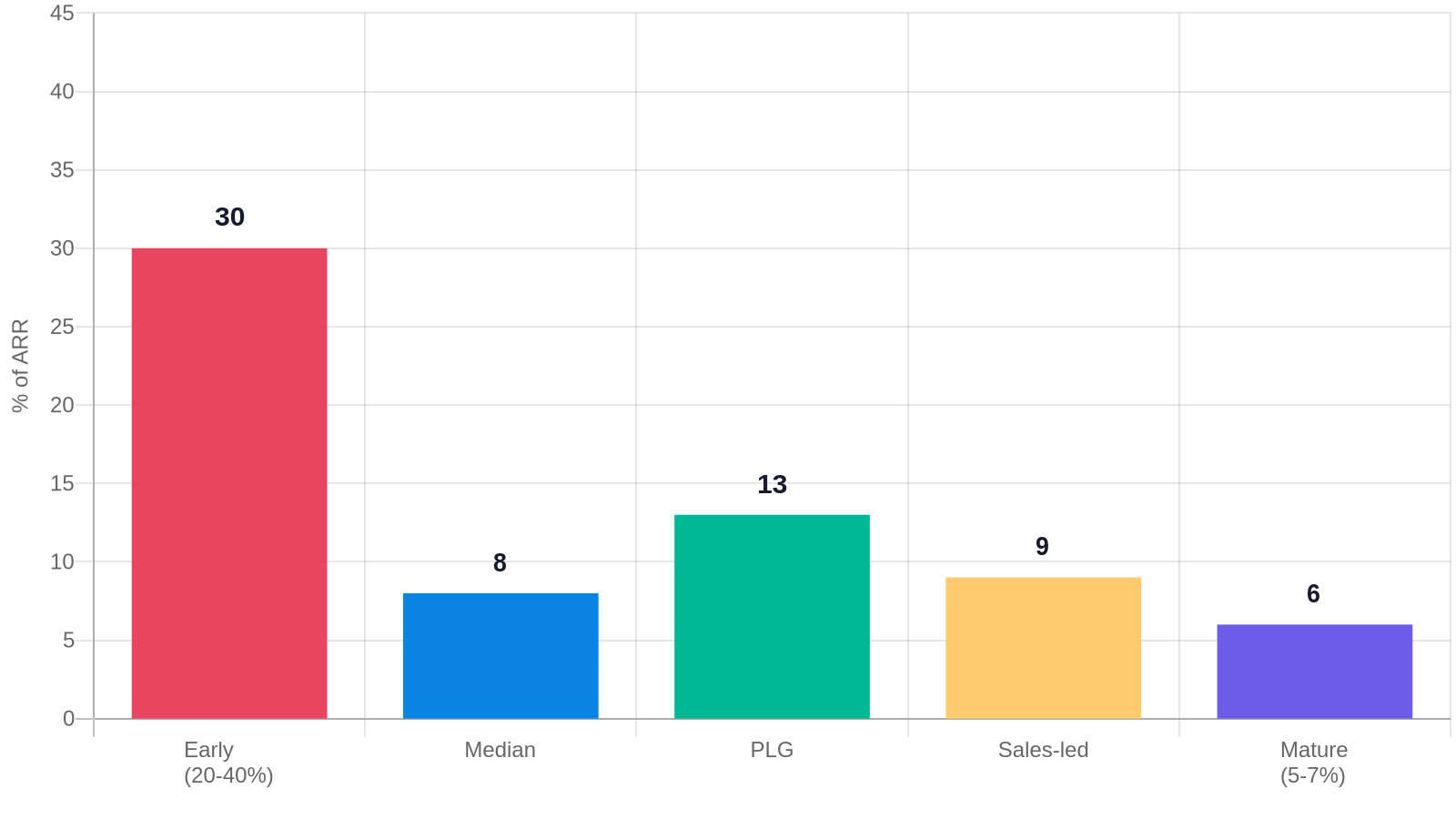
Marketing budgets by stage: early teams spend 20-40% of revenue, mature teams 5-7%. Median is 8%.
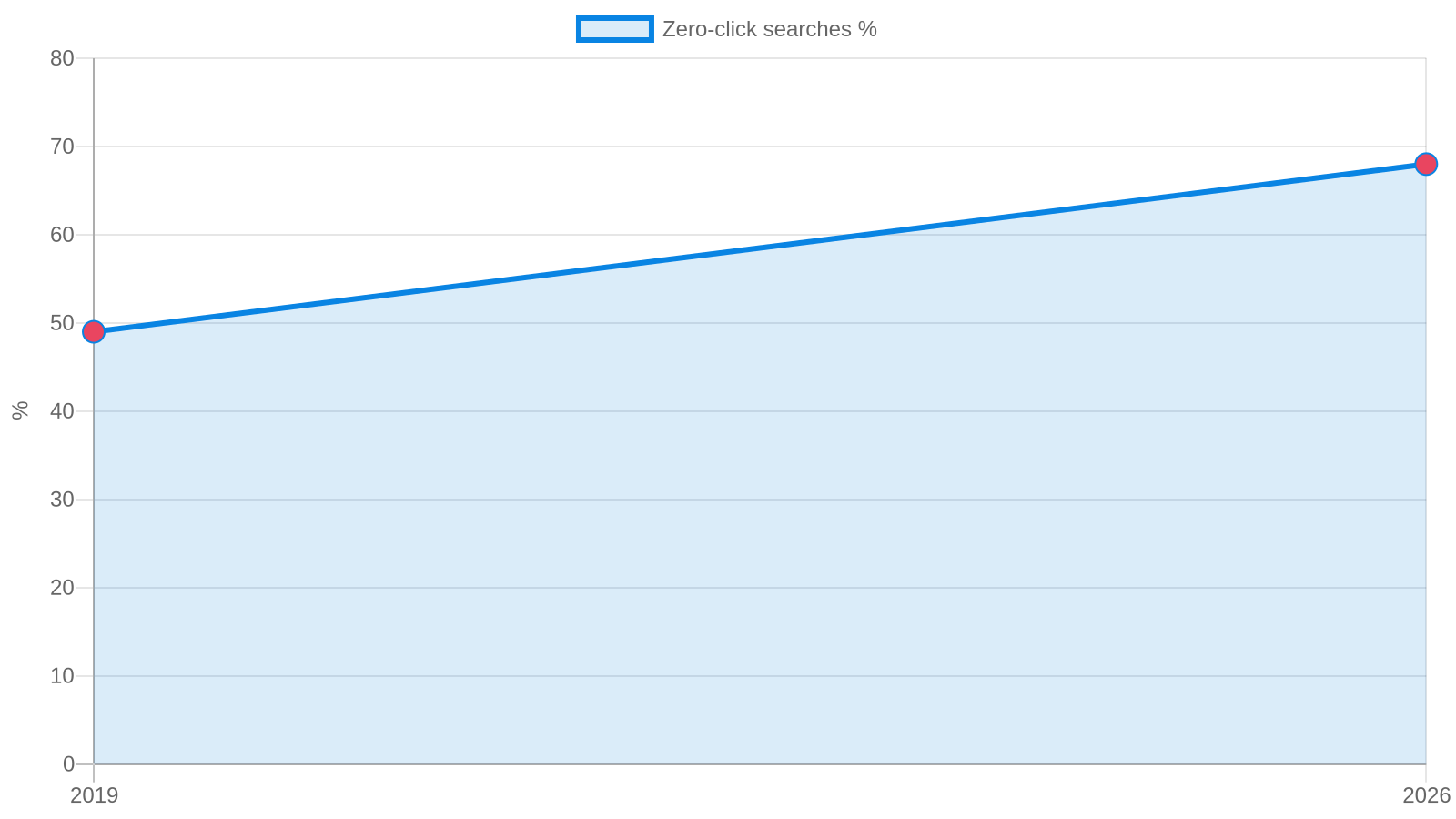
Zero-click searches rose from ~49% (2019) to 68% (2026), reshaping how SaaS content wins.
Which Channels Are Worth a Small Team’s Time
Small teams cannot be on every channel. Here is the honest channel-by-channel assessment, so you know where to spend the hours you actually have.
| Channel | Cost | Payoff | Best for |
|---|---|---|---|
| Organic SEO | Low (tools + time) | 44.6% of B2B revenue | The core engine for every small team |
| Free (founder time) | 80% of B2B social leads | Founder-led distribution + later ads | |
| Email newsletter | Low | 71% of B2B marketers use it | Owned audience + retargeting |
| Docs & product-led | Low-medium | Hard to copy, wins AI citations | PLG motion, proof content |
| Paid (search/social) | High | Fast, but costly | Series A+, BoFU amplification |
For a team of two, the winning four are SEO, founder-led LinkedIn, email, and onboarding docs. Paid is a reserve you spend only once the content engine proves it converts. LinkedIn Ads generate 2x the conversion of Google Ads with a 28% lower cost-per-lead, but only when you have content worth boosting.
Adam Robinson bootstrapped two SaaS startups past $30 million ARR using LinkedIn as the primary acquisition channel, entirely on founder output. That is the extreme case of the rule: the highest-value channel for a small team is the one the founder can personally drive.
Real Examples With Real Numbers
Theory is useful, but small teams need examples they can model. These are the documented outcomes across the research, with the numbers intact.
Webflow. Grew organic traffic from 25,000 to 500,000 unique visitors a month, a 1,900% increase, by launching more than 300 blog posts in 24 months. The lesson is not volume alone. It is that Webflow sustained a product-aligned publishing rhythm without a massive early team.
YouScan. Achieved 29 times more organic clicks in 12 months using a product-led content strategy. A single research-backed article drove 17,000 clicks in a few weeks. Product-led content, one strong piece, unusually large payoff.
Marketer Milk. Reached 50,000 visitors a month from Google by publishing 60 blog posts in a year. That is roughly five posts a month from a small operation, a cadence any lean team can match with a content engine.
Expandi.io. Bootstrapped from zero to $8 million ARR on the back of product-led content. No paid acquisition engine, just content that proved the product.
Leadfeeder. Scaled product signups past 200 a month using conversion-focused SEO. The pattern across every example: proof content converts, product-led content compounds, and research-backed pieces outperform the average by a wide margin.
The shared signal is not that these teams published a lot. It is that they published proof-led, product-integrated content and let it earn citations and conversions. A small team that copies the pattern, not just the volume, gets the same compounding curve.
Frequently Asked Questions
How much should a small B2B SaaS company spend on content?
Spend roughly 8% of ARR on marketing, with 10-15% of that going to content at seed stage. A founder can start with $3,000 to $5,000 a month, allocated across a content engine, SEO tools, and bottom-of-funnel paid search.
How many blog posts a month should a small SaaS team publish?
Companies publishing 11 or more posts a month generate 4 times more leads than those publishing fewer than 4. That said, 16 or more posts drive 3.5 times more traffic. A small team should target 8 to 12 quality posts a month backed by a content engine, not by burnout.
Should a small SaaS startup hire a content marketer?
Not until you have content-market fit. An in-house hire costs near $20,000 per published post at average output. Establish what ranks and converts with a content engine first, then add a fractional strategist or specialist when the proof exists.
What is the difference between content marketing and demand generation for B2B SaaS?
Content marketing builds and distributes assets that attract and educate. Demand generation is the discipline that converts that interest into pipeline and revenue. They work together; content feeds demand, and demand justifies more content. We cover the difference in depth in our guide to our comparison of content marketing vs demand generation.
Is SEO still worth it for B2B SaaS with AI search?
Yes, but it changed. Organic search still drives 44.6% of B2B revenue, yet zero-click means you must also win AI citations. Write for machines with structured data and quiet facts, and for humans with proof pages, and you capture both channels.
Which content type converts best for small B2B SaaS teams?
Comparison and alternatives pages, then product-led workflow guides. RingBlaze built 50,000 visits and 650 leads from an alternatives campaign, and FullSession got 500 qualified leads from 16 product-led articles. proof content converts, as our success-story numbers show and it is built to win AI citations.
What To Do Next
Pick the top alternative or comparison query for your product this week. Score it on the four criteria, write the page, and publish it. That is your first proof asset. Do not start with an awareness pillar.
Download the B2B SaaS content budget worksheet and fill in your actual ARR. It calculates your stage-appropriate budget, your content slice, and your per-post cost, so you know exactly what you can afford before you plan.
The system compounds. Each proof page that ranks makes the next one easier to write and easier to win. Small team, clear filter, proof first. That is the whole strategy.
Get the structured spreadsheet below.
