
95% of B2B marketers now use AI tools, but only 3% run AI agents as a core part of their strategy. That gap is the entire 2026 opportunity. This post explains what the 3% do differently, why most teams stop at better prompts, and how to climb from AI as a writer to AI as an operating system.
Agentic AI in B2B is a reality, not a roadmap item
The Content Marketing Institute and MarketingProfs surveyed 1,015 B2B marketers for the 2026 B2B Content and Marketing Trends report. Most of the “AI everyone uses” story is already table stakes. 95% of B2B marketers say their organization uses AI-powered applications, and roughly nine in ten use AI to produce written content.
The gap shows up one level up. Only 28% of B2B marketers experiment with AI agents. Pacesetters, the teams already at established or leading maturity, use them far more, at 43%. And a small slice of the market, 3% overall but 6% of pacesetters, say agents are core to their strategies.
The 3% is not a rounding error. It is the early majority of the next wave. The 95% that use AI to write are competing on a table where everyone has the same advantage. The 3% that run agents as a system compete on orchestration, speed, and continuous optimization.

What agentic B2B marketing actually means
Agentic marketing replaces a content calendar run by people with a self-organizing system. Research agents watch search trends and competitor output daily, brief agents structure articles, writer agents draft, SEO agents add internal links and optimize meta, and a measure agent closes the loop on performance. The pipeline runs on a schedule, not when a human has time.
This differs from the “AI writes my draft” workflow. A prompt-based tool produces one output when triggered. An agent makes a decision, executes the whole sequence, and acts again when conditions change. That is why results compound: agents keep publishing cadence on off-weeks, refresh pages when rankings dip, and capture new keywords before competitors rank on them.
Gartner predicted traditional search engine volume would drop 25% by 2026 as AI chatbots become substitute answer engines. When buyers research in ChatGPT and Perplexity before visiting your site, visibility is no longer won by ranking a few keywords. It is won by answering the exact questions your ICP asks. Agentic systems are built around that question set.
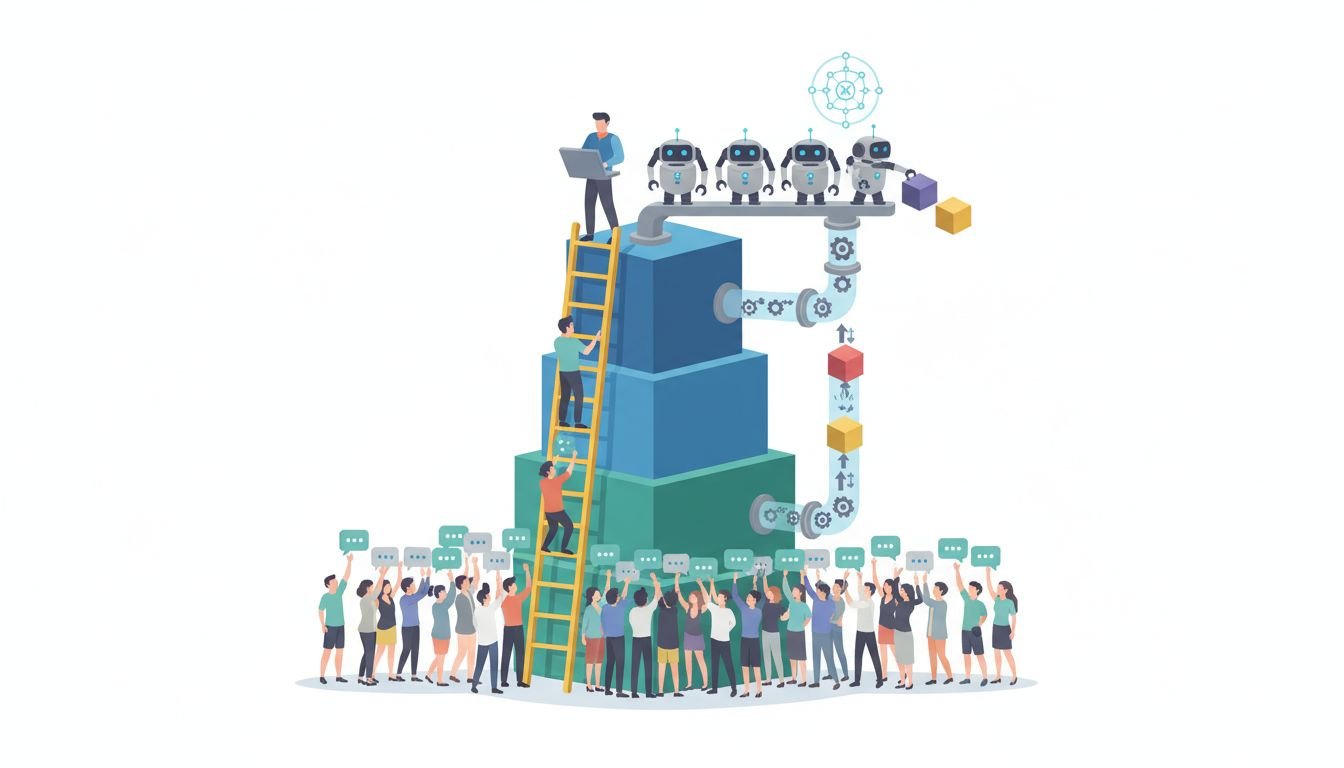
The five-rung agentic adoption ladder
Most teams stall on rung two. They never reach the point where agents take over a workflow end to end. The ladder explains where you likely sit and what the next rung costs.
Teams reliable at rung three and above get the structural payoff. Among B2B marketers experimenting with AI agents, 52% report improved operational efficiency, 21% report better customer engagement, and 19% cite increased campaign performance and ROI. Efficiency comes first; pipeline impact follows as the loop learns what works.
A decision matrix: what to hand an agent first
You do not need to agentize everything on day one. The cheapest high-value move is to pick tasks where volume is high, the repeat is predictable, and a mistake is cheap to catch. This matrix shows what to prioritize.
A six-step agentic content loop
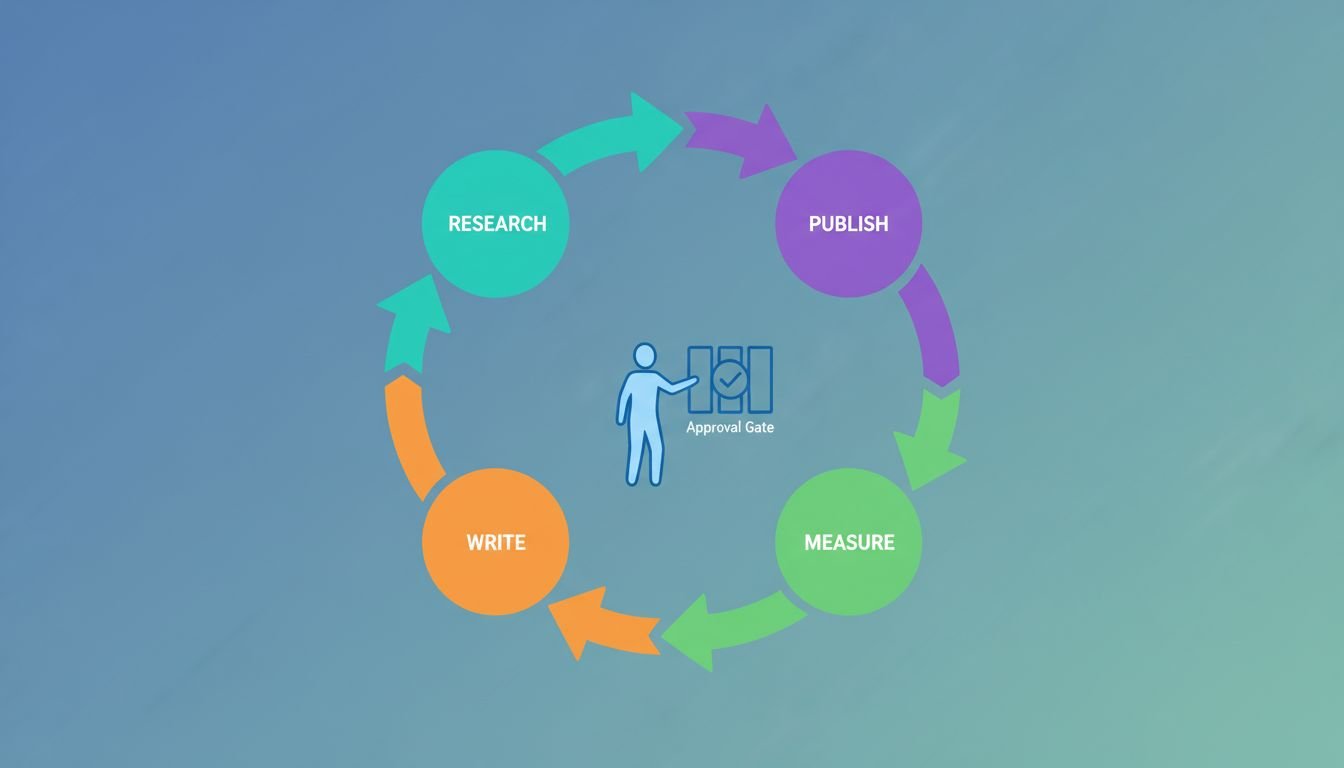
1. Define your ICP and question set. Write the exact questions your buyer asks a chatbot, not just your keywords. This is your agent’s target.
2. Track competitors and trends on a schedule. Research agents watch five competitors daily and surface gaps they cover that you do not.
3. Structure every new topic against the question set. Map each piece to a cluster and link it to the pillar page so the site grows as a web.
4. Draft, optimize, and link automatically. The same automation that writes should optimize meta and add internal links before review.
5. Measure and feed results back. Track which topics generate clicks and shares, then tell the agent to make more of that. Attribution closes the loop.
6. Approve, publish, and monitor. A human sets the quality bar. The agent then patrols published pages for ranking drops and queues the refresh work itself.
What most teams get wrong
They buy the tool, not the loop. Most teams adopt an agent to write faster and keep their old editorial process. The whole point is that research, linking, and optimization replace the old process, not that a writer works faster inside it. It stagnates when you keep the old structure.
They never set the review bar. A pipeline that publishes everything an agent drafts ships filler. The 3% keep a human at the final gate with a clear quality bar, so the output only gets the grade. Setup is where the bar is set, yet it is the step most teams skip.
They let agents outrun the brief. If your ICP definition is fuzzy, the agent produces a lot of content that misses real buyers. The inputs, not the agent, set the ceiling. Fix the brief before you scale the pipeline.
The measurement case: agentic is a ROI problem, not an adoption problem
The real fight is not whether your team uses AI, because everyone uses AI. It is whether your AI runs on a compounding operating system or produces single-shot content. CMI research confirms people still drive the biggest gains, but AI topped the 2026 budget priority list for 45% of B2B marketers who named it among their top three investment areas.
You can apply the ROI framework already covered on this site. If you do not have a measurement loop, your content ROI is a guess. Start there before you scale the agents, so you only scale what you can track.
What to do next
Move up one rung, not all five at once. Pick the research and internal linking tasks, the first automations, and join them to a human approval gate. If you already run a content operating model, bolt the agent onto it instead of rebuilding.
- Begin with the operating model. A sustainable setup for a small team is covered at B2B Content Operating System: The Lean Team Playbook.
- If you want the strategy version of this idea, read AI Agents for B2B Content Marketing: A Lean Team Guide for a step-by-step build.
- Widen the lens: content marketing ROI is measurable and worth building before you scale automation. See B2B Content Marketing ROI: How to Measure What Actually Matters.
- Then decide which cluster to run as your first agent, review the whole loop monthly, and climb the ladder from your current rung.
Agentic B2B marketing FAQs
What is the difference between AI assistants and AI agents?
An assistant responds to a prompt you trigger. An agent makes a decision, runs a multi-step sequence, and acts again when conditions change. For content teams, the concrete difference is whether the system maintains publishing cadence and refreshes pages on its own or waits for a human to start each task.
Is agentic marketing only for large teams?
No. A lean team can start at rung three of the adoption ladder with one operator running a research and drafting round and a human approval gate. Volume and team size are not prerequisites; a defined question set and a review bar are.
How much does an agentic content stack cost?
Costs range from free open-source tools to full platforms. The bigger investment is setup: ICP definition, a topic cluster map, and a measurement loop. Teams that skip those inputs get cheap output and poor results, so budget for the set that defines what the agent targets.
Does agentic content hurt SEO quality?
Only if you remove the human gate and break the loop. Used correctly, agents improve technical SEO because meta, schema, and internal linking are applied consistently instead of deferred. The differentiation risk comes from publishing undifferentiated output, which is a brief problem, not an agent problem.
How long does it take to go agentic?
Most teams can go live in about 90 days with a phased approach: 30 days for foundation and ICP, followed by a running content loop, then scale. Start with research and internal linking, which are high volume, low mistake cost, and cheap to automate.
