

Quick Answer: What should a B2B content brief template include?
A B2B content brief template should include: primary keyword and search intent, target persona and their specific pain point, recommended word count range, required H2 and H3 structure, 3–5 sources to cite or reference, competitor posts to differentiate from, internal links to include, and the specific CTA and conversion goal. Briefs that specify the business outcome (lead generation, SEO ranking, sales enablement) consistently produce better first drafts than briefs focused only on content structure.
Disclosure: Some links in this post are affiliate links. If you sign up through them, I may earn a commission at no extra cost to you. I only recommend tools I believe are genuinely useful.
A B2B content brief template is a structured document that gives writers every piece of information they need to produce a finished draft without a single follow-up question.
The best briefs combine SEO data (keyword, intent, SERP competitors) with subject-matter context (technical specs, buyer pain points, unique POV) and a clear narrative arc. When built correctly, a single brief cuts revision rounds by 60–70% and slashes time-to-publish from weeks to days.
Table of Contents
Why Most B2B Content Briefs Fail (And What to Do Instead)
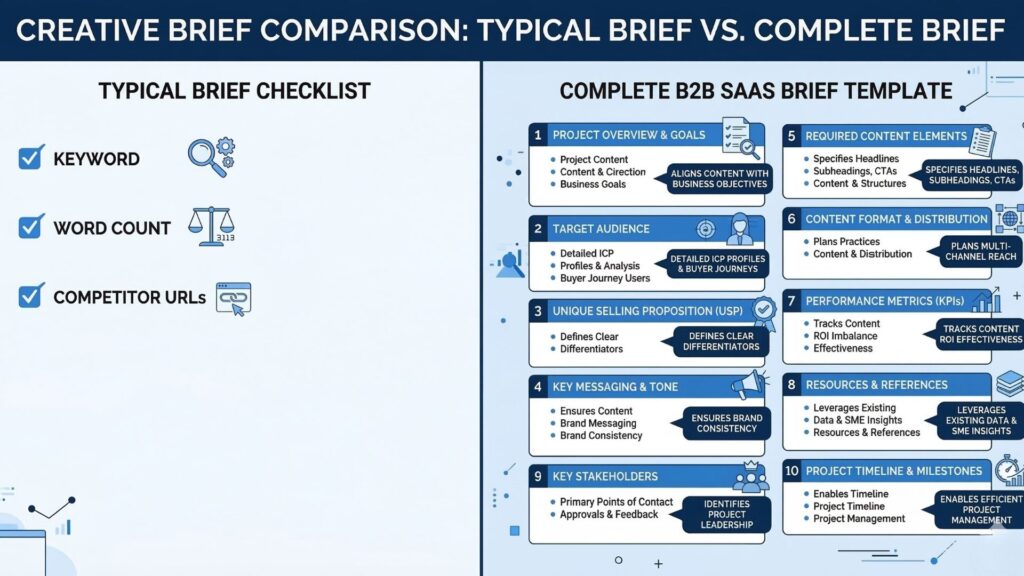
Most B2B content briefs are administrative checklists dressed up as strategy documents. They tell a writer the keyword, the word count, and which competitors to beat, then leave them to figure out what to actually say.
In practice, what we see is writers padding out word count with generic industry observations because the brief gave them no proprietary insight to work with.
The result? Content that could have been written by anyone. Content that doesn’t rank, doesn’t convert, and doesn’t reflect your company’s actual expertise.
The common advice is “just add more detail to your brief.” Here’s the problem: more detail without the right structure produces longer briefs that writers still don’t know how to use. The real failure is that briefs treat translation as the writer’s job, turning dry technical specs into a narrative that resonates with a CFO or VP of Engineering. That’s backwards.
According to the Content Marketing Institute, 43% of B2B marketers say producing content consistently is their top challenge, but the root cause is rarely a lack of ideas. It’s a lack of briefs that actually enable production. A brief that requires the writer to interview three SMEs just to understand the product is not a brief, it’s an incomplete briefing meeting dumped into a Google Doc.
The fix: Your brief should do the expert translation work upfront, so the writer’s only job is to execute the narrative, not decode your product.
The sections below give you a complete, copy-paste template built around three principles: (1) zero ambiguity for the writer, (2) proprietary insight baked in, and (3) a clear narrative arc from first word to CTA.
The 9-Part B2B Content Brief Template
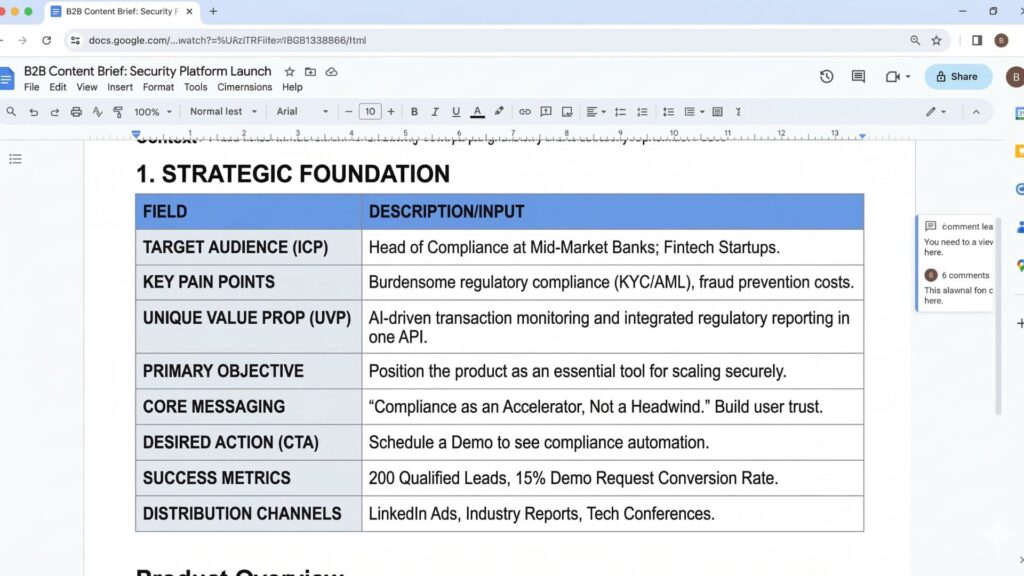
A complete B2B content brief template has three major sections: Strategic Foundation, Translation Layer, and Writer Execution Guide. Each section serves a different person on your team. The foundation is for you and your content strategist. The translation layer is for your SME. The execution guide is for the writer.
Section 1: Strategic Foundation
Fill this section yourself, before you involve anyone else.
| Field | What to Include | Example |
| Article Title (Draft) | Working H1 with primary keyword | “Why Zero-Trust Architecture Matters for Mid-Market Fintech” |
| Primary Keyword | Exact-match target term + monthly volume | zero trust network access (1,900/mo) |
| Secondary Keywords | 2–4 supporting terms, used naturally | ZTNA vs VPN, zero trust implementation |
| Search Intent | Informational / Navigational / Commercial / Transactional | Informational – buyer education, pre-vendor shortlist |
| Funnel Stage | TOFU / MOFU / BOFU | MOFU – awareness of problem, evaluating solutions |
| Target Reader | Job title + company size + trigger event | VP of IT Security, 200–2,000-employee fintech, post-audit |
| Word Count Range | Target ± 10% | 2,200–2,600 words |
| Publish Date | Hard deadline (not ‘ASAP’) | March 28 |
| CTA / Conversion Goal | Specific desired action | Download Zero Trust Readiness Checklist |
If your team runs an editorial calendar (and you should), the Strategic Foundation maps directly to your calendar metadata. Every field here corresponds to a column in your calendar, which means your calendar becomes a living index of brief status, not just a schedule.
Section 2: The Technical-to-Narrative Translation Layer
This is the section that most brief templates skip entirely, and it’s the reason 80% of first drafts miss the mark. The Translation Layer is where you convert your product’s technical reality into the business language that C-suite readers actually respond to.
The Translation Layer is a structured brief component that identifies (1) the regulatory or market trigger creating urgency, (2) the technical differentiator your product owns, and (3) the business outcome language your buyer uses internally when making a purchase case.
| TRANSLATION LAYER FRAMEWORK The Translation Layer Framework (3 Steps): Step 1: Regulatory/Market Trigger: What external event makes this topic urgent RIGHT NOW? (Examples: SOC 2 Type II audit season, FTC data privacy enforcement uptick, a competitor’s recent breach in the press.) This is the “why now” that makes the article feel timely rather than evergreen filler. Step 2: Technical Differentiator: What does your product actually do differently, in specific terms? Not “we’re more scalable”, write it as: “Our agent-based micro segmentation operates without a hardware dependency, which means a 200-person fintech can deploy in 4 hours vs. the 3-week average for appliance-based competitors.” Step 3: Business Outcome Language: How does your buyer describe this problem to their CFO or board? Get the exact language. Pull it from win/loss calls, Gong recordings, or G2 reviews. Example: CFOs don’t say “reduce attack surface”, they say “reduce our exposure in the next audit” or “avoid the $4.2M average cost of a breach.” |
In practice, what we see is that writers who receive a brief with this translation layer sound like subject matter experts without needing a 60-minute SME interview. They have the technical precision and the business context—which means they can write with authority from paragraph one.
To extract this from your SME efficiently, don’t ask open-ended questions. Ask: “If you had 90 seconds to explain why a CFO should care about [feature], what would you say?” Record the answer. Put it verbatim in the Translation Layer box. That’s your writer’s ammunition.
Section 3: Writer Execution Guide
The Writer Execution Guide is the operational half of the brief. It tells the writer exactly how to structure the piece, what not to write, and where to point readers when they’re done.
| Element | What It Contains |
| Proposed Heading Structure | Full H1 → H2 → H3 outline with suggested sub-points per section |
| SERP Competitors to Beat | 3–5 URLs currently ranking for the primary keyword + 1-line note on gap |
| Angle / Unique POV | The one thing this article says that none of the ranking pages say |
| Key Claims to Make | 3–5 specific assertions the article must support (with data if available) |
| Claims to Avoid | Overused angles, myths, or competitor talking points to steer clear of |
| Internal Links Required | 2–4 links to existing site content with anchor text suggestions |
| External Sources Approved | Pre-vetted sources writer can cite (avoids brand-inappropriate citations) |
| Tone & Voice Notes | Specific guidance: e.g., “This is for a VP, not a practitioner—avoid CLI commands” |
| CTA Block | Exact CTA text, linked asset, and placement (end of article, mid-article, or both) |
The “Claims to Avoid” field is underused and one of the highest-leverage items in the brief. If a competitor’s top-ranking article leads with “Zero trust isn’t a product, it’s a philosophy,” that’s now table stakes, every article says it. Tell your writer to skip it and start with the next level of insight.
If you’re building your content engine at scale, the Writer Execution Guide is what makes your briefs repeatable. New writers onboard in hours, not weeks, because the brief holds the institutional knowledge, not just the person who commissioned the piece.
How to Write a Content Brief: The 5-Step Process
To write a content brief that actually produces great drafts, follow these steps in order. Skipping Step 2 or Step 3 is where most teams fall apart.
- Run your SERP analysis first (30 minutes). Open the top 5 ranking URLs for your primary keyword. For each one, note: the angle they lead with, the word count, the content type (listicle, guide, opinion), and one gap, something they miss or get wrong. This becomes your angle and your gap to fill. Don’t brief a writer until you’ve done this step yourself.
- Extract the Translation Layer before you open the brief template (20 minutes). Go to your last 3 win/loss call notes or your most recent Gong recordings. Pull the exact language your buyers use to describe the problem. Get 2–3 sentences from a recent SME conversation about your product’s differentiator. Paste this raw material into Section 2 of your brief before you format anything.
- Build the heading structure based on search intent, not your product roadmap (20 minutes). Map your H2s to the specific questions a buyer at this funnel stage is actually asking. A MOFU reader wants to understand their options and tradeoffs. They don’t want a product pitch embedded in an “educational” guide. If every H2 is secretly a product capability, your writer will produce branded content that gets ignored.
- Define the single unique POV the article will argue (10 minutes). If you can’t complete this sentence, the brief isn’t ready: “This article argues that [claim], which contradicts the common belief that [conventional wisdom].” A brief without a POV produces content without a perspective, and generic content is invisible content.
- Review the brief against the quality checklist before sending (10 minutes). See the checklist in the next section. If more than 2 items are unchecked, the brief goes back to you, not to the writer.
According to Demand Gen Report, B2B buyers consume an average of 13 pieces of content before making a purchase decision.
Every piece of that content had a brief behind it, or it didn’t, and it shows. The 90 minutes this process takes per article pays back in every draft you don’t have to rewrite
Content Brief Example: Enterprise SaaS Security Post
Here’s what a completed Translation Layer looks like for a real article topic. This is the section most briefs leave blank, and the section that makes the difference between a generic draft and one your sales team actually sends to prospects.
| CONTENT BRIEF EXAMPLE Translation Layer Article: “ZTNA vs. VPN: Why Mid-Market Fintech Is Making the Switch” REGULATORY TRIGGER: The SEC’s new cybersecurity disclosure rules (effective Dec 2023) require public companies to disclose material cybersecurity incidents within 4 business days. Mid-market fintechs preparing for IPO or handling public company client data are facing board-level scrutiny on their security posture for the first time. VPN-based architectures produce audit evidence that is difficult to organize and present, this is the acute pain. TECHNICAL DIFFERENTIATOR: Unlike hardware-dependent ZTNA appliances, [Product] deploys as a cloud-native agent with no on-prem hardware requirement. Median deployment time across 40 mid-market fintech customers: 11 business days vs. the 8-week average for legacy ZTNA vendors. Each access session generates a tamper-evident log entry that exports directly into SOC 2 audit packages. BUSINESS OUTCOME LANGUAGE (pulled from win/loss calls): “We needed to show our board we weren’t going to be the next headline.” / “Our auditors asked for a session log in 24 hours. With the VPN we couldn’t produce it in 3 days.” / “The CFO approved it in one meeting once we framed it as audit risk reduction, not an IT project.” |
Notice what this does for a writer: they now have the technical precision to sound credible to a security practitioner AND the business language to resonate with a CFO. They don’t need a single follow-up question. That’s a brief that enables great content.
Brief Quality Checklist: Before You Send It
Run every brief through this checklist before it goes to a writer. If you check fewer than 8 of the 10 items, the brief needs another pass.
Sending an incomplete brief doesn’t save time, it creates revision debt.
| # | Checklist Item | Why It Matters |
| 1 | Primary keyword is in the H1 and confirmed against live SERP volume | Ensures you’re targeting a term with real demand, not an internal phrase |
| 2 | Search intent is explicitly labeled (not just inferred) | Mismatched intent is the #1 reason articles don’t rank despite strong writing |
| 3 | SERP gap is identified in one sentence | Without a gap, the article is a me-too piece that won’t displace incumbents |
| 4 | Translation Layer: Regulatory/Market Trigger is completed | Gives the article a “why now” that makes it feel timely, not evergreen filler |
| 5 | Translation Layer: Technical Differentiator uses specific numbers | Vague differentiators produce vague content—specificity creates credibility |
| 6 | Translation Layer: Business Outcome Language is from real buyer quotes | Invented buyer language reads as marketing speak; real quotes resonate |
| 7 | H2/H3 outline maps to buyer questions, not product features | Feature-mapped outlines produce brand content, not helpful content |
| 8 | Unique POV is stated as a falsifiable argument, not a platitude | “Zero trust is important” is not a POV. “ZTNA is now a procurement requirement, not an option” is. |
| 9 | Internal links are specified with anchor text (not just URLs) | Vague link instructions produce misplaced anchors that dilute SEO value |
| 10 | CTA block includes exact copy, linked asset, and placement instruction | Writers should not be making CTA decisions—that’s a conversion strategy call |
If you take away one thing from this section: a brief that passes this checklist will produce a first draft that needs structural edits, not a complete rewrite. That’s the difference between a 2-day revision cycle and a 2-week one.
What to Do Next
Today: Pull the last article you published and run it backward through the Brief Quality Checklist. Identify which fields were missing from the brief (or if there was no brief at all). This tells you exactly where your current production process is leaking quality.
This week: Use the template above to build briefs for your next 3 planned articles. Fill out the Translation Layer before you assign anything to a writer. If you don’t have SME input yet, block a 20-minute async Loom request from your product or sales team, give them the three Translation Layer questions and ask for a recorded response.
This month: Standardize the template in your project management tool (Asana, Notion, ClickUp) as a repeatable task template. Every new content request should auto-generate a blank brief that the requester must fill in before the article enters the editorial queue. This one process change eliminates 80% of the “what should this article say” questions that slow teams down.
Once your brief process is solid, the next bottleneck is usually your publishing cadence. Read our guide on building a content engine to see how high-performing small B2B teams systematize production from brief to live article, without adding headcount.
Frequently Asked Questions
What should a B2B content brief include?
A B2B content brief should include: the target keyword and monthly search volume, confirmed search intent, a proposed heading structure, the unique angle or POV the article will argue, SERP competitors to reference, internal and external link requirements, a Translation Layer that converts technical product specs into buyer-relevant business language, and an explicit CTA with copy and placement instructions. Briefs that omit the Translation Layer produce generic drafts that require heavy revision.
How long should a content brief be?
A content brief should be long enough to answer every question a writer might have before they start drafting, typically 600–1,000 words for a standard article.
The goal isn’t length; it’s completeness. A 400-word brief that includes a strong Translation Layer will outperform a 1,500-word brief that’s 90% keyword data and competitor URLs.
How do I write a content brief example for a technical B2B product?
To write a content brief for a technical B2B product, complete the Translation Layer section first. Identify the regulatory or market trigger creating urgency, document your product’s specific technical differentiator with real numbers, and pull business outcome language directly from win/loss call recordings or customer reviews.
Give the writer this “translated” version of your product, not the raw spec sheet, and you’ll get first drafts that sound like they came from a subject matter expert.
What is the difference between a content brief and a content outline?
A content brief is a strategic document that tells a writer what to write, why it matters, and who they’re writing for, it precedes and informs the outline. A content outline is a structural document that shows the heading hierarchy and key points in each section.
The brief is written by the content strategist or marketing lead; the outline is often produced by the writer using the brief as input. Skipping the brief and going straight to an outline is the most common reason B2B articles miss the mark on voice, angle, and conversion intent.
How is a B2B content brief different from a B2C content brief?
A B2B content brief must account for longer buying cycles, multiple stakeholders with different priorities (technical evaluators vs. financial decision-makers), and a higher density of regulatory and compliance context.
B2B briefs need a Translation Layer that explicitly bridges technical product specs to business outcome language, a step B2C briefs rarely require. B2B briefs also typically include more specific guidance on tone for seniority level, since the same article may be read by a practitioner and a C-suite executive.
Can I use a template for every content brief?
Yes. And you should. A standardized content brief template creates consistency across writers, makes onboarding faster, and ensures no critical field gets skipped under deadline pressure. The template in this article works for blog posts, long-form guides, and case study derivatives.
For very short-form content (social posts, email subject lines), strip the template down to the Strategic Foundation section only. The Translation Layer is non-negotiable for any content piece longer than 800 words.
