

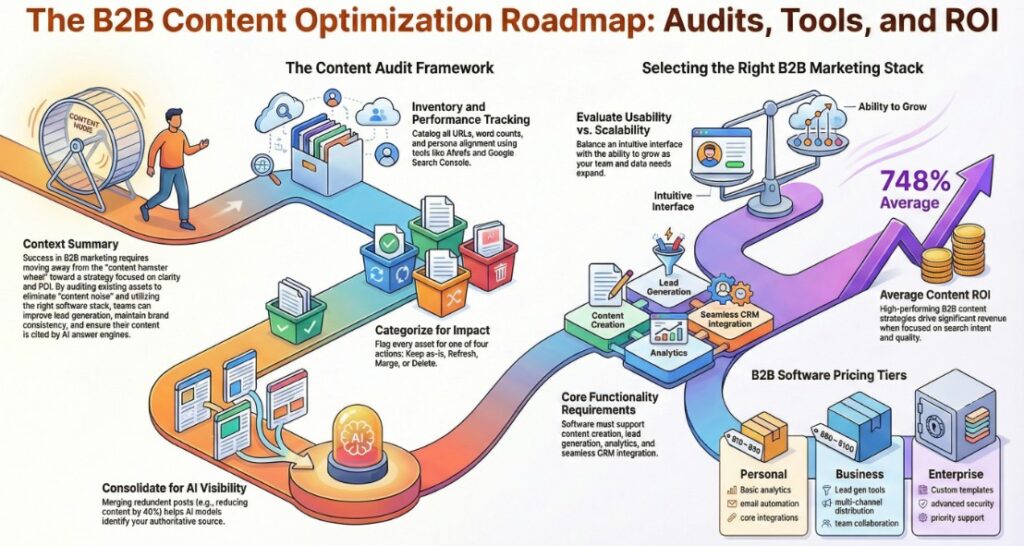
A B2B content marketing audit is a systematic review of all content assets to measure performance, identify gaps, and optimize strategy. This process involves cataloging every piece of content, analyzing performance metrics through tools like Google Analytics and Ahrefs, evaluating alignment with business goals, and creating action plans for improvement or removal.
Content audits solve three main problems.
- They reveal which assets drive lead generation and which waste resources.
- They expose technical SEO issues that hurt search rankings.
- They identify gaps in the buyer journey where prospects drop off.
The process works through five stages: defining audit objectives, inventorying all content assets, evaluating performance against key metrics, creating action plans for each asset, and repeating the audit quarterly or biannually.
Companies use content audits to improve search visibility, increase conversion rates, reduce content production costs, and align marketing with sales enablement goals.
A comprehensive audit examines content data (topics, formats, publishing dates), technical data (page speed, meta tags, backlinks), targeted audience segments, performance metrics (traffic, engagement, conversions), and recommended action items (update, consolidate, delete, or keep as-is).
What Is a B2B Content Audit?
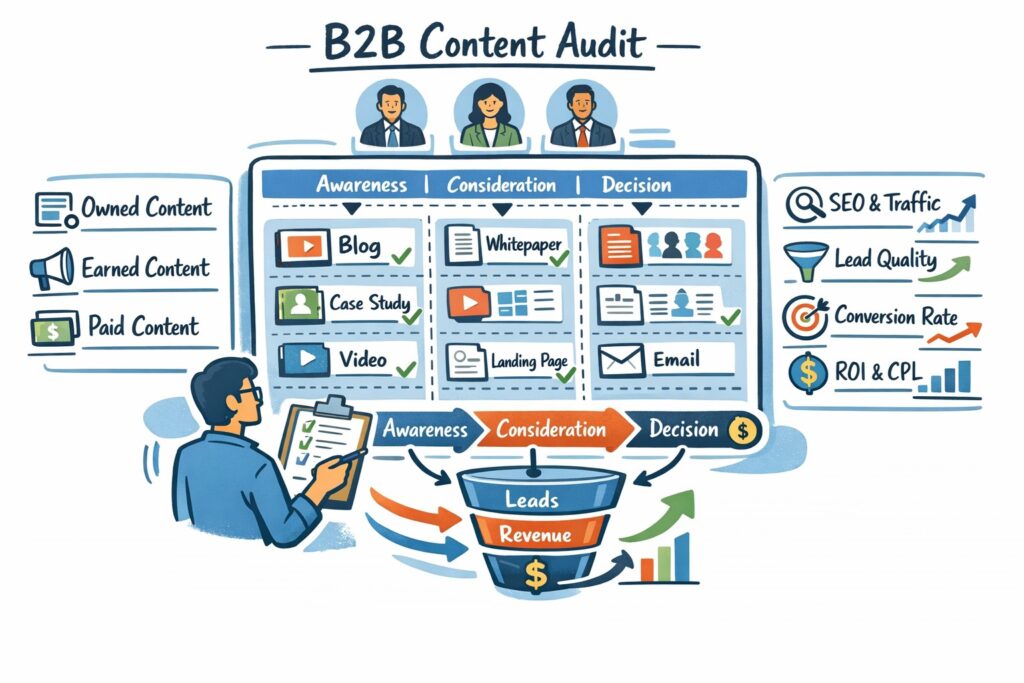
A B2B content audit is a detailed evaluation of all content marketing assets to assess quality, relevance, and performance against business objectives. This includes blog posts, whitepapers, case studies, landing pages, videos, infographics, and email campaigns.
The audit maps every content piece to specific buyer personas and stages of the sales funnel. B2B marketers use this process to understand which content moves prospects from awareness to consideration to decision. Unlike consumer content audits that focus on engagement metrics alone, B2B content audits prioritize lead generation quality, sales cycle influence, and revenue attribution.
Content Marketing Institute research shows that 63% of B2B marketers lack a documented content strategy. Audits fix this by creating a complete inventory with URLs, publication dates, target keywords, and performance data in a centralized spreadsheet or content management system.
The audit distinguishes between owned content (your website and blog), earned content (guest posts and PR mentions), and paid content (sponsored articles and ads). Each type requires different evaluation criteria.
Owned content gets judged on SEO performance and conversion rates. Earned content gets measured by domain authority and referral traffic. Paid content gets assessed by cost per lead and return on ad spend.
The New Urgency: AI and Content Decay

The necessity of an audit has never been greater due to the rise of Generative AI. Old, redundant content does not just clutter your site; it actively hurts your visibility in Large Language Models (LLMs).
When a website has multiple pages covering similar topics (e.g., ten different posts on “employee onboarding”), AI systems struggle to identify the authoritative source, often resulting in no citation at all.
By consolidating overlapping content through an audit, businesses can clarify their signal to AI engines and potentially see a 2–15x increase in AI citations
5 Benefits of a Content Audit
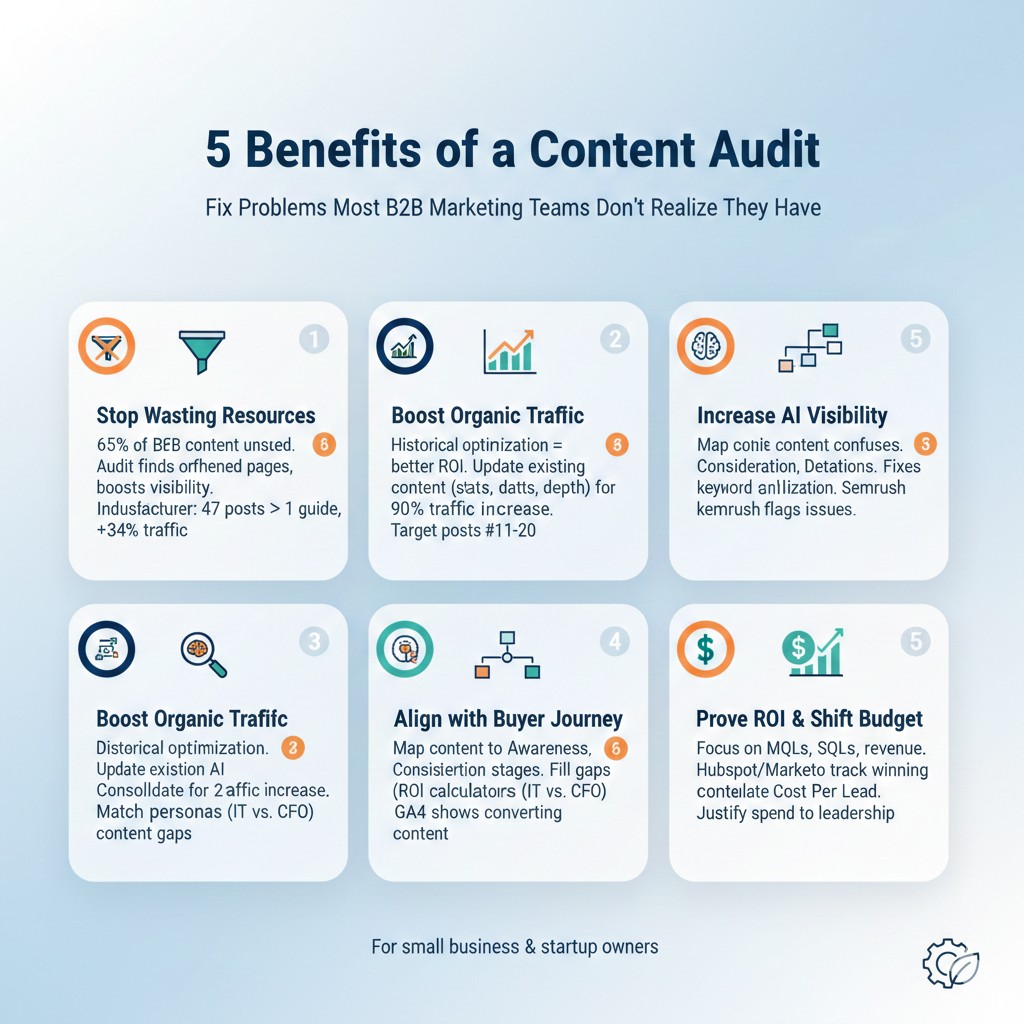
Content audits fix problems most B2B marketing teams don’t realize they have.
1. Stops Wasting Resources on Content Nobody Uses
Research shows that up to 65% of B2B content goes unused because prospects can’t find it or it doesn’t match what they need. Companies keep creating new blog posts, whitepapers, and case studies without checking whether existing content works. This is the content hamster wheel, producing more assets without strategy.
An audit breaks this cycle. Screaming Frog crawls reveal orphaned pages with zero internal links and valuable content buried six clicks deep. You’ll see which content generates qualified leads and which attracts people who never convert.
One industrial manufacturer discovered 47 blog posts about “manufacturing efficiency” that competed with each other for the same keywords. After consolidating them into one comprehensive guide with 301 redirects, organic traffic increased 34% in two months.
2. Boosts Organic Traffic Through Historical Optimization
Historical optimization, updating existing content instead of creating new content, delivers better ROI because the URL already has domain authority and backlinks. A B2B SaaS company refreshed 23 existing blog posts by adding current statistics and expanding thin sections. Organic traffic increased 90% within 60 days using 40% of the time new posts would require.
Look for posts ranking positions 11 to 20 in Google Search Console. These already have authority but need optimization to break onto page one. Add 500 to 800 words of depth, update publication dates, and build internal links from related content.
3. Increases Visibility in AI Search and Language Models
Duplicate content confuses AI language models (LLMs), often resulting in them citing none of your pages. When ChatGPT or other generative AI tools search for information, they struggle with multiple similar pages from the same domain.
Companies that consolidated overlapping content into single authoritative pages saw 2x to 15x increases in AI citations. Content consolidation also fixes keyword cannibalization where your own pages compete in search results. Semrush audits flag these issues automatically.
4. Aligns Content with the Buyer Journey
An audit maps content to buying stages, Awareness, Consideration, Decision, revealing gaps where prospects leave for competitor sites. Most B2B companies have plenty of top-of-funnel content but lack decision-stage assets like ROI calculators, implementation checklists, or product comparison guides.
Map content to buyer personas. B2B purchases involve multiple decision makers. An IT Director evaluates technical integration while a CFO analyzes total cost of ownership. You might have 50 articles for technical evaluators but only 3 for financial decision makers.
Google Analytics 4 Exploration reports show which content appears in converting sessions versus non-converting sessions. This identifies high-traffic pages where adding calls-to-action or gated resources could capture leads.
5. Helps you Prove ROI and Shift Budget to What Works
Audits replace vanity metrics like pageviews with business impact metrics: marketing qualified leads (MQLs), sales qualified leads (SQLs), and revenue influenced. Marketing automation platforms like HubSpot and Marketo track which blog posts or case studies appear in winning deal sequences.
Calculate cost per acquisition for content channels. If organic blog traffic costs $5,000 monthly and generates 100 leads, that’s $50 per lead. If video content costs $25,000 monthly but generates 800 leads, that’s $31.25 per lead. The math justifies shifting budget to video.
This data justifies budgets to leadership. Instead of “we published 40 blog posts this quarter,” you report “our optimized content generated 340 MQLs at $47 cost per lead versus $180 industry average.”
Step-by-Step Process to Conduct a B2B Content Marketing Audit
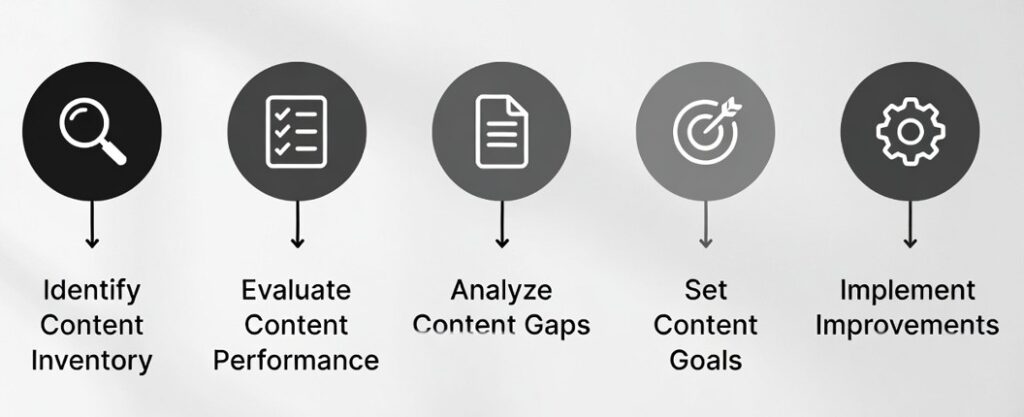
Content audits follow a structured methodology. Skipping steps or rushing the process produces incomplete insights.
Step 1: Define Your Goals
Start by documenting 3 to 5 specific, measurable objectives for the audit. Vague goals like “improve content” fail. Precise goals like “increase organic traffic to product pages by 25%” or “identify content gaps in the consideration stage for the CFO persona” work.
Identify Top Performers
Top performers reveal what works. Sort content by conversions, not just traffic. A blog post with 500 monthly visitors generating 15 demo requests beats a post with 5,000 visitors generating 2 requests.
Look for patterns among winners. Do certain authors, topics, formats, or word counts correlate with success? One agency found their interviews with industry executives consistently outperformed generic how-to guides.
Document the characteristics of top performers: average word count, number of images, use of data, author expertise level, and topic specificity. These become templates for future content.
Unearth Poor Performers
Poor performers waste resources. Identify content with high bounce rates, low time on page, zero conversions, and declining traffic trends.
Some poor performers deserve deletion. Others need updating or consolidation. A thin 200-word post might perform better merged into a comprehensive guide.
Calculate opportunity cost. Every hour spent maintaining low-value content is an hour not creating high-value content.
Understand Relevancy
Relevancy fades over time. Tax law articles from three years ago mislead readers. Product comparison posts with discontinued offerings hurt credibility.
Check publication dates against topic decay rates. Breaking news decays in weeks. Best practices decay in months. Fundamental concepts stay relevant for years.
Compare your content to current competitor content. If their guides are more comprehensive or up-to-date, you’ve lost relevancy.
Generate Better Content Ideas
Content gaps analysis compares your content library to search demand and competitor coverage. Tools like Semrush’s Topic Research or Ahrefs’ Content Gap feature automate this.
Analyze customer support tickets and sales call recordings for recurring questions your content doesn’t answer. These represent high-intent topics.
Review industry publications, conference agendas, and LinkedIn discussions for emerging topics where you could establish early authority.
Discover Lead Generation Opportunity
Map content to conversion paths. Google Analytics 4’s Exploration reports show which content appears in converting sessions versus non-converting sessions.
Look for high-traffic, low-conversion content where adding calls-to-action or gated resources could capture leads. A popular blog post about industry trends might benefit from an embedded industry report download.
Identify bottom-of-funnel content gaps. Most B2B companies have plenty of awareness content but lack decision-stage content like ROI calculators, product comparison guides, or implementation checklists.
Step 2: Collect Data
Build a comprehensive spreadsheet capturing every content asset. This takes 10 to 40 hours depending on library size.
Content Data
Content data includes URL, title, author, publication date, last update date, word count, content type (blog, whitepaper, case study, video), topic category, target keyword, buyer persona, funnel stage, and content status (published, draft, archived).
Use Screaming Frog to crawl your site and export URLs, titles, meta descriptions, word counts, and status codes. This automation saves hours versus manual data entry.
Tag each piece by topic cluster. If you cover five main service areas, label content accordingly. This reveals coverage imbalances.
Note content format and media types. Track whether pieces include video, images, infographics, embedded tools, or downloadable resources.
Technical Data
Technical data covers page load speed, mobile responsiveness, HTTPS status, XML sitemap inclusion, canonical tags, structured data markup, internal link count, external link count, image optimization, and crawl errors.
Google Search Console provides indexing status, mobile usability issues, and Core Web Vitals scores. Export this data and match it to your content inventory by URL.
Check for redirect chains where one redirect leads to another. These slow page loads and dilute link equity. Direct all redirects to final destinations.
Validate structured data implementation using Google’s Rich Results Test. Proper schema markup helps search engines understand content context and can earn rich snippets in search results.
Targeted Audience
Map content to buyer personas. B2B purchases involve multiple decision makers with different concerns. An IT Director cares about integration capabilities while a CFO cares about total cost of ownership.
Tag content by persona (technical evaluator, executive decision maker, end user) and buying stage (problem aware, solution aware, product aware, most aware).
Identify persona coverage gaps. You might have 50 articles for IT Directors but only 3 for CFOs despite CFOs having final budget approval.
Performance Metrics
Performance metrics include organic traffic, direct traffic, referral traffic, average time on page, bounce rate, scroll depth, pages per session, conversion rate, leads generated, marketing qualified leads (MQLs), sales qualified leads (SQLs), backlink count, referring domains, social shares, and revenue influenced.
Pull six to twelve months of data for trend analysis. One month’s performance might be anomalous. Twelve months shows seasonality and true patterns.
Google Analytics 4 provides traffic and engagement data. Ahrefs or Semrush provide backlink and keyword ranking data. Your marketing automation platform provides lead attribution data.
Calculate cost per acquisition for content channels. If organic blog traffic costs $5,000 monthly in production and generates 100 leads, that’s $50 per lead.
Action Items
Assign preliminary action categories: keep, update, consolidate, redirect, or delete. These aren’t final decisions but starting hypotheses.
Keep applies to evergreen content performing well on all metrics. Update applies to good content with outdated information or declining rankings. Consolidate applies to multiple thin posts covering similar topics. Redirect applies to obsolete content with inbound links. Delete applies to poor content with no traffic, no links, and no strategic value.
Flag items requiring deeper analysis. Some underperformers might need promotion rather than updates. Some high performers might cannibalize each other’s rankings.
Step 3: Evaluate Your Content
Analysis transforms data into insights. Sort your spreadsheet by different metrics to spot patterns.
Start with traffic trends. Which content is growing versus declining? Growth indicates strong topic fit and SEO health. Decline signals content decay or increased competition.
Compare traffic to conversion rates. High traffic with low conversions indicates topic mismatch with your offerings or weak calls-to-action. Low traffic with high conversions indicates underexposed valuable content worth promoting.
Examine bounce rates by content type. Industry websites average 45% to 65% bounce rates. Above 70% signals problems. Below 40% is exceptional for B2B content.
Look at assisted conversions, not just last-click attribution. Content near the top of the funnel rarely gets credit in last-click models but plays a crucial awareness role.
Check keyword rankings for target terms. Content ranking 11 to 20 represents quick-win optimization opportunities. These pages already have some authority but need better optimization to break onto page one.
Analyze backlink profiles. Content earning natural backlinks from authoritative sites provides SEO value beyond direct traffic. Prioritize maintaining and updating this content.
Review competitors’ content for the same keywords. If competitors publish 3,000-word guides with original data and you have 600-word generic posts, that explains ranking gaps.
Step 4: Create an Action Plan
Build a prioritized action plan based on effort versus impact. Use a simple four-quadrant matrix with high impact and low effort in the priority quadrant.
Update high-traffic content first. These pages already have authority and audience. Refreshing them provides immediate returns. Add current statistics, remove outdated references, expand thin sections, and update publication dates.
Consolidate overlapping content. If you have five blog posts about industrial SEO that each rank in positions 15 to 30, consolidate them into one comprehensive guide. Set up 301 redirects from old posts to the new guide.
Delete content with zero traffic, zero backlinks, and no strategic value. This includes duplicate content, outdated press releases, and failed content experiments. Use Google Search Console to verify pages have no impressions before deletion.
Optimize high-potential content ranking on page two. Add more comprehensive information, improve title tags and meta descriptions, build internal links from related content, and acquire backlinks through outreach.
Fill content gaps in high-priority topic clusters. If you dominate five topics but have zero coverage of three related high-volume topics, create new content for those gaps.
Assign owners, deadlines, and success metrics to each action item. Without accountability, action plans become wish lists.
Step 5: Repeat
Content audits aren’t one-time projects. Market conditions change. Competitors publish new content. Search algorithms evolve.
Schedule audits quarterly for fast-moving industries and annually for slower industries. Technology companies need frequent audits. Manufacturing companies can audit less often.
Create a rolling audit process where you evaluate a subset of content monthly rather than everything quarterly. This distributes workload and provides continuous improvement.
Track whether implemented actions deliver expected results. If updating old blog posts doesn’t improve rankings after three months, try different optimization tactics.
Build audit learnings into content creation processes. If audits consistently find missing calls-to-action, add CTA requirements to content briefs.
Tools for Conducting a Content Audit

Running a content audit without the right tools means weeks of manual work and missing critical data. Here’s what you need.
Inventory and Crawling
Screaming Frog SEO Spider crawls websites to extract technical data automatically. Free version handles 500 URLs. Paid version costs £149 yearly ($185 USD) for unlimited crawling.
It finds broken links, duplicate content, missing meta descriptions, redirect chains, and orphaned pages. Pulls URLs, titles, and word counts without manual entry. Integrates with Google Analytics, Google Search Console, and Ahrefs.
Most audits also start by exporting your blog posts from WordPress or HubSpot directly into a spreadsheet.
Analytics and Performance
Google Analytics 4 (GA4) tracks traffic, bounce rates, and conversions for free. Shows which content appears in successful user journeys through Custom Explorations. Replaced Universal Analytics in July 2023.
Google Search Console monitors technical health and organic visibility. Flags pages blocked by robots.txt, tracks mobile usability issues, and shows which keywords drive traffic to specific content.
HubSpot measures engagement and ROI for teams on the platform. Tracks attribution data connecting content to closed deals.
SEO and Competitive Research
Ahrefs ($129-$1,499/month) handles backlink analysis and competitive intelligence. Site Audit scans for 140+ technical issues. Content Gap tool shows keywords competitors rank for that you don’t. Tracks up to 10,000 keyword positions.
Semrush ($140-$500/month) offers similar features plus automatic content categorization (rewrite, update, keep, delete). Position Tracking monitors daily rankings for featured snippets and knowledge panels.
SE Ranking runs mobile-friendly tests across devices.
Content Quality Checks
Surfer SEO analyzes content depth and suggests word count targets based on competitor analysis.
Google PageSpeed Insights tests site speed on desktop and mobile. Identifies elements slowing content delivery.
Google Rich Results Test validates schema markup for rich snippets in search results.
Organization
Google Sheets or Excel serves as your master spreadsheet. Include columns for: URL, title, publication date, word count, content type, target keyword, buyer persona, traffic, conversions, bounce rate, backlinks, and action items.
Color-code categories (Keep, Update, Consolidate, Redirect, Delete) for visual scanning. Set up formulas to calculate metrics like cost per lead before starting the audit.
In Summary
Conducting a regular B2B content marketing audit transforms your digital strategy from guesswork into a data-driven engine for online growth.
By utilizing tools like Screaming Frog, Ahrefs, Semrush, and Google Analytics, marketers can effectively unearth poor performers and identify lead generation opportunities within their content inventory.
This systematic process ensures Improved SEO Performance and Enhanced User Experience while providing the actionable insights necessary for Informed Decision-Making.