
Quick Answer: What are the best content audit tools in 2026?
The best content audit tools in 2026 are: Semrush Content Audit (best all-in-one, integrates GSC and analytics), Screaming Frog SEO Spider (best for technical audits), Ahrefs Site Audit (best for backlink and SEO health), ContentKing (best for real-time monitoring), and Google Search Console (best free option). For most B2B teams with under 500 pages, Semrush Content Audit or Google Search Console plus a structured spreadsheet covers all audit needs.
Disclosure: Some links in this post are affiliate links. If you sign up through them, I may earn a commission at no extra cost to you. I only recommend tools I believe are genuinely useful.
The best content audit tools in 2026 are Screaming Frog (technical depth), Semrush (all-in-one SEO), and Ahrefs (backlink-heavy audits), but the right choice depends on whether you’re optimizing for Google rankings, AI-search visibility, compliance risk, or direct revenue impact. The stakes rose this year: 97% of web pages get zero organic search traffic, and only 5.7% of newly published pages crack Google’s top 10 within a year, so auditing the content you already have is now the highest-return move.
This guide compares 10 tools using a proprietary Revenue-to-Risk (R2R) framework so you can pick the one that maps your content to business outcomes, not just traffic numbers.
Table of Contents
Why Most Content Audits Fail (and What to Do Instead)
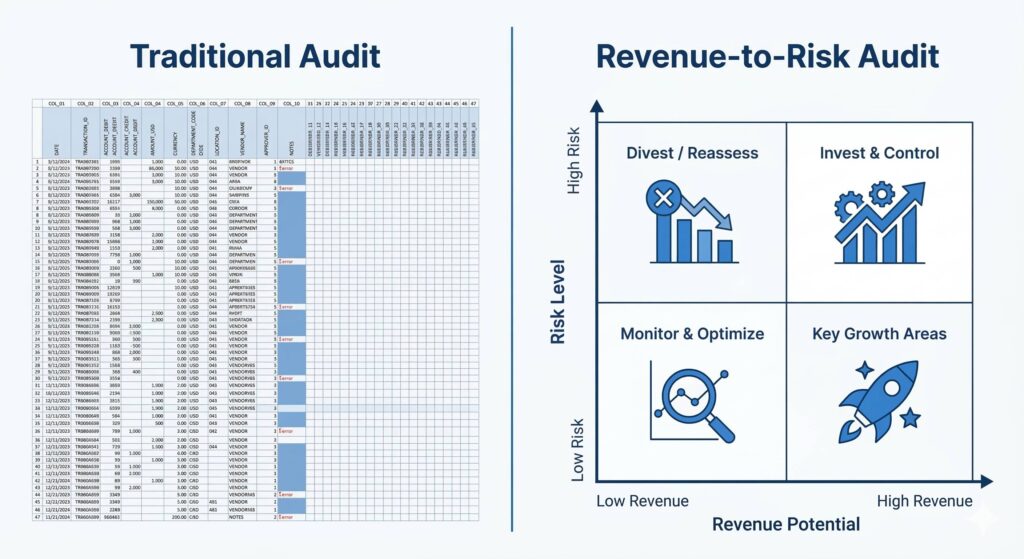
Most content audits fail because they treat every page as equally important. Your team spends three weeks crawling 4,000 URLs, exports a spreadsheet with 47 columns, and then… nothing ships. The audit sits in a Google Drive folder while the real problems, thin product pages, compliance landmines, and dying lead-gen assets, go unaddressed.
The common advice is “audit everything first, prioritize later.” Here’s the problem: for a B2B team of 1–5 people, that’s 40+ hours of work that produces a document instead of results.
The fix is to audit with commercial intent from the start; filtering your content inventory through a lens of revenue impact and risk exposure before you ever open a crawl tool.
In practice, what we see is that B2B companies in regulated industries (fintech, healthcare, legal, SaaS with compliance requirements) have an additional layer most audit guides ignore entirely: content that generates traffic but creates legal liability.
A blog post citing an outdated GDPR stat, a landing page with an unverified ROI claim, these pages are SEO assets on paper and legal liabilities in practice.
This guide covers the tools that help you catch both problems.
The Revenue-to-Risk (R2R) Matrix: A Better Way to Prioritize
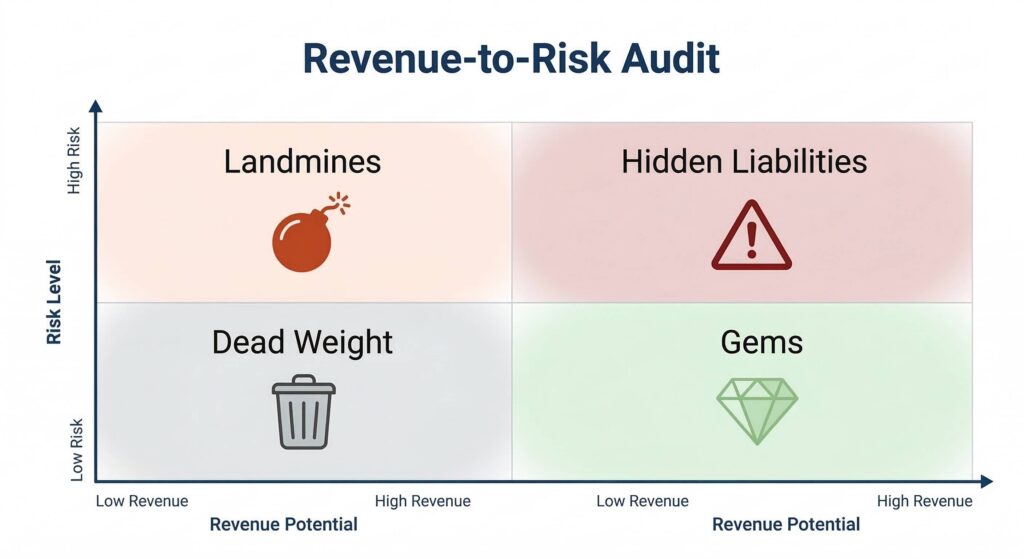
The Revenue-to-Risk (R2R) Matrix is a content prioritization framework that classifies every page in your audit across two axes: commercial impact (does this page generate leads, pipeline, or revenue?) and compliance liability (could this page expose your company to legal or reputational risk?).
This is the framework many brands use to help teams cut through the noise of 2,000-URL crawls and get to decisions in hours, not weeks.
Here’s how the four quadrants work:
| Quadrant | Commercial Impact | Compliance Risk | Action |
|---|---|---|---|
| Gems | High | Low | Protect and scale. Refresh with new data, add internal links, expand. |
| Landmines | High | High | Immediate legal review. Add disclaimers, update claims, add compliance caveats before touching SEO. |
| Dead Weight | Low | Low | Consolidate or redirect. Don’t waste time updating content that serves no commercial purpose. |
| Hidden Liabilities | Low | High | Depublish or redirect. Low traffic masks real risk. These are your biggest blind spot. |
Your audit tool needs to surface the inputs for this matrix: traffic, conversion data, keyword intent, and ideally flagging for compliance-sensitive topics like financial claims, health outcomes, or legal language.
Most tools handle the traffic and keyword side well. Almost none handle the compliance dimension. That gap is what this comparison is designed to close.
Before diving in, bookmark our comprehensive B2B content marketing audit guide and our step-by-step audit process walkthrough, both will give you the strategic context to use any of the tools below effectively.
How We Evaluated These Tools
To compare these 10 content audit tools, we assessed each against five criteria weighted for small B2B marketing teams:
| Criterion | Weight | What We Looked At |
|---|---|---|
| Technical crawl depth | 20% | Can it find broken links, duplicate content, missing metadata, redirect chains? |
| Content quality signals | 20% | Does it assess readability, thin content, topical relevance? |
| Commercial data integration | 25% | Can it pull in conversion or revenue data, or connect to GA4/GSC? |
| Compliance flagging | 20% | Does it flag content with regulatory risk signals (disclaimers, unverified claims, outdated data)? |
| Team usability | 15% | Can a 2-person team run it without a developer? |
Pricing data is accurate as of 2026. Each tool section ends with a clear verdict so you can skip to what fits your situation.
The 10 Best Content Audit Tools Compared
1. Screaming Frog SEO Spider
Best for: Technical crawl depth on a budget.
Screaming Frog is the gold standard for technical site crawls. It’s not pretty, but it finds problems nothing else catches. i.e., orphaned pages, broken internal links, redirect loops, duplicate title tags, and missing hreflang attributes.
For B2B teams running a content audit for the first time in 12+ months, start here. The free version crawls up to 500 URLs, which covers most small B2B sites. The paid license is £259/year (~$325), one of the best value-per-feature ratios in this list.
Where it falls short: Screaming Frog gives you raw data, not decisions. It won’t tell you which of your 200 broken links actually matter, and it has zero content quality or compliance analysis. You’re buying a crawler, not a content strategist.
In practice, what we see is that most teams use Screaming Frog alongside a GSC integration to pull in impressions and clicks. That combination closes the “technical + traffic” gap in about 2 hours of setup.
R2R Matrix fit: Strong on identifying technical issues that suppress “Gem” pages. Weak on flagging Landmines or Hidden Liabilities.
Action step: Download Screaming Frog, run a crawl of your site, and filter for pages with 0 inbound internal links. These are your orphan pages, a 15-minute fix that immediately improves crawl equity.
2. Semrush Site Audit
Best for: All-in-one SEO teams who want one platform.
Semrush Site Audit is the most complete out-of-the-box audit tool for B2B marketers. It combines technical crawling, keyword gap analysis, backlink auditing, and content quality signals in one dashboard. According to Semrush’s own benchmarks, their crawler checks over 130 technical SEO issues per crawl.
The content audit module (available on Guru and Business plans, starting at $229.95/month) lets you import your Google Analytics data to segment pages by traffic, engagement, and conversion, which is the closest any single tool gets to the “commercial impact” axis of the R2R Matrix.
The downside: Semrush is expensive for small teams, and the sheer volume of data it produces can be paralyzing. If you don’t already have a clear prioritization framework (like R2R), you’ll spend more time in dashboards than making decisions.
R2R Matrix fit: Best commercial impact data of any tool on this list. No compliance flagging.
Action step: If you’re on a Semrush Guru plan, go to Content Audit → connect GA4 → filter by pages with high traffic and low engagement rate. These are your Landmine candidates, high visibility, underperforming, potentially misleading visitors.
3. Ahrefs Site Audit
Best for: Teams where backlink profile is a primary SEO lever.
Ahrefs Site Audit is technically excellent and slightly more intuitive than Screaming Frog for non-technical users. Where it genuinely leads the market is in combining site audit data with Ahrefs’ world-class backlink database, so you can immediately see which flagged pages have real link equity at stake.
For B2B companies where domain authority and backlink profiles drive pipeline (think: category-defining SaaS, agencies, or consultancies), the ability to see crawl issues layered against backlink data is a genuine competitive advantage.
Pricing starts at $129/month for the Lite plan, with Site Audit included.
Like Screaming Frog, Ahrefs gives you technical and traffic data but no compliance signals. It also lacks native conversion data integration, so you’ll need to pull GSC and GA4 data separately to populate the commercial impact axis.
R2R Matrix fit: Strong on identifying high-risk technical issues on pages with backlink equity. No compliance layer.
Action step: In Ahrefs Site Audit, filter for 3xx redirect chains on pages with 10+ referring domains. Fixing one redirect chain on a linked page can recover rankings within 2–4 weeks.
4. Sitebulb
Best for: Agencies and teams who need to present audit findings to clients or leadership.
Sitebulb is a desktop crawler (Mac and Windows) that produces the clearest visual audit reports of any tool in this list. Where Screaming Frog exports raw data, Sitebulb turns your crawl into an executive-ready report with charts, prioritized recommendations, and explanations written in plain English.
For B2B Heads of Marketing who need to present audit findings to a CEO or board, Sitebulb cuts the “translate to stakeholder” step that usually takes 3–5 hours after a raw data export.
It’s also excellent for compliance-adjacent use cases: its content hints flag thin content, low word count pages, and duplicate content, all of which can mask compliance issues if the original intent was a high-stakes landing page.
Pricing starts at $13.50/month for the Lite plan.
R2R Matrix fit: Best for visual reporting and stakeholder communication. Good technical depth. Partial content quality signals. No compliance flagging.
Action step: Run a Sitebulb crawl and export the “Content Hints” report. Sort by severity. Any “Thin Content” flag on a page targeting a bottom-funnel keyword is a priority fix.
5. ContentKing (now Conductor)
Best for: Enterprise teams who need real-time site monitoring, not just periodic audits.
ContentKing, now part of Conductor, is a continuous content monitoring platform. It watches your site 24/7 and alerts you the moment a page changes, a redirect breaks, or a title tag disappears. This is a fundamentally different use case than the crawl-and-export tools above.
For regulated B2B industries, this is the tool that catches compliance issues before they become liabilities. If a developer accidentally removes a legal disclaimer from a landing page at 11pm on a Friday, ContentKing alerts you in real-time. No other tool on this list does that.
Pricing is enterprise and requires a custom quote and expect $500–$2,000+/month depending on site size. Not for teams under 50 employees unless compliance is mission-critical.
R2R Matrix fit: The only tool that operationalizes the Landmine and Hidden Liability quadrants on an ongoing basis. Overkill for a one-time audit but essential for compliance-sensitive teams at scale.
Action step: If you’re in fintech, healthtech, or legaltech and you don’t have a real-time monitoring tool, book a ContentKing/Conductor demo. The cost of one compliance incident almost always exceeds a year of the platform fee.
6. Clearscope
Best for: Content quality and topical authority assessment.
Clearscope is a content optimization platform that grades existing content on topical completeness. It essentially asks “does this page cover the topic thoroughly enough to rank?” It uses NLP to identify related terms and concepts that should appear in a piece, then scores your content against those benchmarks.
For B2B content audits, Clearscope is most valuable in the “update or consolidate” decision. If a page is underperforming, Clearscope tells you whether it’s a relevance problem (missing key subtopics) or a different problem entirely.
Pricing starts at $199/month for the Essentials plan. The biggest limitation: Clearscope grades content quality, but it doesn’t surface which pages to audit first. You need another tool (GSC, Screaming Frog) to build your URL list, then use Clearscope to prioritize which ones to rewrite.
R2R Matrix fit: Best tool for assessing whether low-performing “Gem” candidates have a topical depth problem. No technical crawl or compliance features.
Action step: Export your 20 lowest-traffic pages targeting high-intent keywords. Run them through Clearscope. Any page scoring below 70 is a rewrite candidate, not a redirect candidate, the intent is right, the execution isn’t.
7. MarketMuse
Best for: Topic modeling and content gap analysis at a portfolio level.
MarketMuse is a content intelligence platform that maps your entire content inventory against a topic model, identifying gaps, redundancies, and opportunities across your whole site. It’s more strategic than Clearscope and more expensive: plans start at $149/month, with meaningful features starting at $399/month.
Where MarketMuse genuinely earns its price is in identifying which topics you have authority in and which topics your competitors dominate. For B2B companies trying to build a content moat around a core category, this is the audit layer that shapes your 6–12 month content strategy, not just next week’s rewrites.
The platform also flags content cannibalization, meaning multiple pages targeting the same keyword, which is one of the most common and damaging audit findings for B2B sites that have been publishing for 3+ years.
R2R Matrix fit: Excellent for strategic portfolio prioritization. Weak on technical issues and has no compliance layer.
Action step: Run MarketMuse’s Content Inventory report on your blog. Filter for topics where you have 3+ pages with overlapping keyword targets. Consolidate the weakest two into the strongest one before doing any new content creation.
8. Google Search Console
Best for: Every team, as a baseline data source.
Google Search Console is not technically a content audit tool, but no audit is complete without it. GSC is free, and it provides the most accurate picture of how Google actually sees your content, impressions, clicks, average position, crawl errors, and Core Web Vitals.
The common advice is to use GSC as a supplementary tool. Here’s the problem: most teams use it reactively (checking when rankings drop) instead of proactively (building audit workflows around its data).
For the R2R Matrix, GSC is your primary source for commercial impact signals. Pages with high impressions but low click-through rates are telling you something is wrong. Either the title tag is off or the content doesn’t match searcher intent. Both are fixable.
R2R Matrix fit: Essential for the commercial impact axis. Pull impression-to-click ratios to identify pages where you’re visible but not converting interest into traffic.
Action step: In GSC, go to Performance → filter by pages → sort by impressions descending. Export the top 50. Any page with over 1,000 impressions and a CTR below 2% needs a title tag and meta description rewrite today.
9. Lumar (formerly DeepCrawl)
Best for: Enterprise teams with large, complex site architectures.
Lumar is an enterprise-grade technical SEO platform built for sites with 100,000+ URLs. For most B2B companies (under 5,000 pages), it’s overkill. But if you’re a B2B SaaS with a large content library, multi-region site structure, and a dev team that needs to be looped into audit findings, Lumar’s integrations with Jira, Slack, and CI/CD pipelines make it genuinely powerful.
According to Lumar’s documentation, their platform can crawl JavaScript-rendered content that other crawlers miss entirely, critical for modern SaaS sites built on React or Next.js where key content may never be indexed.
Pricing is enterprise-tier with custom quotes.
R2R Matrix fit: Best for large B2B sites where technical infrastructure complexity creates hidden liabilities. No content quality or compliance layer.
Action step: If your site is built on a JavaScript framework and you haven’t verified that your key landing pages are being fully indexed, book a Lumar trial and run a JavaScript crawl comparison. The gap between what you think Google sees and what it actually sees may surprise you.
10. Surfer SEO
Best for: Teams optimizing content performance post-publish.
Surfer SEO combines content optimization (like Clearscope) with SERP analysis to tell you exactly how to rewrite underperforming content to rank higher. Its Content Audit feature analyzes pages against current top-ranking content and gives you a specific action list: add 300 words here, include these NLP terms, increase internal links to this page.
For small B2B teams, Surfer’s audit workflow is the most actionable of the content quality tools. It doesn’t just tell you a page is underperforming, it tells you what to do about it.
Pricing starts at $99/month for the Essential plan.
The limitation: Surfer optimizes for rankings, not for commercial impact or compliance. You can end up with a perfectly optimized page that ranks well but converts poorly, or, in regulated industries, that ranks well but creates liability. Always layer your own commercial and compliance judgment on top of Surfer’s recommendations.
R2R Matrix fit: Best for the “what to fix” question once you’ve identified your Gem candidates using the R2R Matrix. Not a prioritization tool.
Action step: Identify your 5 highest-potential “Gem” pages using GSC + the R2R Matrix. Run each through Surfer Content Audit. Prioritize the one with the highest Content Score gap, that’s your fastest ranking recovery opportunity.
Full Comparison Table
| Tool | Best For | Technical Crawl | Content Quality | Commercial Data | Compliance Signals | Starting Price |
|---|---|---|---|---|---|---|
| Screaming Frog | Technical audit | ⭐⭐⭐⭐⭐ | ⭐ | ⭐ (with GSC integration) | ❌ | Free / £259/yr |
| Semrush Site Audit | All-in-one SEO | ⭐⭐⭐⭐ | ⭐⭐⭐ | ⭐⭐⭐⭐ | ❌ | $229.95/mo |
| Ahrefs Site Audit | Backlink-heavy sites | ⭐⭐⭐⭐ | ⭐⭐ | ⭐⭐ | ❌ | $129/mo |
| Sitebulb | Stakeholder reporting | ⭐⭐⭐⭐ | ⭐⭐⭐ | ❌ | ❌ | $13.50/mo |
| ContentKing/Conductor | Real-time monitoring | ⭐⭐⭐⭐⭐ | ⭐⭐ | ⭐⭐ | ⭐⭐⭐⭐⭐ | Custom ($500+/mo) |
| Clearscope | Content quality scoring | ❌ | ⭐⭐⭐⭐⭐ | ❌ | ❌ | $199/mo |
| MarketMuse | Topic modeling | ❌ | ⭐⭐⭐⭐⭐ | ⭐⭐ | ❌ | $149–$399/mo |
| Google Search Console | Baseline traffic data | ⭐⭐ | ❌ | ⭐⭐⭐ | ❌ | Free |
| Lumar | Enterprise JS sites | ⭐⭐⭐⭐⭐ | ⭐ | ⭐⭐ | ❌ | Custom |
| Surfer SEO | Post-audit optimization | ❌ | ⭐⭐⭐⭐ | ❌ | ❌ | $99/mo |
Which Tool Is Right for Your Team?
Stop trying to find the single “best” tool. In practice, what works for most B2B teams is a two-tool stack: one for technical crawling and one for content quality signals. The right combination depends on your situation.
If you’re running your first-ever content audit: Use Screaming Frog (free tier) + Google Search Console. This costs you nothing and surfaces 80% of the issues that matter. Do this before buying anything else.
If you’re a 1–3 person marketing team with an established content library (100+ posts): Semrush Site Audit + Clearscope. Semrush gives you the technical and traffic picture; Clearscope tells you what to fix. Total cost: ~$430/month. Expensive, but this combination directly maps to the R2R Matrix.
If you’re in a regulated B2B industry (fintech, healthtech, legaltech, insurtech): Screaming Frog + ContentKing/Conductor + a legal review process. The tools handle technical and real-time monitoring; your legal team handles compliance flagging. No tool on this list fully automates compliance review, and any vendor claiming otherwise is overselling.
If you need to present audit findings to a board or investor: Sitebulb for the report, GSC for the data. Sitebulb’s visual reports require almost no post-processing for executive audiences.
If you’re an enterprise SaaS with 50,000+ pages: Lumar + Semrush. You need enterprise crawl infrastructure and commercial data. Budget accordingly.
One cost warning before you scope any of these: the starting-at price is rarely the true cost. The AI and GEO tracking add-ons are where costs climb. Ahrefs Brand Radar runs about $800 to $1,000 extra a month on top of a plan, and Profound jumps to roughly $399 a month once you want coverage beyond one AI engine. Tally the price of the layer you actually need, not the marketing price, before you commit a team to a stack.
The 2026 Addition: Audit for AI-Search Visibility, Not Just Google
Here is the gap most 2026 tool roundups still miss. A content audit that only measures Google rankings is now incomplete. Current 2026 research on content audits shows that about 80% of LLM citations do not rank in Google’s top 10; a page can sit at position one in Google and stay invisible to ChatGPT, Perplexity, or Gemini if it lacks the structure those engines quote from.
The practical result: your audit must now score each page for AI visibility the way it scores for search traffic. That is not a vanity metric. Outdated stats, deprecated product names, or old pricing on legacy pages become active liabilities because AI engines quote them to buyers as current facts. When a buyer asks an AI assistant to compare vendors, the assistant cites the page, not a disclaimer buried in your analytics.
The Three-Layer Audit Stack That Covers Both
Instead of chasing a single tool, run a three-layer stack that pins down Google performance, technical crawl health, and AI visibility separately:
- Baseline performance (free): Google Search Console plus Google Analytics 4 for first-party clicks, impressions, and conversions, and the free GEO Audit Tool for an instant AI-readiness score.
- Crawl and link equity (low to mid cost): Screaming Frog (free to 500 URLs) or Ahrefs to surface technical errors and tie crawl issues to backlink equity.
- Content quality and AI visibility (paid specialist): Clearscope or MarketMuse for topical depth, paired with an AI-tracking layer such as Ahrefs Brand Radar, Semrush’s AI Visibility Toolkit, or Profound for enterprise GEO coverage.
This is the same AI-search visibility measurement approach we cover in depth separately. The audit tools above feed it; the method tells you what to do with the signals.
A Content Health Scoring Matrix for the AI Era
To fold this into the R2R Matrix above, score every page across three dimensions on a low, medium, or high basis:
- SEO performance: the 90-day traffic trend pulled from GSC and GA4.
- AI visibility: whether ChatGPT, Perplexity, or Gemini cite the page, checked with Ahrefs Brand Radar, Semrush AI Visibility, or Profound.
- Content quality: topical depth, freshness, and E-E-A-T signals.
Then act on the pattern, not the single score. A page low on all three is a deletion or redirect candidate. A page high on content quality but low on AI visibility is a reformatting candidate, not a delete, it likely just lacks the answer-first structure and FAQ schema that AI engines quote. This is the diagnostic depth that separates 2026 audits from the surface-level “AI mention count” check older guides still rely on.
For the full method, see our AEO vs GEO vs SEO breakdown and the AI-search visibility pillar.
What to Do Next
Picking the right tool is step one. Using it correctly is step two, and that’s where most audits stall.
Before you open any of the tools above, read our step-by-step B2B content audit guide. It walks you through how to structure your audit inventory, apply the R2R Matrix to your URL list, and turn findings into a prioritized action plan your team can actually execute in a single sprint.
If you want to start even earlier in the process, understanding what a comprehensive B2B content audit will really help.
Here’s your action plan for this week:
- Export every URL on your site using Screaming Frog (free).
- Pull impressions and clicks for each URL from Google Search Console.
- Map each URL to one of the four R2R Matrix quadrants.
- Pick your top 10 “Gem” pages and your top 5 “Landmine” pages.
- Run your Gem pages through Surfer or Clearscope. Get your Landmine pages in front of legal.
That’s a full content audit framework, executable in one week, with the tools listed above.
FAQs
What is a content audit tool?
A content audit tool is software that analyzes some or all pages of a website to identify technical issues, content quality gaps, and performance problems. Most tools crawl your site to surface broken links, duplicate content, missing metadata, and thin pages, helping marketing teams decide which content to update, consolidate, redirect, or delete.
How often should you do a content audit?
For most B2B teams, a full site audit once per quarter is sufficient, with a focused review of high-priority pages (product, pricing, key landing pages) monthly. According to HubSpot’s research, companies that regularly update old blog content generate 106% more leads than those that don’t, making a quarterly audit cadence one of the highest-return activities for small content teams.
What is the best free content audit tool?
Google Search Console is the best free content audit starting point, it gives you real Google performance data including impressions, clicks, and crawl errors for every page. Screaming Frog’s free version (up to 500 URLs) is the best free technical crawler. Used together, these two free tools can produce a solid initial audit for small B2B sites.
How long does a content audit take?
A focused content audit of a 500-page site takes 2–5 days for a skilled marketer: roughly 4 hours for the crawl and data export, 4–6 hours for URL-by-URL prioritization using a framework like the R2R Matrix, and 4–8 hours for compiling recommendations and getting stakeholder sign-off. Avoid open-ended audits with no scope, they expand to fill whatever time you give them.
Can AI tools replace manual content audits?
AI content tools can accelerate audits significantly, particularly for content quality scoring, topical gap analysis, and identifying thin content at scale. However, no AI tool currently available can replace human judgment on commercial prioritization (which pages drive pipeline) or compliance risk (which pages create legal liability). Use AI tools to scale the data collection and surface-level analysis; use human judgment to make the final decisions.
What’s the difference between a technical SEO audit and a content audit?
A technical SEO audit focuses on how search engines crawl and index your site, addressing issues like site speed, broken links, redirect chains, and structured data. A content audit evaluates the quality, relevance, and commercial performance of your content, addressing issues like thin pages, keyword cannibalization, outdated information, and misaligned intent. A complete site review requires both; most tools specialize in one or the other.
