

B2B content marketing ideas are strategies and formats that businesses use to attract, educate, and convert professional buyers, from chief operating officers and technical leads to HR directors and procurement teams.
These ideas work by moving prospects through a decision cycle that is longer, more complex, and more committee-driven than typical consumer purchases. The right content marketing ideas for B2B give buyers the evidence they need to choose your solution with confidence.
The main benefits of a strong B2B content strategy are measurable: higher-quality lead generation, shorter sales cycles, lower cost-per-acquisition, and compounding organic search traffic.
CMI research shows that B2B marketers with a documented content marketing strategy are roughly twice as likely to rate their efforts as effective compared with those without a documented plan. Joe Pulizzi, founder of CMI, and Ann Handley of MarketingProfs have long argued that consistency and audience focus, not production volume, are the deciding factors.
B2B content marketing applies across the full funnel: search engine optimization (SEO) to capture demand, thought leadership to build credibility, gated content like white papers and ebooks to generate leads, and community-building to retain customers. Platforms such as HubSpot, Salesforce, Adobe, and LinkedIn have each built substantial market positions partly on the strength of their content programs.
The 15 ideas below cover four core components of modern B2B content marketing: interactive and high-engagement formats, authority-building and research-based content, strategic messaging and SEO tactics, and community-plus-human-centric engagement.
Each idea connects directly to long-term goals like pipeline growth, brand authority, and content return on investment (ROI). Whether you are building a strategy from scratch or refining an existing content calendar, these ideas provide specific, executable starting points rather than abstract principles.
High-Impact Interactive Content Ideas

Interactive content converts passive scrollers into active participants.
Brands using interactive content marketing ideas for B2B report a 94% increase in content views compared to static formats, because users click, configure, and receive personalised outputs rather than simply reading.
There are 4 high-impact interactive formats worth prioritising.
1. ROI and Cost Calculators
ROI calculators let prospects quantify the value of your solution before a single sales meeting. A buyer inputs their team size, current costs, or average deal size, and the calculator returns a personalised projection.
Many high-converting calculators attach a downloadable PDF summary that captures the lead’s email address, making the tool a powerful gated content asset.
Interactive ROI calculators are especially effective for workflow automation guides, compliance framework overviews, and supply chain optimisation solutions, where the financial case needs to be concrete before a decision committee will act.
2. Interactive Quizzes and Assessments
B2B assessments help stakeholders benchmark their organisation against competitors while revealing a gap your solution addresses.
A cybersecurity threat intelligence vendor, for example, can build a 10-question maturity assessment that scores a company’s current posture and then maps the score to a recommended product tier.
The quiz generates a qualified lead; the result generates urgency. Survey your audience first to identify the 3 or 4 benchmark questions that matter most to your target vertical, then build the assessment around those data points.
3. Interactive Infographics and Maps
Static infographics are easy to skip. Interactive infographics, with clickable hotspots, scrolling timelines, or expandable data layers, keep buyers exploring longer.
Executive summary infographics work well when decision-makers need high-level data quickly, while interactive maps suit companies with regional data, such as logistics providers visualising delivery performance by geography.
Each hover interaction gives the user new information, increasing time-on-page and brand recall.
4. Gamification
Gamification does not require building a video game. It means adding low-friction, choice-driven experiences to the buyer’s journey. A prospect selects their company size, industry, and biggest operational pain point; an animated sequence then shows a custom solution path.
Gamification works because it lets buyers define their own outcome, making the content feel consultative rather than promotional.
B2B companies in SaaS, remote workforce enablement, and AI-powered content curation have used gamified experiences to increase campaign engagement by double-digit percentages.
The experience does not need to be elaborate: a simple three-step interactive scenario with a branching result is enough to increase time-on-page and conversion intent, especially among technical leads who prefer exploring a problem to reading a static pitch.
Authority-Building and Research-Based Ideas

Establishing authority is the foundational objective of B2B content strategy. Sophisticated buyers, especially at enterprise level, do not convert without trust. There are 4 research and authority formats that build the credibility required for high-value deals.
5. Publishing Original Research
Original research, built from your own customer data, platform analytics, or commissioned surveys, creates content assets no competitor can replicate.
A hyper-personalised industry report based on 500 real customer outcomes, for example, generates backlinks from publications that want to cite the statistics, earns coverage from industry analysts, and gives your sales team third-party-quality evidence that is actually first-party. Create a report annually or quarterly.
Add a resources page to your site to house these reports so they compound organic search value over time.
Statistics that only your brand can offer, because only your platform generates the underlying data, become permanent reference points in your industry, meaning other publications will link to your domain every time they cite those numbers. That inbound link volume directly raises your domain’s search authority, benefiting every piece of content on your site.
6. Thought Leadership Involving Subject Matter Experts (SMEs)
Thought leadership content is most effective when it challenges conventional wisdom through a specific mental model or framework, not just when it restates industry news. The differentiator is the Subject Matter Expert (SME).
Aligning your brand with internal engineers, product leads, or domain specialists who publish original perspectives builds compound credibility over time.
Thought leadership roundtables, where 4 to 6 experts debate a contested industry question, produce particularly high-engagement content and give multiple stakeholders a reason to share the piece with their networks.
7. High-Value White Papers
White papers remain one of the strongest gated content formats in B2B marketing, but only when they tell a narrative. There are 3 primary white paper types: technical (covering solution architecture diagrams and product specifications), problem-solution (outlining the industry context and the specific fix), and educational (showcasing best practices with concrete data).
The mistake most B2B teams make is listing features rather than building a case. Data-driven sales enablement white papers that open with a clear financial problem and close with a validated resolution outperform feature catalogues in both download volume and pipeline influence.
8. Outcome-First Case Studies
Vertical-specific case studies that lead with a single, measurable key performance indicator (KPI) in the headline convert better than generic success stories.
A headline like ‘Acme reduced onboarding time by 47% in 90 days’ answers the buyer’s core question before they read a single paragraph.
High-performing case studies in 2025 include 3 structural elements: a snapshot box summarising the challenge, solution, and result in under 100 words; a proof pack with a validated quote, a before/after comparison table, and a solution architecture diagram; and a call to action that matches the buyer’s stage. Best B2B content marketing examples from HubSpot and Salesforce consistently use this structure.
Strategic Messaging and SEO Tactics

Random acts of content produce random results. A structured SEO and messaging strategy ensures that every piece of content works toward the same long-term goals. There are 4 strategic approaches that meaningfully improve B2B content ROI.
9. Teaching the ‘Cost of Inaction’
Teach your audience what happens when they do nothing, not just what happens when they buy. Most B2B marketers focus exclusively on product benefits, but the most powerful motivator for executive buyers is risk avoidance.
Quantify the cost of software bugs, revenue leakage, compliance failures, or missed deadlines that the buyer’s current approach creates.
A competitive landscape analysis showing where peers have already moved, and what the laggards lost, is a highly effective format for this tactic. Showing the cost of inaction shortens the sales cycle because it creates urgency without requiring a sales conversation.
10. Targeting Horizontal Keyphrases
Horizontal keyphrases are high-volume short-tail keyphrases that cut across multiple target verticals rather than serving only one niche.
A workflow automation platform, for example, captures far more organic traffic by targeting a broad term used by business owners, educators, and operations executives simultaneously, rather than only targeting vertical-specific phrases.
Neil Patel and the HubSpot blog have demonstrated this approach repeatedly: ranking for broad, problem-oriented B2B content ideas brings in a diverse relevant audience that then self-segments based on the content they engage with most.
Combine horizontal keyphrases with strong calls to action to convert broad traffic into niche-specific leads.
11. Hub and Spoke Content Model
The Hub and Spoke model builds topical authority by establishing a single comprehensive ‘hub’ page around a primary keyword and surrounding it with ‘spoke’ articles that cover every related facet.
The hub earns the primary ranking; the spokes drive internal link equity and cover the long-tail queries that bring in high-intent traffic.
Account-based content pillars, hubs designed around the specific pain points of target accounts, are a powerful variation. When search engines detect that one domain covers a subject more thoroughly than any other, rankings improve across the entire cluster, not just the hub page.
12. Comparison Content
Comparison content addresses the buyer’s natural question: ‘Is your solution better than what I’m already doing?’ Compare your product against unideal alternatives, manual spreadsheets, legacy software, or outdated processes, rather than against direct competitors. This approach sidesteps legal and reputational risk while telling a story that positions your solution as the logical upgrade.
Workflow automation guides that compare automated processes to their manual equivalents consistently perform well in organic search because buyers at the awareness stage type queries like ‘Excel vs. [category software]’ before they know specific vendor names.
These comparison pages also serve a secondary purpose in the sales cycle: account executives share them with prospects who have not yet acknowledged the cost of their current approach, using the content to open the conversation rather than starting with product features.
Community and Human-Centric Engagement

In a landscape saturated with AI-generated content, human connection is a concrete differentiator. The B2B buyers most likely to convert are those who already trust your brand, and trust is built through genuine community and human interaction. There are 3 approaches that build that trust at scale.
13. Private Slack or Discord Communities
Build a true community by creating an exclusive, niche space where your ideal B2B buyers can discuss their real problems without being sold to.
A private Slack or Discord channel moderated by your team, but not dominated by your brand voice, gives members a reason to return daily.
The key is niche audience micro-segmentation: create separate channels for different verticals, roles, or use cases so each member receives conversations that are directly relevant. When the community is genuinely helpful, your brand becomes the go-to solution organically, because members recommend your product in peer-to-peer conversations that no ad campaign can replicate.
14. Source Content from Experts and Influencers
Source content from experts and influencers who already have the trust of your target audience. This is distinct from generic influencer marketing: the goal is to collaborate with practitioners, consultants, industry analysts, or respected operators, who write guest posts, contribute to reports, or co-create case studies.
Their audience becomes your audience, and their credibility transfers to your brand. For B2B content marketing in technical domains like blockchain application insights, sustainable business practices, or cybersecurity threat intelligence, an expert co-author adds legitimacy that no in-house writer can provide on their own.
15. Micro-Podcasts with Ideal Buyers
Offer virtual events or short-form podcast appearances to prospects before pitching them. Inviting a potential buyer to appear as an expert on a 15-minute micro-podcast gives the buyer a platform, creates a warm relationship before a sales conversation, and generates ungated content that addresses lifestyle appeal, the professional growth, recognition, and industry standing your audience values beyond the product itself.
Micro-podcasts also repurpose efficiently: one 15-minute recording produces 3 to 5 LinkedIn clips, 2 blog post summaries, and an email marketing sequence.
Recurring webinars follow the same logic: each virtual event is not a one-time asset but the starting point for a content flywheel.
Maximising Content ROI and Efficiency
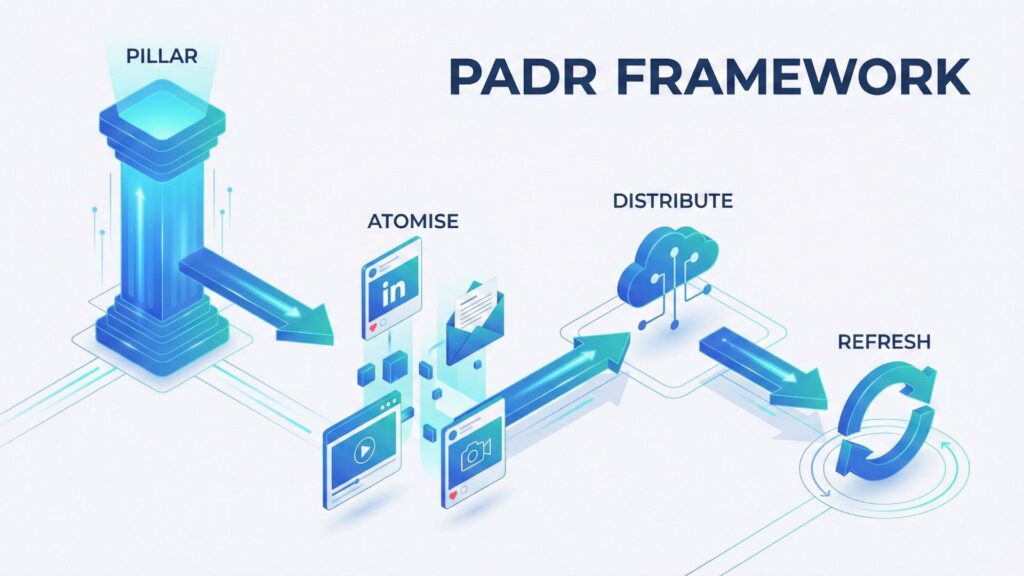
Producing content without a distribution and repurposing system wastes the investment. There are 3 efficiency frameworks that B2B marketers use to extract maximum value from every content asset.
The PADR Framework: Pillar, Atomise, Distribute, Refresh, turns one high-value pillar asset into a quarter’s worth of channel-ready content.
A 3,000-word original research report becomes a LinkedIn carousel, a three-part email marketing sequence, a webinar outline, and 6 social media posts. The Atomise step is where most B2B teams leave value on the table; they publish the report and move on rather than extracting every discussion-worthy insight from it.
Breaking content for micro-conversions means adding natural pause points, ‘Read the full report,’ ‘Download the template,’ or ‘Watch the 2-minute demo’, within long-form content.
These breaks let teams track specific engagement events and identify exactly where visitors convert or drop off, giving the content calendar data-driven guidance on what to produce next. A content management system (CMS) with event tracking built in makes this analysis straightforward.
The webinar flywheel works by treating every virtual event as a production run rather than a live broadcast. After the event, chop the recording into 5 to 10 short clips, each covering one key insight or addressing one common objection, and distribute each clip as a standalone lead generation asset on LinkedIn or YouTube.
Technical deep-dive webinars, in particular, produce clips that attract highly qualified prospects who are already deep in the evaluation phase of the buyer journey.
In Summary
The 15 B2B content marketing ideas covered here span interactive tools, original research, strategic SEO, community building, and repurposing systems. Taken together, they form a complete B2B content strategy that generates leads, builds authority, and compounds in value over time.
The most important principle connecting all 15 ideas is audience relevance. Survey your audience regularly, not just at the start of a campaign, but as an ongoing practice that feeds every content calendar decision.
Understand what their real problems are, not just the surface-level pain points your sales team hears most often, but the deeper operational and strategic challenges that keep your buyers from hitting their goals. B2B content ideas that connect to genuine buyer challenges will always outperform content created to fill a calendar.
The difference between a content programme that builds a pipeline and one that produces analytics noise is almost always specificity: specific problems, specific audiences, specific metrics.
Artificial intelligence is a useful production accelerator: it helps teams draft faster, repurpose more efficiently, and analyse content performance at scale.
But the B2B content marketing strategy that wins in 2026 will be built on human thinking, original research only your team can conduct, SME perspectives only your experts can provide, and community relationships only your people can sustain.
Use saved production time for deeper strategy, stronger positioning, and more precise targeting of your relevant audience. That investment in fundamentals is what turns a content programme into a lasting competitive advantage.