
B2B buyers complete nearly 60% of their purchasing process online before ever contacting a seller. That shift changes everything. Many marketers face lead leakage, nearly 80% of leads never convert due to poor follow-up, and struggle to manage complex, multi-touch journeys manually. Marketing automation is no longer just about scheduling emails. It is the engine for personalized, real-time customer experiences that scale.
By combining high-value content with automated workflows and AI, B2B marketers can increase efficiency, align with sales, and drive compounding ROI. Marketing Automation handles behavioral content triggers that respond to specific user actions. Dynamic content personalization tailors experiences based on firmographic data and engagement history. Predictive lead scoring identifies account-level buying intent across 6-10 decision-makers. AI-powered content insights optimize distribution across email marketing, social media marketing, and Landing Pages.
The core components include trigger-based marketing systems, personalized nurture sequences, account-based content journeys, and CRM integration for sales enablement automation. Marketing automation platforms like HubSpot, Marketo, Pardot, and Eloqua track multi-touch attribution through 6-18 month sales cycles. Content performance dashboards measure Marketing Qualified Leads (MQLs), Sales Qualified Leads (SQLs), and content marketing ROI.
The result is workflow content orchestration that transforms disjointed campaigns into cohesive Account-Based Marketing (ABM) strategies.
Why Automation is Critical for B2B Content Success
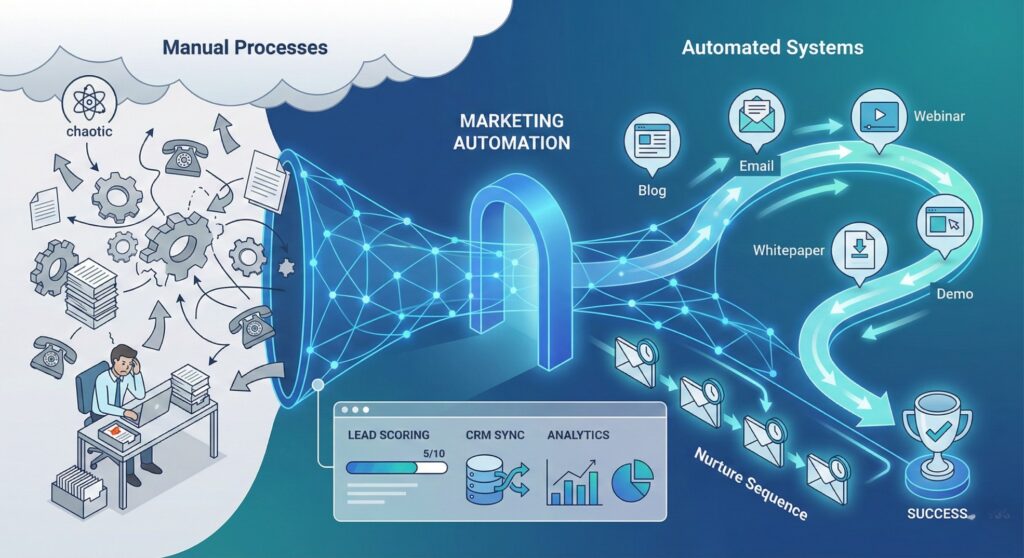
Nearly 80% of leads never convert due to poor follow-up. That’s not a sales problem. It’s a lead leakage problem that happens when manual processes can’t keep up with the volume and complexity of B2B customer journeys.
Content marketing delivers compounding ROI of 844% over 3 years. Paid advertising stops generating results the moment budgets dry up. Content assets continue attracting traffic, generating Marketing Qualified Leads (MQLs), and converting Sales Qualified Leads (SQLs) long after publication. Marketing Automation ensures this content reaches the right people at the right time through automated content distribution.
Marketing automation platforms increase sales productivity by 14.5%. That number comes from eliminating repetitive tasks. Email marketing automation handles scheduling. Lead scoring systems sort prospects automatically. Drip campaigns nurture leads without manual intervention. Sales teams spend less time on data entry and more time closing deals.
B2B SaaS buying cycles last 6–18 months and involve 6–10 decision-makers. Traditional last-click attribution models fail here. Someone might read a blog post in month 2, download a whitepaper in month 5, attend a webinar in month 8, and request a demo in month 11. Marketing Analytics through automation platforms tracks these multi-touch interactions and assigns proper attribution across the entire B2B marketing funnel.
HubSpot data shows companies using Marketing Automation see 451% increase in qualified leads. That’s not just more leads. It’s better leads. Lead Nurturing through automated workflows keeps prospects engaged until they’re actually ready to buy, not just when marketing decides to push them to sales.
The disconnect between marketing and sales costs revenue. Sales teams ignore 50% of marketing leads because they arrive at the wrong time or lack proper context. Automation fixes this through defined lifecycle stages and automated hand-offs. When a lead hits specific engagement thresholds, Customer Relationship Management (CRM) systems notify sales reps with complete interaction history.
Demand Generation through automation creates consistent pipeline flow. Instead of campaign-based spikes and valleys, automated nurture sequences maintain steady lead progression through the sales funnel. Trigger-Based Marketing responds to prospect behavior in real-time rather than following rigid campaign calendars.
Core Pillars of Automated Content Marketing
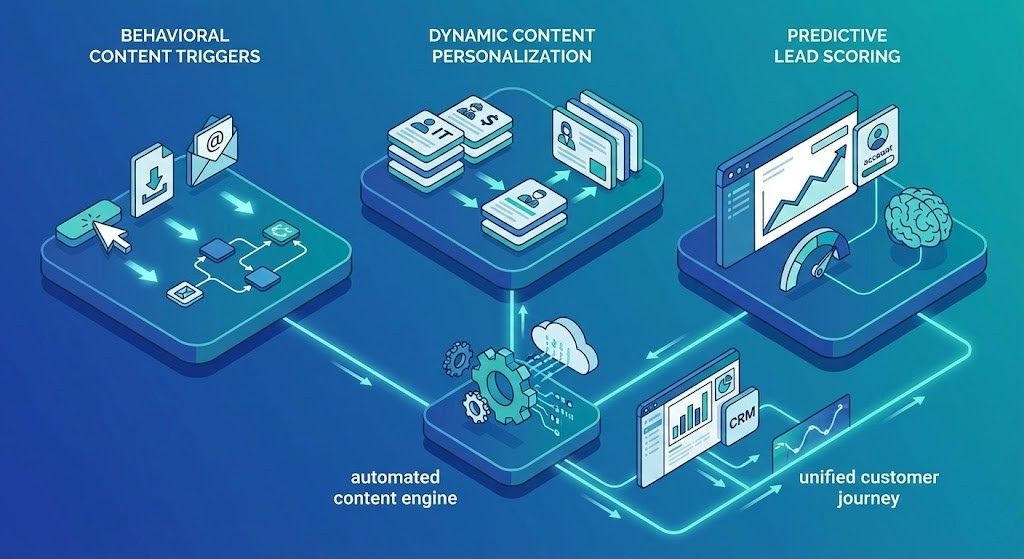
Behavioral Content Triggers
Generic email blasts don’t work in B2B. Behavioral content triggers send specific content based on user actions. Someone visits a pricing page at 2 PM. One hour later, they receive an email with a pricing guide and case study relevant to their industry. That’s trigger-based marketing.
Pardot and Eloqua excel at setting up these conditional workflows. If a prospect downloads a whitepaper about marketing automation ROI, the system triggers a follow-up sequence. Day 1: implementation checklist. Day 3: video tutorial. Day 7: invitation to product demo.
Frequency caps prevent message fatigue. Set maximum touch limits per week or month. HubSpot allows you to cap automated emails at 3 per week per contact. That prevents the same person from receiving 15 emails in 3 days when they engage heavily with your Content Management System (CMS).
Intent signal amplification works through third-party data. Tools like Bombora track when specific companies research topics related to your product. When a target account shows intent signals, automation platforms trigger account-specific content sequences. Sales enablement automation notifies reps that Account XYZ is actively researching solutions.
Best practice: Map triggers to specific content offers. Don’t send the same follow-up email regardless of which resource someone downloads. A technical whitepaper download should trigger different content than a high-level industry report.
Dynamic Content Personalization
Dynamic content personalization swaps specific content blocks based on user data. The same email template shows different images, product recommendations, and Call-to-Action (CTA) buttons depending on recipient attributes.
Marketo’s dynamic content feature segments by industry, company size, role, or previous interactions. A CFO at a 500-person company sees ROI calculators and cost-benefit analyses. A marketing director at a 50-person company sees implementation guides and quick-start templates.
Firmographic data tailors content to company attributes, not just individual behavior. Industry, revenue, employee count, and technology stack inform content selection. Adobe Marketing Cloud uses these firmographic signals to create hyper-segmented content delivery.
Website personalization extends this concept. Salesforce customers logging into a B2B content marketing portal see different homepage content than non-customers. First-time visitors see educational content. Return visitors see product-specific resources. High-value accounts see white-glove support options.
Email marketing automation platforms support 3 levels of personalization:
| Level | Personalization Type | Example |
| Basic | Name and company | “Hi Sarah from TechCorp” |
| Intermediate | Role and industry | Content focused on SaaS marketing challenges |
| Advanced | Behavior and stage | Resources matching their current buying stage |
Content Personalization builds trust. Recipients feel the interaction is a one-to-one conversation rather than mass communication. Open rates increase 26% with personalized subject lines. Click-through rates improve 14% with personalized content blocks.
Just-in-time content nudges deliver micro-content at decision moments. Someone viewing a product comparison page for 3+ minutes triggers a chat popup offering live assistance. That’s contextual content experiences based on real-time behavior.
Predictive Lead Scoring
Traditional lead scoring assigns points to individual actions. Downloaded ebook: +10 points. Visited pricing page: +15 points. Opened 3 emails: +5 points. That model fails in B2B because purchasing decisions involve buying committees, not individuals.
Account-based content journeys score the entire account. Combine three data types:
- Fit (Firmographic): Does this company match your Ideal Customer Profile (ICP)? Industry, revenue, employee count, tech stack.
- Intent (Third-party data): Is this company actively researching solutions? Bombora, G2, TechTarget data shows topic research activity.
- Engagement (First-party data): How is this account interacting with your brand? Website visits, content downloads, email opens, webinar attendance.
Salesforce Einstein and HubSpot predictive lead scoring use machine learning to identify which combinations of signals best predict conversion. The algorithm analyzes thousands of past conversions to determine which behaviors matter most.
When an account score crosses a threshold, automation triggers sales notification. The hand-off includes complete content consumption history. Sales sees which whitepapers the account downloaded, which webinars they attended, and which product pages they viewed.
Marketing Qualified Leads (MQLs) become account-level designations. Instead of “John from TechCorp is an MQL,” the system flags “TechCorp is a qualified account with 4 active contacts.” Sales Qualified Leads (SQLs) emerge when both score and human verification confirm readiness.
Attribution model optimization tracks which content pieces contribute to account progression. Did the pricing guide move them from awareness to consideration? Did the case study push them from consideration to decision? Content performance dashboards show ROI by asset type.
Cross-channel content integration connects behavior across platforms. Someone who clicked your LinkedIn ad, visited your site, and downloaded a resource isn’t three separate leads. They’re one account showing consistent interest.
Advanced Strategy: Integrating AI and Operations
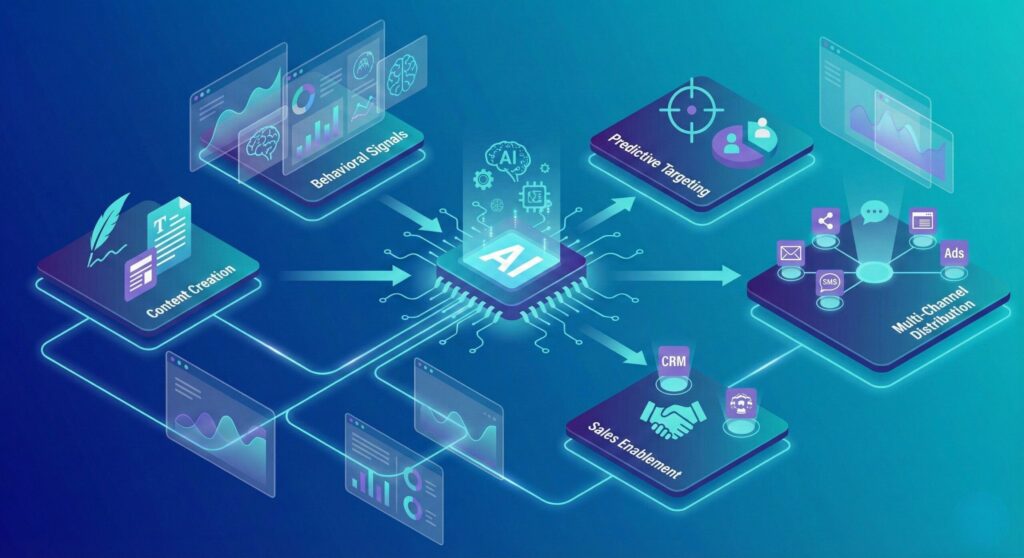
AI-Powered Content Insights
Predictive targeting uses AI to analyze behavioral signals and micro-interactions. Machine learning models identify patterns in pre-purchase behavior that humans miss. Someone who visits your blog 4 times in 2 weeks, spends 8+ minutes per session, and views 3 different product pages shows different intent than someone who bounces after 30 seconds.
AI search optimization creates content for conversational queries. Neil Patel calls this “ultra long tail” content. Instead of targeting “marketing automation,” create content answering “how does marketing automation reduce lead leakage in B2B SaaS companies with 6-month sales cycles?” That specificity ranks in AI-generated search results from Perplexity and Google Gemini.
Generative AI drafts content at scale. Use large language models (LLMs) to create first drafts, repurpose long-form content into social media posts, and generate A/B testing variations. Ann Handley emphasizes keeping a “human-in-the-loop” for quality assurance. AI writes the skeleton. Humans add expertise, personality, and fact-checking.
Automated content curation pulls relevant third-party content into nurture sequences. Joe Pulizzi’s Content Strategy framework recommends mixing owned, earned, and curated content. Automation platforms can pull industry news, research reports, and thought leadership pieces into email newsletters without manual compilation.
Smart content recommendations work like Netflix. Based on what similar companies consumed, the system suggests next-best content offers. Adobe Marketing Cloud analyzes content consumption patterns across thousands of accounts to predict which assets will resonate.
AI also detects content decay. Older assets with declining engagement get flagged for updates. Topic relevance scores drop when industry terminology shifts or competitor content improves.
Multi-Channel Orchestration
Multi-channel content integration coordinates messaging across email, social media marketing, SMS, and website. A prospect clicks a LinkedIn ad about marketing automation ROI. They land on a dedicated Landing Page. Two hours later, they receive a follow-up email. Three days later, an SMS alerts them to a webinar on the same topic.
Customer Data Platforms (CDPs) unify data from disparate channels. Salesforce CDP, Adobe Experience Platform, and Segment collect interaction data from every touchpoint. That unified view prevents redundant messaging and enables workflow content orchestration.
Conversational content automation extends to chatbots and AI assistants. Someone asking about pricing on your website at 11 PM gets immediate, relevant content from an automated assistant. The conversation history syncs to your Marketing Automation Platform, triggering appropriate follow-up sequences.
Account-Based Marketing (ABM) requires coordinated multi-channel plays. Target accounts receive coordinated outreach:
- Personalized direct mail arrives Monday
- LinkedIn ads start Tuesday
- Email sequence begins Wednesday
- Sales rep calls Friday with context from all previous touchpoints
Marketo and Pardot integrate with advertising platforms for closed-loop reporting. You can measure which ad impressions influenced content downloads and eventual pipeline.
Social Media Marketing automation schedules content distribution across platforms but also monitors engagement. When someone from a target account likes or comments on your LinkedIn post, automation can trigger a connection request or DM from a sales rep.
Sales Enablement Automation
The disconnect between marketing and sales costs revenue. Marketing creates content that sales teams never use. Sales teams ignore 50% of marketing leads because they arrive without proper context or at the wrong time.
SMarketing (Sales + Marketing Alignment) fixes this through Service Level Agreements (SLAs). Define exactly when a lead qualifies as sales-ready:
- Minimum lead score threshold
- Specific behaviors required (demo request, pricing inquiry)
- Account-level engagement requirements
- Response time commitments from sales
Eloqua and HubSpot automate lead routing based on these criteria. When all conditions are met, the system assigns the lead to the appropriate sales rep with complete interaction history. Reps see which content the prospect consumed, which pages they visited, and which topics interest them most.
Automated content curation creates sales-ready assets. Marketing maintains a library of case studies, one-pagers, and competitive battle cards. Sales reps access these through Salesforce or Microsoft Dynamics CRM. Usage analytics show which assets correlate with won deals.
Marketing automation ROI improves when sales actually uses marketing content. Track content consumption in sales conversations. If reps never send the whitepapers you created, either the content doesn’t address real objections or sales doesn’t know it exists.
Inbound Marketing brings leads to you, but sales enablement ensures proper follow-up. A 2019 study found companies with strong SMarketing alignment achieve 38% higher sales win rates and 36% better customer retention.
Implementation Roadmap: How to Start
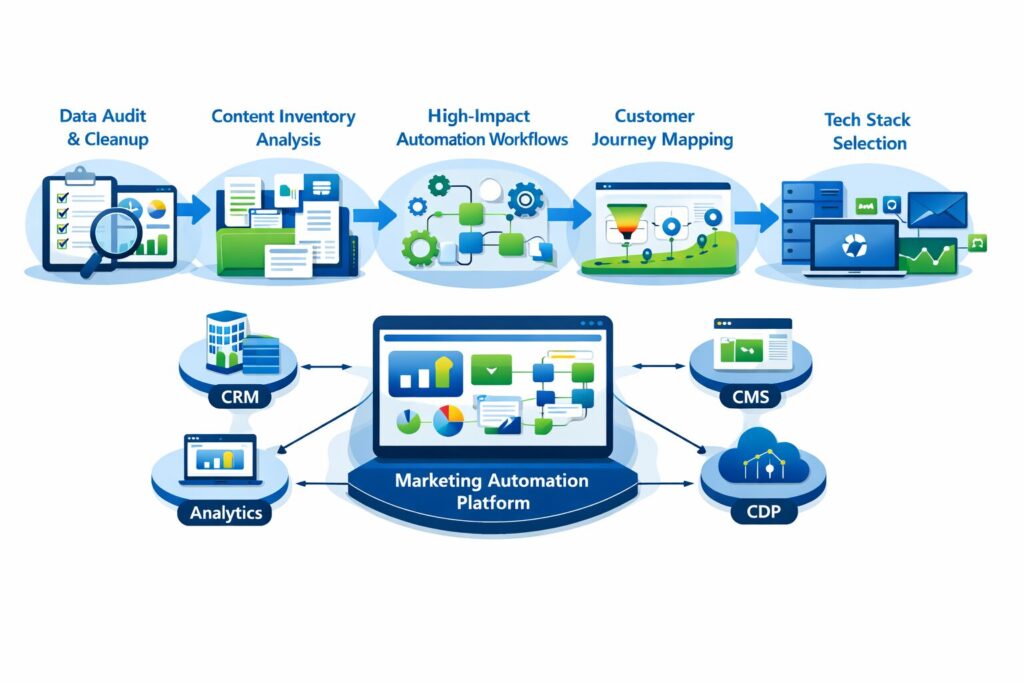
Audit Your Content and Data
Start with data centralization. Unclean or disorganized data leads to bad automation. Email addresses with typos. Duplicate contact records. Inconsistent company names (IBM vs. I.B.M. vs. International Business Machines).
HubSpot and Salesforce include data quality tools. Run deduplication reports. Standardize field formats. Establish data governance rules before automating anything.
Audit existing content to identify top performers. Use Marketing Analytics to find which blog posts generate the most leads, which whitepapers drive the most conversions, and which email subject lines achieve highest open rates. Those high-performers become the foundation of automated nurture sequences.
Content inventory spreadsheet should include:
- Asset type (blog, whitepaper, video, case study)
- Target buyer stage (awareness, consideration, decision)
- Topics covered
- Performance metrics (views, downloads, conversion rate)
- Maintenance status (current, needs update, outdated)
Search Engine Optimization (SEO) audit reveals content gaps. What queries are competitors ranking for that you’re not? Create content to fill those gaps, then automate distribution.
Start Small with High-Impact Wins
Don’t automate everything at once. Pick 1-2 high-impact workflows to test and refine.
Welcome email series for new subscribers:
- Email 1 (immediate): Thank you + top resource
- Email 2 (day 2): Educational content
- Email 3 (day 5): Case study
- Email 4 (day 7): Product overview + CTA
Abandoned form workflows for people who start but don’t complete forms. Track partial form completions through Marketo or Pardot. Send a reminder email 24 hours later with a simplified form.
Re-engagement campaigns for dormant contacts. Anyone who hasn’t opened an email in 90 days receives a “We miss you” sequence offering their choice of content topics. Their selection informs future automation.
Webinar follow-up automation segments attendees vs. no-shows. Attendees receive slides and recording plus next-step content. No-shows receive recording plus invitation to next webinar.
Map the Customer Journey
Define lifecycle stages before building automation. Common B2B lifecycle:
- Subscriber: Email list member, no significant engagement
- Lead: Downloaded content, attending webinars, researching
- Marketing Qualified Lead (MQL): Hit score threshold, matches ICP
- Sales Qualified Lead (SQL): Verified by sales, active opportunity
- Opportunity: In active sales process
- Customer: Closed won
- Evangelist: Active referrer, case study participant
Map content to each stage. Subscribers need educational content about the problem. Leads need solution-focused content. MQLs need product-specific information. SQLs need pricing, implementation details, and customer proof.
Content Strategy maps specific assets to specific questions at each stage:
| Stage | Primary Questions | Content Types |
| Awareness | Do I have this problem? | Blog posts, infographics, research reports |
| Consideration | What solutions exist? | Comparison guides, webinars, expert interviews |
| Decision | Why this solution? | Case studies, product demos, ROI calculators |
| Retention | How do I maximize value? | Training videos, best practice guides, community access |
B2B Lead Generation focuses on moving prospects through these stages efficiently. Automation ensures each interaction delivers relevant value.
Select the Right Tech Stack
Marketing Automation Platforms (MAPs) form the core. Major options:
HubSpot: Best for small to mid-size B2B companies. Native CRM integration. Strong content management system. Pricing scales with contact volume.
Marketo (Adobe Marketing Cloud): Enterprise-grade with advanced segmentation and revenue attribution. Steeper learning curve. Better for companies with dedicated marketing ops teams.
Pardot (Salesforce): Built specifically for B2B. Deep Salesforce integration. Account-based marketing features. Einstein AI for predictive lead scoring.
Eloqua (Oracle): Enterprise solution for complex multi-touch campaigns. Advanced canvas interface for workflow building. Higher cost, requires implementation partner.
CRM Integration is non-negotiable. Marketing automation software must sync bidirectionally with your Customer Relationship Management system. Lead data flows from MAP to CRM. Sales activity data flows from CRM to MAP.
Additional tools in the stack:
- Content Management System (CMS) for website content
- Customer Data Platform (CDP) for unified customer profiles
- Analytics platforms for attribution modeling
- ABM platforms for account-based plays
- Webinar software with MAP integration
Test integrations before committing. Does your email marketing automation tool sync with your webinar platform? Can your MAP pull intent data from third-party sources?
Pitfalls to Avoid & Ethical Considerations
The Set-It-and-Forget-It Trap
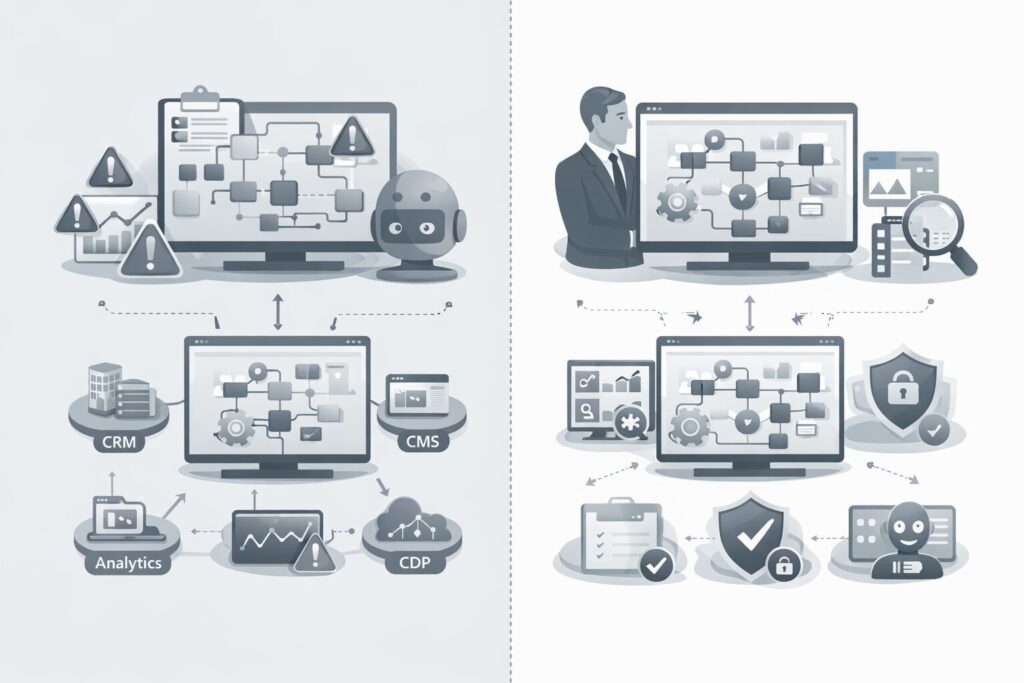
Automation requires continuous testing and refinement. Email open rates decline over time. Content relevance degrades as industries evolve. Workflows that converted well in 2024 may underperform in 2026.
Implement regular A/B testing:
- Subject line variations
- Email send times
- Content offer types
- Landing Page layouts
- Call-to-Action (CTA) wording
HubSpot recommends reviewing automation workflows quarterly. Check key performance indicators:
- Open rate trends
- Click-through rate trends
- Conversion rate by workflow
- Time from MQL to SQL
- Content ROI by asset
Marketing automation benefits don’t materialize on autopilot. Adaptive content governance means someone owns workflow performance. Assign responsibility for monitoring, testing, and optimizing automated campaigns.
Privacy-First Automation
GDPR and CCPA require explicit consent for data collection and automated communication. Double opt-in processes confirm email subscription intent. Preference centers let contacts choose communication frequency and topics.
Pardot and Marketo include consent management features. Track consent status by region. European contacts require explicit GDPR consent. California contacts need CCPA disclosure and opt-out ability.
Data-driven content personalization must balance relevance with privacy. Using firmographic data to tailor content is acceptable. Using sensitive personal data crosses ethical lines.
Privacy-first automation practices:
- Clear unsubscribe options in every email
- Preference centers for communication control
- Transparent data usage policies
- Regular data retention audits
- Consent re-confirmation for dormant contacts
Marketing technology platforms increasingly include privacy features by default. Salesforce Einstein flags records missing required consent. HubSpot blocks emails to contacts without proper subscription status.
Ethical AI and Bias
AI algorithms can perpetuate bias. If historical data shows certain industries convert better, AI may deprioritize other industries even when individual accounts show strong intent.
Algorithmic transparency means understanding how AI makes decisions. When using predictive lead scoring, audit which factors carry the most weight. If company size dominates the model, smaller companies with strong intent get undervalued.
Manipulative targeting crosses ethical boundaries. Using psychological vulnerabilities or creating false urgency through automation damages trust. Countdown timers showing “limited time offers” that reset daily are deceptive.
Anthropic’s work on AI safety emphasizes alignment with human values. Marketing automation should facilitate informed decision-making, not manipulate prospects into poor choices.
Regular algorithm audits check for:
- Industry or demographic bias in scoring models
- Over-targeting specific individuals
- Content that preys on fear or anxiety
- False scarcity or urgency tactics
Ann Handley emphasizes that ethical content marketing builds long-term relationships, not short-term conversions. Automation should scale good practices, not amplify manipulative ones.
In Summary
Marketing automation transforms B2B content marketing from a series of disjointed campaigns into a cohesive, behavioral-driven journey. By moving away from generic schedules, businesses can utilize behavioral triggers and dynamic adaptation to deliver personalized experiences at scale.
This strategy is particularly effective for account-based journeys, as it aligns with the reality of B2B purchasing, targeting entire buying committees rather than isolated leads. Leveraging AI and platforms like HubSpot or Marketo allows for predictive targeting and multi-touch attribution, ensuring engagement remains consistent across long-term sales cycles.
Successful implementation requires a foundation of data centralization and clear journey mapping to answer specific buyer questions at every lifecycle stage. Beyond just “setting and forgetting,” the most effective marketers treat automation as an ongoing optimization system that bridges the gap between marketing and sales through automated lead routing and defined SLAs.
Given that content marketing can deliver an 844% ROI over three years, companies that automate their workflows today will secure a massive competitive advantage over those still relying on manual, unscalable processes.