

GreenGeeks is worth it for B2B teams running content-heavy sites, marketing blogs, or lightweight lead generation pages. It is not the right choice if you need enterprise uptime SLAs, granular team permissions, or a hosting provider your IT team can audit for SOC 2 compliance. For most solo operators and small B2B marketing teams publishing content to drive organic traffic, GreenGeeks hits a useful sweet spot: solid performance, genuine eco credentials, and a price point that makes sense before you add agency management overhead.
GreenGeeks at a Glance
GreenGeeks launched in 2008 and now hosts more than 600,000 websites for over 55,000 customers. The company offsets 300% of its energy consumption through renewable energy credits purchased from the Bonneville Environmental Foundation, one of the most established renewable energy nonprofits in the United States. It has been an EPA recognized green power partner since 2009 and plants one tree per account through its partnership with One Tree Planted.
Performance data from independent testing shows a 734ms average page load time (GTmetrix A grade), a Largest Contentful Paint of 487ms, and 99.97% uptime over a 30-day monitoring window. Load tests at 50 concurrent users showed stable response times without notable degradation. For a B2B content site expecting steady SEO-driven traffic rather than traffic spike campaigns, those numbers are more than adequate.
Pricing starts at $2.95/month for the Lite plan, $4.95/month for Pro, and $8.95/month for Premium on introductory rates. VPS hosting runs $39.95 to $109.95/month. Every shared plan includes a free SSL certificate, a free domain for the first year, and unlimited email accounts. The catch, and it is a meaningful one, is that renewal prices climb significantly above those introductory rates.
The B2B Hosting Fit Score
Most GreenGeeks reviews score the host on generic criteria: uptime, speed, support quality, value for money. Those metrics tell you whether GreenGeeks works as a host. They do not tell you whether it works for your specific B2B use case.
The B2B Hosting Fit Score rates GreenGeeks across four dimensions that actually drive decisions for B2B marketing teams: Content Performance (can it handle a high-volume WordPress blog without degrading?), Business Continuity (what are your exposure levels during an outage?), Team Scalability (can multiple contributors work in the environment without friction?), and Compliance Fit (does the setup meet your buyers’ vendor expectations?).
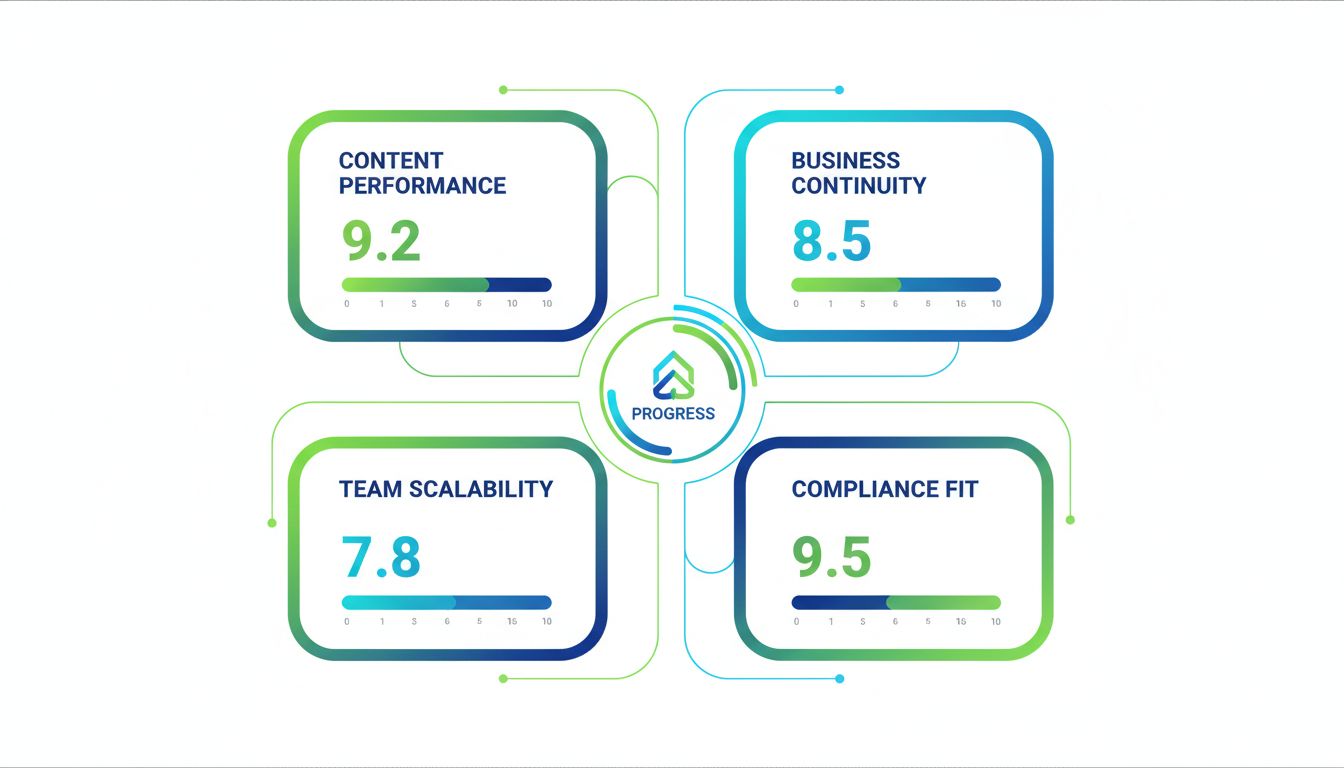
Here is how GreenGeeks scores on each dimension:
- Content Performance: 8/10. The shared hosting stack handles WordPress well. LiteSpeed web server with LSCache is genuinely fast for content-heavy blogs. Performance degrades if you run heavy WooCommerce operations or high-volume campaign landing pages on the Lite plan without caching optimization.
- Business Continuity: 7/10. 99.97% uptime is solid. There is no SLA with financial accountability for downtime. Managed backups are daily, not real-time. For most B2B content sites this is adequate. For sites tied directly to pipeline generation or active ad campaigns, the lack of a contractual uptime guarantee is worth noting.
- Team Scalability: 6/10. One cPanel account per plan. Adding team members requires shared credentials or sub-account setup. No native multi-user dashboard. If you are a solo operator or a two-person marketing team, this is a non-issue. Larger teams will feel the friction.
- Compliance Fit: 5/10. No SOC 2 report. No detailed security white papers accessible for procurement review. GreenGeeks does not position itself as an enterprise-grade provider, and its documentation reflects that honestly. If your buyers’ IT teams ask about your hosting environment during a security review, a GreenGeeks shared plan will not satisfy that conversation.
Total B2B Fit Score for a content marketing site: 26/40. That is a solid pass for the specific use case of organic content-led growth. It is not a pass if your primary use case is SaaS landing pages, client portals, or anything requiring enterprise accountability standards.
Performance Numbers That Actually Matter for B2B
Affiliate link — we earn a small commission at no extra cost to you.
A 734ms average load time sounds abstract. Here is the context that makes it meaningful: page speed directly affects how long visitors stay before bouncing, and for B2B content sites where the goal is organic ranking plus time-on-page, load time compounds with content quality to determine whether you convert a reader into a subscriber or lead.
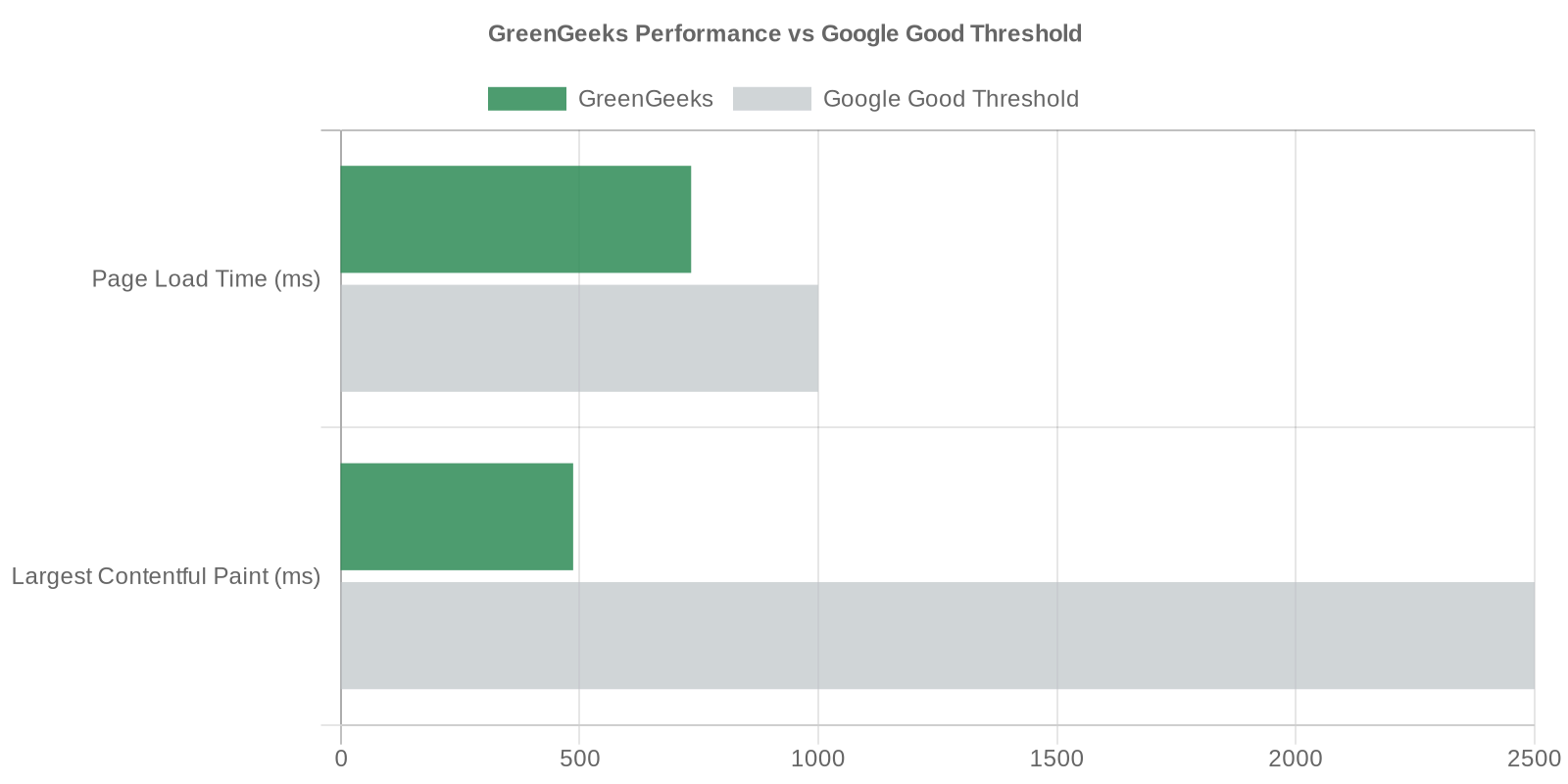
GreenGeeks runs LiteSpeed web server with LSCache enabled by default on all plans. That stack is meaningfully faster than the Apache configuration most budget shared hosts use. The CDN integrates Cloudflare. PHP 8.2 is available and recommended. These are actual infrastructure choices, not marketing language, and they translate to faster Time to First Byte numbers in practice.
The honest caveat for B2B teams: shared hosting performance is variable under sudden load. If a LinkedIn post drives a traffic spike you did not plan for, you are on shared resources with other sites on the same server. GreenGeeks handled 50 concurrent users cleanly in load testing. Beyond that threshold, particularly if you are running active paid campaigns in parallel with your organic content operation, the $39.95/month VPS entry point starts to justify itself faster than pushing a shared plan to its limits.
For most B2B content marketing operations, though, the traffic profile is steady and predictable. SEO-driven organic traffic does not spike the same way paid does. Shared hosting from GreenGeeks is a rational fit for the typical content operation at the scale most of these sites actually run.
Pricing and the Renewal Trap
The introductory pricing is real. So is the renewal pricing, and the gap between the two is where most critical reviews of GreenGeeks originate. The Lite plan at $2.95/month is what you pay upfront for a multi-year initial term. When that term expires, you pay the standard renewal rate. GreenGeeks does not display the exact renewal rates prominently on its main pricing pages, which is a transparency issue worth flagging before you commit.
The practical guidance for B2B buyers: calculate total cost of ownership over two to three years before comparing against competitors. If you are evaluating GreenGeeks against Hostinger, the renewal rate gap narrows the apparent price difference considerably. The B2B web hosting comparison on this site covers the renewal math across the main options in detail.
One actionable option: lock in the longest initial term at the intro rate that you are confident you will actually use the site through. A 36-month commitment at $2.95/month gives you three years before renewal pricing applies. For a B2B content site generating real organic traffic by month 12, the hosting cost conversation looks very different against that ROI context than it does on day one of the account.
GreenGeeks vs. the Alternatives for B2B Teams
Here is how GreenGeeks compares to the options B2B content teams most commonly evaluate:
| Host | Best For | Entry Price | Performance Standout | B2B Weakness |
|---|---|---|---|---|
| GreenGeeks | B2B content sites with ESG angle | $2.95/mo | LiteSpeed + LSCache, 734ms avg load | Renewal price spike, no SOC 2 |
| Hostinger | Budget-focused solo operators | $2.99/mo | LiteSpeed stack, competitive speeds | No eco story, thinner enterprise support |
| SiteGround | Teams needing managed WordPress | $3.99/mo | Google Cloud infrastructure, staging | Higher price, aggressive renewal increases |
| Kinsta | Revenue-generating B2B sites | $35/mo | Google Cloud, dedicated containers | Significant cost for low-traffic content sites |
For a B2B team whose primary goal is organic content marketing, GreenGeeks and Hostinger are the serious contenders at the budget tier. The choice comes down to one honest question: does the eco angle matter to your business or your buyers? If yes, GreenGeeks wins that dimension by a clear margin. If not, the decision is pure performance and renewal-math comparison.
When the Green Angle Actually Helps Your Business
The 300% renewable energy match is not marketing fluff. It is a documented commitment backed by third-party renewable energy certificates from the Bonneville Environmental Foundation, with independent EPA verification going back to 2009. That is a verifiable, auditable claim, not a self-reported badge.

This matters for B2B companies in specific situations. If your company publishes an annual sustainability report, noting that your digital infrastructure runs on green hosting is a defensible, sourceable claim. If your buyers come from industries with strong ESG commitments, such as financial services firms with published net-zero targets, professional services companies tracking scope 3 emissions, or enterprise tech organizations with climate pledges, the hosting choice becomes part of your own vendor story in conversations about responsible supply chain decisions.
This is not a reason to choose GreenGeeks if the performance and price do not already work for your situation. But if those fundamentals do work, the eco credential is a real differentiator that no other host at this price tier can match. For B2B content marketers whose editorial focus includes sustainability, ESG, or responsible business practices, there is also a credibility signal in operating infrastructure that reflects your content positioning. Your content marketing ROI is not purely traffic. It includes brand coherence signals like this one.
What Most B2B Teams Get Wrong When Choosing GreenGeeks
The most common mistake is treating GreenGeeks as a short-term option to grow out of. Teams sign up at the intro price, grow the site over 18 months, hit the renewal rate, and switch hosts. The migration cost in time, the temporary SEO disruption from a domain transfer or DNS change, and the setup overhead on a new host often exceed the money saved by switching. If you are going to use GreenGeeks, commit to the full initial term and treat it as your hosting home for at least three years.
The second mistake is starting on the Lite plan without checking its actual limits. Lite allows one website only. If you have any expectation of running a second property, a subdomain campaign site, or a client site from the same account, the Lite plan forces an unplanned mid-contract upgrade. Start on Pro if there is any reasonable chance you will need multiple sites within two years.
The third mistake is using GreenGeeks’ included email as your primary business email. The cPanel email hosting works, but it ties your email deliverability to your hosting account’s IP reputation. If your hosting IP ends up on a shared blacklist because of another tenant on the server, your business email is affected. Separate email infrastructure, Google Workspace being the standard choice for B2B teams, decouples that risk entirely. Use GreenGeeks for the website. Use a dedicated platform for business email.
Frequently Asked Questions
Is GreenGeeks good for WordPress?
Yes. GreenGeeks runs LiteSpeed web server with LSCache, which is well-optimized for WordPress. They offer one-click installs, automatic updates, and staging environments on Pro and Premium plans. Performance testing consistently places GreenGeeks in the faster tier of shared WordPress hosts at this price point.
Does GreenGeeks actually use renewable energy?
GreenGeeks purchases renewable energy certificates that offset 300% of their energy use. This is not the same as operating data centers directly on renewable power, but it is a real and verifiable environmental commitment. They partner with Bonneville Environmental Foundation for the RECs and have held EPA green power partner status since 2009.
How does GreenGeeks compare to SiteGround?
Both offer solid WordPress hosting. SiteGround runs on Google Cloud and offers more advanced staging and team collaboration features, making it a better fit for marketing teams that need environment management. GreenGeeks is cheaper on introductory rates and adds the eco credential SiteGround does not match. For solo B2B content operators, GreenGeeks is the better value. For growing teams that need staging and access controls, SiteGround’s features justify the higher cost.
What is the renewal price for GreenGeeks?
GreenGeeks does not display renewal rates prominently on its pricing pages. The renewal prices are higher than the introductory rates, and the exact amount depends on plan and term length. Before purchasing, contact GreenGeeks support directly to get the renewal rate for your chosen plan. Factor that number into your total cost calculation before committing to any term length.
Is GreenGeeks suitable for a B2B agency managing client sites?
It works with limitations. You will need the Pro or Premium plan to host more than one site. GreenGeeks does not have a white-label reseller dashboard or native multi-client management tooling. For an agency with a handful of client sites on a constrained budget, it is workable. For anything larger or more operationally complex, a purpose-built reseller hosting product or a managed WordPress platform makes more sense.
Does GreenGeeks offer a money-back guarantee?
Yes. GreenGeeks offers a 30-day money-back guarantee on shared hosting plans. Domain registration fees are not included in the refund. If you cancel within 30 days and did not register a new domain through the account, you get a full refund on the hosting cost.
Affiliate link — we earn a small commission at no extra cost to you.
What To Do Next
If you are evaluating GreenGeeks for a B2B content site, here is the decision path. You can review their current plan pricing directly at GreenGeeks.com. If your primary use case is organic content marketing and your site is unlikely to see more than 50 concurrent users on a typical day, the Lite plan at the introductory rate is a sound starting point. Ask support for the renewal rate before committing and factor it into a three-year total cost view before comparing against alternatives.
If you need multiple sites or expect your content operation to grow, start on the Pro plan. The price difference is small compared to the friction of an unplanned mid-contract upgrade later on.
If the eco angle matters to your business narrative, GreenGeeks is the only host at this price tier that can substantiate the claim with third-party verification. If it does not matter and you are optimizing for cost or team features, the full B2B hosting comparison covers alternatives that may fit your specific situation more precisely.
