

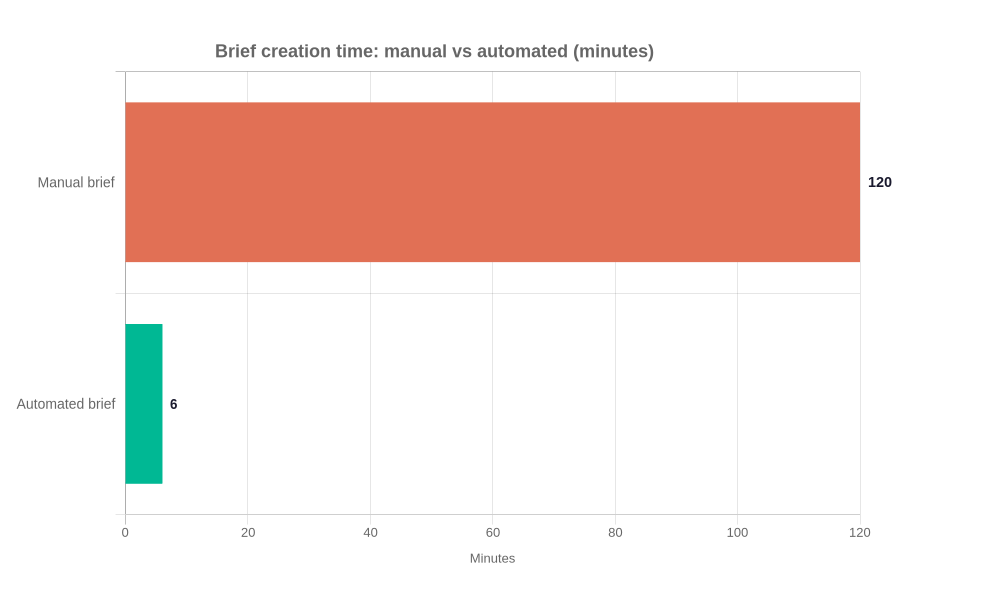
You do not need to write faster. You need to brief better. Content brief creation is the bottleneck that makes teams miss editorial calendars, and it is also the easiest place to automate without surrendering quality. Automating the brief that a writer starts from is very different from automating the writing itself. Done right, it cuts brief creation time from about two hours to minutes, gives every piece a consistent research foundation, and leaves the human room to be original.
What automating a content brief actually means
Automating a content brief does not mean asking an AI to rewrite a title. It means building a system that assembles the research a writer needs before they write: target keyword and search intent, competitor headings, semantic and secondary keywords, suggested structure, internal linking candidates, and the sources to cite. The output is a document, not a finished article.
That distinction matters. When teams try to skip straight to automated articles, they trade strategic positioning for speed and get copycat, keyword-stuffed text that mirrors whatever already ranks. Writers either ignore it or spend as much time rewriting as they would have spent writing. When teams instead automate the brief, they free writers to do the work AI cannot: real audience insight, subject matter expertise, and brand voice.
One senior B2B content manager put the effect plainly. At Hack The Box, content manager Hassan Ud-deen used a repeatable briefing and content engine approach and credited it with a 78% boost in organic traffic and a 45% year-over-year increase in page-one rankings. The brief came first. The writing followed.
Why most brief automation fails: the copycat trap
Most brief tools scrape the top ten search results and tell a writer to reproduce what is already ranking. That approach builds the AI echo chamber in miniature. Every page on page one repeats the same headings, the same facts, and the same examples. A brief that only copies them produces content with zero information gain. Google and AI engines both favor pages that add something the top ten do not have.
The result is a cost hidden in plain sight. Teams see faster briefs and more production, yet traffic stays flat. The automation delivered efficiency, not differentiation. A static brief that never measures what happened after publication also locks in those weak choices.
Here is the honest benchmark from the research. About 73% of marketing teams say they struggle to produce enough content to meet their editorial calendars. That is not a writing shortage. It is a pipeline shortage caused by slow, manual briefs and fuzzy prioritization. The fix is a feedback loop inside the brief, not a faster template.
The strongest automated briefs answer four questions that copycat templates ignore. What position does this page own in the topic cluster? Which search intent stage does it serve? What original angle makes it worth reading? And how will we know, six weeks from now, whether the brief was right? That last question is the one almost everyone leaves out.
The Information-Gain Brief Loop: an original framework
The Information-Gain Brief Loop, or IG Brief Loop, ties the brief to live performance so it improves on its own. It has four stages: Feed, Frame, Publish, Measure. Most teams stop after Frame and never close the loop.

Feed pulls in data from three places, not just the SERP. It mixes competitive search data with first-party inputs such as customer surveys, support ticket patterns, and SME interview transcripts. This is the step that prevents the echo chamber, because it forces original material into the brief.
Frame turns that raw input into a writer-first briefing document with a target keyword, an explicit intent stage, a required original angle, a skeleton of H2s, internal linking candidates, and one explicit instruction on what this page must say that page one does not.
Publish is the handoff. The writer follows the frame but owns the voice and the narrative. The brief leaves room for the human to dissent.
Measure closes the loop. Eight to twelve weeks after publish, you map traffic, ranking, and conversion data back to the brief decisions that produced the piece. The system then demotes failing keywords, promotes working structures, and feeds the learning into the next round of briefs.
The loop turns a static template into a system that gets better every cycle. The research on closed-loop briefs shows the payoff. Teams that map published performance back to brief inputs report reduced brief creation time, fewer writer revisions, and higher correlation between briefs and content that actually performs. Three metrics matter most: brief creation time, writer revision frequency, and content performance correlation to the brief.
A step-by-step workflow to automate brief creation
Here is a repeatable workflow you can stand up in a week. It assumes no custom engineering is required, only the tools and data most B2B teams already have.
- Standardize a template. Build one brief structure with fixed dropdowns for audience persona, funnel stage, and content type, plus numeric ranges for length. Fixed fields make automation possible. Free-form text does not.
- Connect your data sources. Pipe in search volume and competitor data from your SEO tool, query data from Search Console, and any internal notes from your CRM. The goal is a brief that carries its own research instead of asking a writer to go find it.
- Add the non-SERP inputs. Attach one customer survey, one support ticket pattern, or one SME note to every brief. This single step is what separates original content from cloned content. Without it, the brief is a copy machine.
- Generate a skeleton, not a script. Have the system draft the H2s, the primary and secondary keywords, and the internal linking candidates. Leave the narrative, the examples, and the voice to the writer. The brief directs the shape; it does not dictate the sentences.
- Install a human check. Route every brief past a content manager or the writer for approval on angle and brand voice before it becomes a drafting assignment. Automation handles data. Humans handle judgment.
- Measure the loop. After publish, record the brief decisions. Eight to twelve weeks later, compare them against traffic and rankings and feed the result back into step two.
Here is a worked example. Imagine a small B2B team that produces four blog posts a month. Their manual briefing process takes about two hours per post, or eight hours a month, and writers still get briefs that say little more than a keyword and a title. Once they standardize the template and connect Search Console and their SEO tool, brief creation drops to about twenty minutes per post. The brief now arrives with competitor headings, a target intent stage, and one required original angle pulled from a customer survey they ran last quarter.
The measurable result is less dramatic than a vendor case study but more honest. The team moves roughly four hours a week from research drudgery back to writing and strategy. Revisions drop because the brief and the writer finally agree on what the piece is for. Traffic per post climbs because each brief now contains at least one angle the top ten pages do not share.
Build, buy, or hybrid: a decision matrix
Choosing how to automate is a real fork, and the right answer depends on your volume, your budget, and your in-house engineering capacity. The table below gives you a working comparison.
For a team publishing a handful of posts a month, a paid tool paired with a performance-tracking spreadsheet is the sweet spot. You get automated competitor and keyword research without paying for a platform scaled to agencies.
For context on price, brief-focused tools cluster in two bands. Entry plans run from about $19 to $49 a month and cover a handful of briefs or a small content calendar. Mid-tier plans, which include things like Frase at about $45, Surfer at about $99, Content Harmony at about $99, and MarketMuse at about $99, suit a team producing several posts a week. Agency plans climb into the hundreds. The one signal worth paying for is a live feedback loop between briefs and published performance, because that is the feature that fixes the copycat problem over time.
The build route makes sense only when you already engineer content tooling or when your differentiation depends on proprietary data that no vendor ingests. A lightweight Scripts-and-API pipeline can pull your internal metrics into a brief generator, but it is weeks of work and ongoing maintenance, not a weekend project.
Which tool fits your workflow
Named tools differ less on features than on where they sit in your stack. Frase and Surfer act like writing companions, scoring your draft against live SERPs as you type, which suits teams that want optimization inside the editing step. MarketMuse and Topical Map AI lean toward topic architecture, building the clusters and coverage map before a single draft exists, which suits teams that plan a month of content at once. Content Harmony is a stand-alone rapid brief generator that suits agencies handling many clients.
Match the tool to the step you want automated. If your biggest drag is planning, buy a topic-architecture tool. If your drag is editing and optimization, buy a companion-style tool. If your drag is volume across clients, buy a rapid-brief tool. Never buy a tool that does not let you inject your own inputs, because that is the exact feature that keeps originality in the loop.
Whatever you choose, keep the tracking layer separate and cheap. A spreadsheet that records the three loop metrics will work fine for years, and it avoids locking your process inside one vendor. The tool can change; the loop and its data stay yours.
What most teams get wrong
Three mistakes show up again and again, and each one quietly eats the ROI of brief automation.
They automate the writing instead of the brief. This is the biggest one. Teams see AI output and assume the answer is full automation of articles. The result is volume without differentiation, and senior readers can smell it. Keep the AI on research and structure. Keep the human on the words.
They leave the loop open. A brief is a hypothesis about what will rank. If nothing measures what happened after publish, the brief never improves and the same weak choices repeat every cycle. The teams that see compounding results close the loop with performance data.
They feed the machine only the SERP. A brief built solely from competitor headings copies the average. The entire point of a brief is to aim above average. Route in at least one first-party input, whether that is a survey, support data, or an SME conversation, so the brief carries an angle the SERP cannot supply.
How to keep the writer in the loop
The biggest unaddressed risk in brief automation is writer friction. AI-generated briefs often feel rigid, unnatural, and overly prescriptive, and writers respond by ignoring them or burning hours rewriting the guidance before they write anything new. The fix is a writer-first design.
Make each section of the brief a starting point, not a mandate. Give writers the intent, the audience, and the required original angle, then let them decide the narrative. Add one explicit instruction on what the page must say that page one of the rankings does not. That single line turns a template into an invitation to think.
This is also where a decision matrix earns its keep inside the brief. Rather than telling the writer the answer, the brief can present the options the research surfaced and let the writer make the call. The automation does the reporting; the human does the deciding. Pair this with a branded review checkpoint so voice stays consistent without constraining every sentence.
If you manage a distributed team, the loop still works. Standardize the fields, route every brief through one approval step, and measure the same three metrics across every writer so the baseline is comparable. The method scales because the system, not any single person, holds the institutional memory.
Frequently asked questions
How long does it take to automate content brief creation? A basic setup with an existing SEO tool takes a few days, mostly template design and connecting data sources. A full loop that feeds published performance back into briefs takes a few weeks because you need a couple of post-publication cycles to have data to measure.
Does automating briefs hurt originality? It can, if you feed the brief only competitor headings. It protects originality when you also route in first-party inputs like surveys, support data, and SME notes, and when you leave the narrative and voice to the writer. The brief directs the shape; the human owns the words.
What is the difference between automating the brief and automating the writing? Automating the writing produces copycat articles with little differentiation. Automating the brief produces a research-backed starting document that frees the writer to do original work. The brief is the automation target if you care about ranking.
What tools should a small B2B team use? Start with a brief-focused tool in the $19 to $99 per month range, paired with a tracking spreadsheet for the performance loop. Build your own pipeline only when you have engineering capacity and proprietary data no vendor ingests.
How do I measure whether brief automation works? Track three metrics: brief creation time, writer revision frequency, and the correlation between brief decisions and published performance. If briefs get faster, writers revise less, and pieces built from closed-loop briefs outperform the rest, the system is working.
Do automated briefs help with AI search and GEO? Yes, when they are built for it. Because AI search is conversational, briefs should ask writers to frame content as direct, authoritative answers to buyer research questions rather than keyword strings. The same semantic clusters that signal topical authority to search engines help AI engines cite you.
What to do next
Start with one templated brief for your next post. Add a customer survey or SME note as the required original input. Publish, measure at eight to twelve weeks, and adjust the template with what you learn. That single closed loop is the entire system. You do not need a software purchase to begin.
If you do not have a brief template yet, build one before you buy anything. Structure it around the four questions from the IG Brief Loop: what position the page owns, what intent stage it serves, what original angle it brings, and how you will know whether the brief was right. Once that exists, connecting your SEO data and closing the loop is straightforward.
For teams that post frequently, this pairs well with a production tracker and a clear content workflow so briefs move to drafts without losing the original angle. On a lean team, the human-in-the-loop AI workflow keeps quality high while automation handles the research. If originality under AI pressure is your concern, tie the brief loop to first-party research that AI engines cite. The brief is where the whole effort starts.
