

You Need All Three. The Real Question Is Where to Put Effort.
SEO, AEO (answer engine optimization), and GEO (generative engine optimization) are not three separate jobs. They are three layers of one visibility system, and any guide that forces you to pick between them is missing the point. The direct answer: keep classic SEO as your baseline, add the AEO structure layer to your best pages, and build GEO consensus signals over time. This post gives you the decision matrix to know which one deserves your next hour, and a single workflow to optimize one asset for all three without tripling your workload.
Here is why this matters right now. 84% of B2B buyers now use AI tools during discovery, up from 24% a year earlier (Wynter 2026 buyer research, cited by Column Five). More than 65% of Google searches end without a single click (Column Five 2026). An LLM cites only two to seven domains per answer (Princeton and Search Engine Land 2026), so the competition for an AI mention is far tighter than a traditional page-one listing. If your content cannot be extracted and quoted, in 2026 it essentially does not exist for a huge slice of your buyers.
The good news: the playbook is learnable and it is not a huge new budget line. Let me show you exactly what each discipline does, how they fit together, and how a lean B2B team ships one piece of content optimized for all three.
What SEO, AEO, and GEO Actually Are (in Plain Terms)
SEO, AEO, and GEO each answer a different question from a different engine surface. SEO gets you found by classic search. AEO gets you quoted by an AI answer. GEO gets you recommended when an LLM synthesizes a multi-source answer. They look similar on the surface but serve different moments of the buyer journey.
- SEO (search engine optimization). The established discipline of ranking in Google, Bing, and other classic results. You optimize titles, meta, content, and technical crawlability to win a click from a blue link. Its KPIs are clicks, click-through rate, and organic sessions.
- AEO (answer engine optimization). Structuring content so an AI assistant extracts one clean, self-contained answer from your page. You lead sections with direct 40 to 60 word answers, use clear headings, machine-readable tables, and schema. Its KPI is citation frequency per question.
- GEO (generative engine optimization). Building off-page proof so an LLM recommends you when it synthesizes an answer across sources. Analyst mentions, reviews, LinkedIn, YouTube, and original data all feed this. Its KPI is share of model and brand accuracy in AI answers.
One way to hold them: SEO is about the web page you rank. AEO is about the sentence you get quoted. GEO is about the entity you get recommended as. The distinctions matter because the mechanics differ, but they share a foundation in trust, authority, and clarity. That is the overlap most guides ignore.
Why the “Versus” Framing Is a Trap
Most page-one comparisons treat SEO, GEO, and AEO as competing checklists. That framing is wrong for one reason: generative AI is grounded in the same core search and indexing systems that classic SEO feeds. Google states plainly that its generative AI features are an extension of Search, built on crawl, index, and retrieval-augmented generation (Google Search Central, 2026). You cannot do GEO or AEO on content that Google cannot crawl in the first place.
So the honest model is layered, not opposed. Classic SEO creates the baseline: it makes you visible, indexed, and authoritative. AEO then formats that authority into standalone, citable answers. GEO then validates the entity across third-party surfaces so a synthesizing model trusts you enough to recommend you. Each layer depends on the one beneath it.
This is why the single highest-value move for most B2B teams is not to launch a new program. It is to make the content you already have quotable, then add the off-page proof that makes it recommendable. The rest of this post shows you that path.
The Three-Layer Visibility Stack: A Framework for B2B Content
Here is the named framework I use with B2B teams. Call it the Three-Layer Visibility Stack. It frames every decision about where to spend time on a piece of content, and it prevents the wasted effort of optimizing a page that no one can find, or promoting a page that no AI can quote.
Read the stack from the bottom. Origin is crawlability, indexation, and domain authority; it is what classic search and AI engines both rely on to find you. Structure is the on-page shape that turns your content into extractable answers. Consensus is the off-page proof that turns authority into a recommendation. A page can be perfectly structured (Layer 2) and still not get recommended if no third party validates it (Layer 3). It can be heavily promoted (Layer 3) and still fail if Google cannot index it (Layer 1).
The body image below gives you a visual of the three layers converging on one core. Think of the core as the single answer an LLM gives a buyer.

The B2B Decision Matrix: Which Discipline Deserves Your Next Hour
If you can only improve one thing this week, this matrix tells you which. Match your content’s buyer intent, your goal, your KPI, and your time horizon to decide where the marginal effort belongs.
Here is the plain-language read for a working B2B marketer. You almost certainly already do a version of lean SEO. The fastest, most defensible gain is the structure column: taking your top two or three pages by intent and making them instantly quotable. That is AEO, and it is a weeks-level effort on existing work, not a new program. GEO is the longer game and pays off through original research, SME quotes, and consistent off-page presence, which is exactly what a multi-source LLM needs to recommend you.
How Each AI Engine Actually Sources Its Answers
You do not optimize for “AI” in the abstract. You optimize for three different retrieval behaviors, and knowing the difference stops you over-investing in the wrong surface. A Semrush audit of AI answers for “best CRM tools” shows the engines behave very differently when they build an answer (Semrush 2025).
- ChatGPT. Tends to synthesize a tabular, summarized answer and often omits a direct source URL for general knowledge. It prefers clean tables and structured brand entity presence across the web. If ChatGPT is your target, a well-structured page plus consistent third-party mentions matters more than chasing a visible citation link.
- Perplexity. Heavily citation-driven and transparent. It favors listicles, technical documentation, third-party press releases, and community threads like Reddit. Perplexity is the closest engine to legacy search in that visible citations matter and are clickable.
- Google AI Overviews. Built on retrieval-augmented generation over Google’s own index, so it behaves much like a rich snippet: it over-indexes on content you already rank for and on video and LinkedIn. YouTube is the most-cited domain in AI Overviews, with LinkedIn second (Surfer and Semrush data, cited by ABI Research 2026).
- Gemini. The least structured of the four: fewer visible citations and a tendency to name different vendors altogether. In the same CRM audit, Gemini was the only engine to mention Microsoft Dynamics 365 and the only one to exclude HubSpot from its top three.
Take the practical consequence. For Perplexity and AI Overviews, invest in visible, citable assets: threaded technical answers, press-tone content, and strong LinkedIn presence. For ChatGPT, invest in structured tables and broad entity consistency so a synthesizing model can represent you accurately even without a shown link. The engine you optimize for should match where your buyer actually researches, which rough analytics on referral sources will tell you in a couple of weeks.
How to Measure Each Layer (and Why Zero-Click Is Not a Loss)
Each layer has its own KPI, and conflating them is where most teams go wrong. Here is the practical measurement model, with the numbers that tell you whether AI search is working for you.
The adoption trend is the reason this matters at all. The chart below shows how quickly AI Overviews went from a niche experiment to a default result: 6.49% of Google queries triggered an AI Overview in January 2025, 13.14% by March 2025 (Semrush, 10M+ keywords), and roughly 25% by 2026 (Conductor, 21.9M searches).
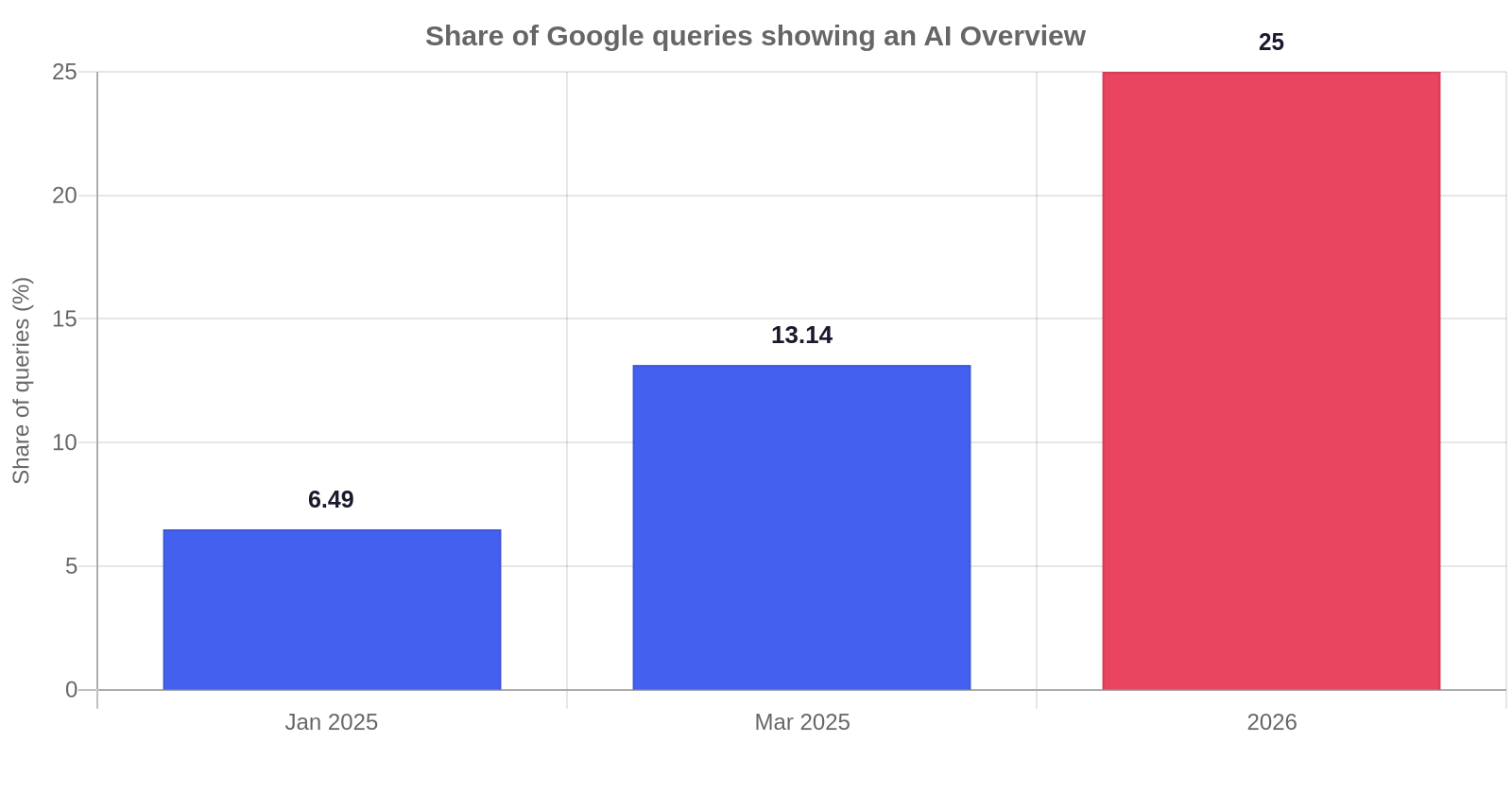
Here are the KPIs per layer, and how to read them.
- Origin (SEO). Track organic sessions, clicks, and click-through rate in Google Search Console. A falling click count is not automatically a crisis. Zero-click searches remove low-intent sessions, and the visits that do arrive through AI carry much higher intent. Adobe analysis shows AI-referred visitors browse 12% more pages per visit and have a 23% lower bounce rate. Semrush data shows they convert at 4.4x the rate of traditional organic visitors.
- Structure (AEO). Track citation frequency per question. Pick your top 10 buyer questions, prompt ChatGPT, Perplexity, and Gemini monthly, and log whether you appear and how accurately you are described. LLM answers are non-deterministic, so a single prompt check is meaningless. You need longitudinal tracking across a fixed prompt panel to see real movement.
- Consensus (GEO). Track share of model and brand accuracy. Ask each engine who the top vendors are in your category and see if you are recommended. Feed third-party surfaces (LinkedIn, review sites, analyst quotes, YouTube) and watch that recommendation rate rise over quarters.
Do not chase clicks alone. ABI Research, which runs its own AEO program, reported a 70% surge in AI referral traffic within four months, a 93% increase over ten months, and a 126% rise in overall organic search across Google, Bing, Yahoo, DuckDuckGo, and Baidu between June 2025 and March 2026 (Semrush data for ABI Research). Note the mechanism: improving AI citations pulled more overall organic traffic too, because the two systems reinforce each other.
What Most Teams Get Wrong
The biggest mistake is treating AI search optimization as a list of hacks instead of a narrative-coherence problem. Teams add FAQ schema and llms.txt files while their blog, product pages, and sales decks tell slightly different stories. Structured markup does not fix that; it makes the incoherence easier for an LLM to extract and amplify.
- Chasing dead hacks. Google has explicitly debunked llms.txt files, artificial text chunking, and special AI markup as visibility levers (Google Search Central, 2026). Generative AI uses normal crawl, index, and retrieval. Spend your effort on structure and proof, not magic files.
- Panicking over lost clicks. A drop in raw sessions while conversions hold is not failure. HubSpot saw exactly this when AI chatbots launched: traffic dipped but revenue and conversions climbed because AI-driven traffic carried higher intent. Watch conversion quality, not vanity sessions.
- One-off prompt checks. A single “does ChatGPT mention us” test varies run to run because LLMs are non-deterministic. Track a fixed monthly prompt panel over time, or you will chase noise.
- Treating GEO and AEO as the same checkbox. They are related but not identical. AEO is on-page extractability. GEO is off-page consensus. One makes you quotable, the other makes you recommended. Small teams often discover they have done a lot of AEO work and no GEO work at all.
- Ignoring the freshness clock. Content updated within the last 30 days earns 3.2x more AI citations, and 95% of ChatGPT citations come from content updated within the past 10 months (Geoptie and AirOps research). Static pages slowly become invisible to AI. Your refresh cycle is now an AI visibility tool, not a housekeeping chore.
The Single-Pass Triple-Optimization Workflow
Now the practical part. Here is a step-by-step workflow that optimizes one core asset for classic search, direct answers, and LLM synthesis in a single pass. A workable scenario follows so you can see it running on a realistic example.
Step 1: Pull real buyer questions. Do not invent keywords. Extract questions from your sales call transcripts, support tickets, webinar Q&As, and SME interviews. These are the questions buyers actually type, and they are the ones an AI engine will match. Choose one core asset: a page that answers one of these questions.
Step 2: Lead every section with a direct 40 to 60 word answer. Put a self-contained answer in the first sentence under each H2. Opening paragraphs that answer the query upfront get cited 67% more often (Search Engine Land 2026). Each section must make sense read in isolation, because an LLM retrieves standalone chunks, not whole pages.
Step 3: Make the evidence machine-readable. Replace screenshot images with real HTML tables where possible; pages with original data tables earn 4.1x more citations. Embed specific numbers; statistics boost citation performance by over 5.5%. Add a named statistic to every major claim.
Step 4: Add Article, FAQ, and HowTo schema. Proper schema markup raises AI citation rates by 28% (Search Engine Land 2026). Build the schema with structured JSON and validate it, because a syntax error wipes the benefit and triggers Search Console warnings.
Step 5: Publish and repurpose across consensus surfaces. Publish the page, then repurpose the answer into the off-page surfaces that feed recommendation: a LinkedIn post, a short video transcript, a guest mention, or a research nugget. Google AI Overviews most often cite YouTube (number one) and LinkedIn (number two), so your presence there directly feeds GEO consensus.
Step 6: Set a 30-day refresh reminder. Revisit the asset monthly, update the statistics, and re-publish. This keeps it inside the freshness window that earns 3.2x more citations.
Worked Scenario: A Pricing Comparison Page
Say you sell a specialized CRM for mid-market firms, and sales calls repeatedly surface the question “how is your pricing structure different from the big two?” That is your core asset. In step 1 you pull that exact question. In step 2 you open with a 45 word direct answer: your pricing is usage-based with a flat platform fee, the incumbents charge per-seat, and the trade-off is cost predictability versus per-user flexibility. In step 3 you add an HTML table comparing pricing models, per-seat versus usage-based, with example numbers. In step 4 you add FAQ schema around that exact trade-off. In step 5 you post the same comparison as a LinkedIn article and a short explainer video. In 90 days an LLM asked “what mid-market CRMs have usage-based pricing” has a structured, dated, third-party-validated answer to cite. That is the whole workflow in action on one realistic asset.
Frequently Asked Questions
Do I have to choose between SEO, AEO, and GEO?
No. They are layers of one system, not competitors. Use SEO as your baseline to stay crawlable and authoritative, add AEO structure to become quotable, and build GEO consensus to become recommended. The only real question is which one deserves your next hour, and the decision matrix above answers that.
Is AEO the same thing as GEO?
They describe the same underlying goal but operate on different surfaces. AEO is on-page structure that makes content extractable by an AI answer engine. GEO is off-page proof that makes an LLM recommend your entity when it synthesizes a multi-source answer. Related, but not identical. Google treats both as extensions of core SEO.
Will zero-click search kill my organic traffic?
It changes what you should measure. Raw sessions can fall as low-intent clicks disappear, but the AI-referred visits that replace them convert at 4.4x the rate and stay longer. Track conversion quality and citation frequency alongside clicks, and do not panic over a raw session dip.
Does llms.txt or special AI markup help me rank in AI answers?
No. Google has explicitly said these do not improve visibility in its generative AI features. AI search runs on the same crawl, index, and retrieval-augmented generation as classic search. Spend effort on structure and trust signals instead of magic files.
How do I know if ChatGPT, Perplexity, or Google cites my content?
Run a monthly prompt panel: save your top ten buyer questions, ask all three engines, and log whether you appear and how you are described. Track this longitudinally because a single answer varies run to run. Over quarters you will see whether your citation frequency is improving.
How often should I refresh content for AI visibility?
Aim for a meaningful update at least every few months. Content updated within the last 30 days earns 3.2x more citations, and 95% of ChatGPT citations pull from content updated within the past 10 months. Your refresh cycle is now an AI visibility lever, not just housekeeping.
What To Do Next
Start smaller than it sounds. Pick your top two pages by buyer intent and run the single-pass workflow on them this week: lead with direct answers, add the comparison table, set the FAQ schema, and repost the core answer on LinkedIn. Then set a monthly prompt panel to track citations. When you see the first citation appear in an AI answer for a high-value buyer question, you will understand what this entire discipline is for.
For the deeper mechanics, read our full guide to generative engine optimization for B2B and our post on why SEO alone is no longer enough. If you are weighing which AI SEO tools to run any of this with, our honest stack for small teams helps you pick. And if buyers now ask an AI assistant before they ever see your site, our guide to the AI agent as a second buying audience is the natural next read.
