

Content operations is the system that turns your content strategy into published work without burning out a small team. For a lean B2B team, it is not about buying software or adding headcount. It is about removing the dozens of small decisions that slow every post. The proof is that a two-person marketing team can scale content output to a measurable share of pipeline when the process is documented instead of carried in one person’s head.
Why a lean B2B team needs content operations
Most B2B content teams of one to five people skip operations entirely. They rely on memory, chat threads, and whoever pushes hardest that week. That works for ten posts a year. It collapses at fifty. The bottleneck is not writing. It is the mental overhead of deciding who reviews, what format ships first, and where assets live.
Content operations is the people, process, and technology that move content from idea to published, measured result. Screendragon and Brafton both describe it as the orchestration layer of a content program, the way you design, produce, review, and distribute every asset. Content strategy answers what to publish and why. Content operations answers how, where, and when it gets done. Most guides treat these as one thing. Treating them separately is what lets a small team scale without hiring.
In a 2026 guide on lean content systems, The B2B Playbook puts it plainly: “Content operations is the documented system behind how an organisation produces, reviews, distributes and measures its content.” The key word is documented. A system you carry in your head is not a system at all; it is a memory that disappears when someone leaves.
What most guides miss: scaling B2B content is a decision-reduction problem, not a capacity or software problem. A documented workflow removes repetitive judgment calls, so two people can produce what used to need five.
The Lean Ops Loop: a framework for small B2B content teams
The Lean Ops Loop is a five-stage cycle that any team of one to five people can run with a spreadsheet and a shared calendar. It names the exact decision each stage removes. The loop is reduce, intake, produce, verify, and distribute. Run it in a fixed cadence and you replace guesswork with a repeatable system.
1. Reduce
Document your current process so every repetitive call has one owner and one answer.
2. Intake
Pull ideas, briefs, and requests into one place with a fixed due date and owner.
3. Produce
Create from a standard brief so every draft meets the same bar and the same format.
4. Verify
One reviewer, one decision-maker, and a clear sign-off deadline. Stop review loops.
5. Distribute
Ship to channels on a fixed rhythm, then feed results back into stage one.
Each stage has a single clear owner on a small team. Stage one usually belongs to the lead marketer. Stage three belongs to the writer or freelancer. Stage four belongs to one accountable editor, never a committee. That single-owner rule is what keeps a lean team fast.
Content strategy versus content operations
The direct answer is that strategy decides what to publish and why, while operations decides how, where, and when it ships. Brafton describes content operations as the air traffic control for your content program. Content strategy is the flight plan. Without operations, the best strategy never takes off because no one owns the sequence.
On a lean team the two roles often sit with the same person. That is fine. What matters is that you separate the decisions. Your strategy should answer which topics, audiences, and goals matter this quarter. Your operations should answer who writes, who reviews, when it publishes, and how it distributes. Most small teams only do the strategy part and improvise the rest.
Spreadsheet versus software: a decision matrix
A common mistake is buying a project management platform before you have a process. The honest way to choose is simple. Start with a spreadsheet, and only upgrade when the spreadsheet itself creates recurring friction that you can name. The direct answer: most lean teams should stay on a spreadsheet until a specific, repeated pain makes the jump worth it. Software cannot supply a process that does not exist. It only hardens the process you already run.

Which software you pick matters far less than whether your team opens it weekly. An empty tool is a whisper, not a system. The moment you find yourself maintaining the tool instead of publishing content, step back. A useful test is simple: if the spreadsheet takes ten minutes a week to update and the tool takes an hour, the spreadsheet wins until the spreadsheet itself becomes the bottleneck you can point to.
The step-by-step workflow a lean team can run
Here is the workflow that puts the Lean Ops Loop into practice. It assumes two people: one lead marketer and one writer, with a part-time subject matter expert for input. It runs on a weekly cadence of roughly ninety minutes of planning and a repeating five-stage pipeline.
Stage one: plan ninety minutes a week
Block one ninety-minute slot every week to review your pipeline. The direct answer to why this works is that it replaces reactive firefighting with a fixed decision point. In that slot you assign owners, set due dates, and decide which posts move to production. Write these decisions down. Your single source of truth is a shared spreadsheet with columns for topic, owner, status, due date, and result.
Stage two: standardize the brief
Every post starts from the same brief, so your writer does not rediscover your standards each time. The brief names the target keyword, the reader, one question it answers, the required sections, and where supporting data comes from. A fixed brief cuts decision time and improves quality at the same time. If you already use a content brief template, link it here so every asset pulls from the same source.
Stage three: produce from the brief
Writing becomes execution rather than invention. Because the brief is complete, the writer produces a draft that matches your format and quality bar. On a lean team this is where freelancers are most useful. They write from your brief, and you own the brief and the review. You keep the strategy, they keep the volume.
Stage four: one reviewer, one sign-off
Name one accountable editor for every asset. Centralize feedback in one place instead of scattered email. Set a sign-off deadline and hold it. The most common way content dies on a small team is not bad writing. It is a draft sitting in a status no one owns. A single decision-maker with a deadline prevents that stall.
Stage five: distribute on a fixed rhythm
Publish each asset, then push it through a repeatable distribution path. Ship organic pillar content first, repurpose it into weekly social posts and a newsletter, and layer paid promotion onto the best performers a week to a month after launch. Distribution is not a launch-day blast. It is a calendar.
Worked mini-example. A two-person team at a fictional SaaS company, Northbeam, runs this loop. Lead marketer Priya owns planning and review. Writer Marco produces from briefs. Each week Priya reviews the pipeline on a spreadsheet, Marco writes two posts from completed briefs, and Priya signs off within forty-eight hours. The subject matter expert joins a thirty-minute interview every other week, which becomes a pillar post. After three quarters, organic content drives 40 percent of their qualified leads because the loop removes the stalls that used to hide drafts for weeks.
Why most content operations stalls by month four
There is a predictable pattern behind most abandoned content systems. Leading indicators, the engagement and conversation signals you can feel in weeks, move fast. Lagging indicators, pipeline influence and revenue, move slowly and often take six months or more to show up. Teams that judge their system on the slow signals start to panic around month four, see flat numbers, and quit. The system was fine. The metrics were the wrong ones to watch this early.
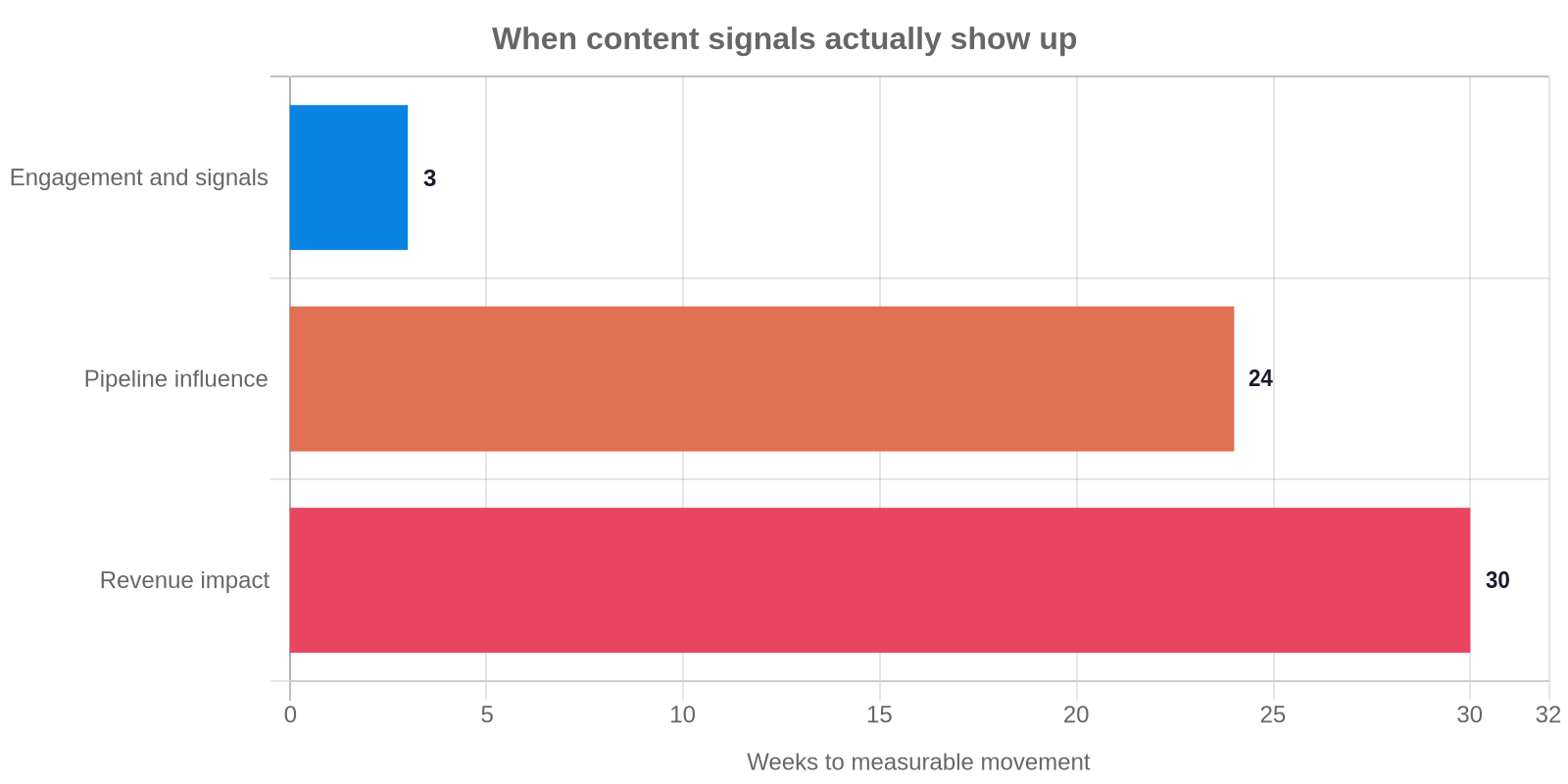
The practical takeaway is to pair the two. Track a small set of leading signals every week to confirm you are building traction. Do not let those move your strategy. Then run one honest quarterly review that looks at the slow, meaningful numbers. This one change, the switch from monthly to quarterly judgment, keeps lean teams from abandoning a winning system right before it pays off.
Your first week of content operations
You do not need a month to stand up a content operations system. Five focused steps in one week get you from improvisation to a working loop. The direct answer is that most of the value comes from documenting what already happens, not from building something new.
Day one, write down your current flow. Map every asset from idea to publication and note where it stops today. Day two, build the shared spreadsheet. Columns are topic, owner, status, due date, review deadline, and result. Day three, write one standard brief that every future post follows. Day four, name one reviewer for every role and set their sign-off deadline. Day five, pick a distribution rhythm, even if it is one weekly newsletter and two social posts.
That is the whole setup. You now have a system that a decent freelance writer can follow without asking you fifteen questions. The spreadsheet replaces memory. The brief replaces reinvention. The single reviewer replaces review committees that never decide.
Who owns what in a lean content operations setup
Role clarity is the cheapest efficiency you will buy. On a one-person team, you wear every hat, but you still separate the decisions in your calendar so you are not a writer, editor, and publisher in the same hour. On a two-person team, split the loop in half. One person owns intake and verification. The other owns production and distribution.
When a subject matter expert joins, protect their time. Do not ask them to draft. Ask them to talk for thirty minutes on a fixed, rotating calendar slot. Turn that interview into a pillar asset. This single change removes the most common production stall in B2B, which is waiting on a busy expert who never writes.
How your review process should actually work
Reviews fail on small teams for one reason: there is no single accountable editor. Centralize every comment in the document or the tool you use, and set a hard deadline. As this guide to content workflow management notes, drafts quietly stall in open statuses when no single owner is accountable. The direct answer is that a draft should not wait more than forty-eight hours for a decision on a lean team. If it does, it is probably not the writing that is slow, it is the ownership.
Keep review lightweight. The editor checks the brief is honored, the facts trace to a source, and the angle is distinct. They do not rewrite every sentence. If the editor is rewriting, the brief was weak or the writer was wrong for the asset. Fix the brief, not the paragraph.
How to review your content operations quarterly
The direct answer is that you review three things every quarter: what shipped, what the leading indicators show, and which process steps caused friction. Do not judge pipeline monthly. Monthly reviews capture short-term noise and push lean teams to abandon systems that only needed a few more months to mature.
Use a simple scorecard. Track posts published, review turnaround time, the share of drafts that hit their due date, and the leading engagement signals you care about. If a step keeps causing delays, fix that one step. Then let the system run another quarter before you judge it.
What Most Teams Get Wrong
Across the sources reviewed for this post, four mistakes recur in lean B2B content operations.
First, they treat scaling as a hiring problem. Growth is a documentation problem before it is a capacity problem. Making the process simpler, not more sophisticated, is what lets a two-person team scale. Second, they ask subject matter experts to write. SME time is the hardest input to secure. Standardize extraction instead, with fixed calendar slots, a rotating expert schedule, and a structured interview that becomes a pillar asset. Third, they judge revenue impact too early. Leading indicators shift in weeks, but pipeline and revenue take six months or more. Fourth, they evaluate strategy monthly and pivot to the noise. A quarterly review cadence stops small teams from confusing slow traction with no traction.
What To Do Next
Start this week with a single spreadsheet. List your open content assets, assign each an owner and due date, and name one reviewer. That is the whole first loop. Then standardize one brief, run one weekly ninety-minute planning session, and review the system quarterly.
For a fuller picture of how documenting your current process pays off, read our guide to building a proven content engine for small teams. If you are still deciding who does what on your team, our staffing guide for one, two, and five-person teams walks through the roles. And because a complete brief is the fastest way to shorten the production stage, our step-by-step guide to automating content briefs removes most of the setup friction. For the closer, our content marketing strategy guide shows how operations feeds the higher-level plan.
Frequently Asked Questions
What is content operations in B2B marketing?
Content operations is the people, process, and technology that move content from idea to published, measured result. It covers planning, production, review, approval, distribution, and measurement. It answers how content gets done, not why it exists.
Do small B2B teams need content operations software?
Not first. Start with a spreadsheet and a shared calendar. Only upgrade to a project management tool when a specific, repeated pain makes it worth it, such as frequent missed deadlines or scattered approvals. Software hardens an existing process. It does not create one.
How many people do you need to run content operations?
Two people can run a documented content operations system without adding headcount. One person owns planning and review. Another owns production. The system, not the headcount, is what scales output.
What is the difference between content strategy and content operations?
Content strategy decides what to publish and why. Content operations decides how, where, and when it ships. Strategy is the plan. Operations is the system that executes it. Small teams often do strategy and then improvise operations.
How should a lean team measure content operations success?
Track process health, not just output. Watch posts published, review turnaround, the share of drafts meeting their due date, and leading engagement signals. Review these quarterly. Judge revenue and pipeline on a six-month horizon, not monthly.
