

Quick Answer: How do you build a repeatable B2B content engine for small teams?
A B2B content engine for small teams runs on four systems: (1) keyword-driven editorial calendar (one post per week per writer, all targeting pre-researched keywords), (2) a content brief template that gives writers everything they need to draft without research, (3) a lightweight review process (editor checks for accuracy, SEO, and CTA alignment), and (4) a distribution checklist (email, LinkedIn, internal Slack) executed for every post. Small teams that systematize production outpublish larger teams that rely on ad-hoc creativity.
A B2B content engine for a small team is a documented system that turns one high-value asset into multiple distribution-ready pieces across channels, consistently, without adding headcount. Unlike ad-hoc publishing, a content engine connects creation, repurposing, and measurement into a repeatable workflow your two- or three-person team can actually sustain.
Most B2B teams approach content like they are filling a bucket with holes in it. They publish blog posts, record podcasts, write whitepapers, then watch those assets disappear into the void after a single distribution push. The calendar stays full. The team stays exhausted. But the pipeline? Still empty.
A content engine works differently. It is a systematic approach to creating, distributing, and measuring content that actually generates leads without destroying your team in the process.
According to the Content Marketing Institute‘s 2025 B2B benchmarks, 45% of B2B marketers lack a scalable content creation model, making execution bottlenecks the most common reason content programs stall. But here’s what matters more: companies publishing 11+ posts per month generate 4 times more leads than those publishing fewer than 4.
The difference isn’t just volume. It’s having a repeatable system that turns one substantial asset into dozens of smaller pieces through strategic repurposing.
For small teams, the minimum viable velocity is 2–4 high-quality, targeted pieces per month. Not 20 mediocre posts. Not random acts of content creation. A focused system that builds habitual attention with your Ideal Customer Profile without requiring you to hire five more people.
According to CMI’s 2025 research, 54% of B2B content marketing teams consist of just two to five people, so if your team is small, you are the majority, not the exception.
The Foundation: Start With Goals, Not Output Quotas
Small B2B teams that start with revenue goals, not publishing quotas, build content engines that compound. Teams that start with output targets build treadmills.
The content factory trap destroys small teams. You set a goal of “4 blog posts per week” without asking what those posts should accomplish. So you produce assets to fill the editorial calendar. Each piece exists in isolation. Nothing connects. Nothing compounds. You are busy but not effective.
The question isn’t “how many blog posts this month.” It’s “which specific revenue goals will this content support.”
Shift to a media company mindset. Media companies succeed because they understand their audience deeply and create content those audiences actively seek out. For B2B teams, every piece should pass one test: “Would my ICP actually care about this?” Content that fails this test wastes resources and dilutes your message.
Document your Brand Foundation before creating anything. This includes:
- Your positioning (what makes you different from competitors)
- Your voice (how you communicate that difference)
- What you always say and never say
- Preferred terminology and formality level
Without this documented baseline, your content drifts into generic territory that could belong to any company in your space. HubSpot, Marketo, and Salesforce integrate with Content Management Systems to support these processes. But the technology only helps if you’ve defined what your brand actually sounds like.
💡 Key term – Ideal Customer Profile (ICP): A detailed description of the company and buyer most likely to get value from your product, stay longest, and refer others. Unlike a persona, an ICP describes a company type, not just a job title.
For small teams with limited resources, prioritize Bottom-of-Funnel (BOFU) topics first. This means:
- Comparison pages showing how your solution stacks up against competitors
- Buying guides that answer “how to choose” questions
- Implementation content addressing “how to get started” concerns
💡 Key term – BOFU (Bottom of Funnel): Content targeting buyers who are actively evaluating solutions. Examples include “[Your Product] vs [Competitor]” pages, pricing guides, and ROI calculators. BOFU content converts at dramatically higher rates than awareness-stage content because the reader already knows they have a problem.
These topics capture existing demand from prospects already searching for solutions. They convert at significantly higher rates than Top-of-Funnel awareness content targeting cold audiences who don’t know they have a problem yet. Use our B2B Content Marketing Strategy Checklist to map BOFU topics to each stage of your buyer journey before building your content calendar.
Marketing automation platforms enable attribution modeling that connects content touches to pipeline progression. You can see exactly which pieces move prospects through the sales cycle and which ones just generate pageviews that never convert.
What Does a B2B Content Engine Actually Look Like?
A B2B content engine is a documented system with four interlocking parts: a content brief workflow, a modular production process, a repurposing playbook, and a measurement framework tied to pipeline.
This is where most teams get stuck. They have content. They don’t have a system. Here is what each layer looks like in practice for a lean team:
1. Content brief workflow: Every piece starts with a standardized brief, target keyword, ICP segment, funnel stage, word count, success metric. Without this, writers make guesses and editors make corrections. With it, production time drops. (See our B2B Content Brief Template for a ready-to-use version.)
2. Modular production: Assets are designed to be broken apart from the start. A 3,000-word pillar page isn’t written as one monolithic document — it’s written as five sections that can each stand alone as a LinkedIn carousel, email segment, or social post.
3. Repurposing playbook: Before anything is written, the team maps where each section will appear post-publication. Blog section → LinkedIn slide → newsletter paragraph → short-form video hook. This is not repurposing after the fact. It is designing for repurposing from the first outline.
4. Measurement framework: Track inputs (briefs completed, assets published, content velocity) alongside outputs (MQLs influenced, pipeline touched, sales cycle length for content-engaged prospects). Vanity metrics — pageviews, social impressions — tell you nothing about whether the engine is working.
According to HubSpot’s 2026 State of Marketing Report, the top five metrics marketers prioritize are lead quality and MQLs (39%), lead-to-customer conversion rate (34%), ROI (31%), customer acquisition cost (30%), and lead generation volume (29%). Build your measurement framework around these from day one.
Build Modular Content From the Start
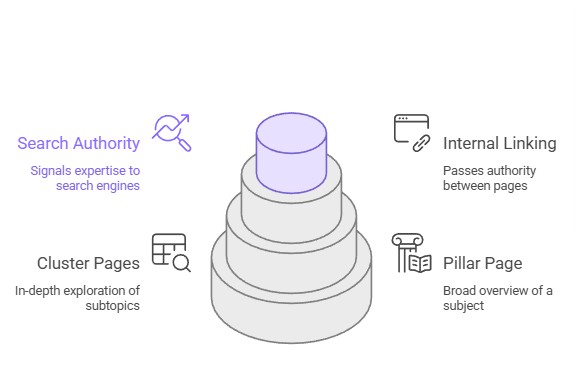
Modular content, built around topic clusters, is the fastest way for a small B2B team to signal topical authority to search engines while keeping production manageable.
Isolated blog posts don’t build authority. They’re one-offs that die on the vine.
Topic Clusters work differently. You create a central pillar page that provides a broad overview of a subject, maybe 3,000 words covering the fundamentals. Then you build 8–12 cluster pages that explore specific subtopics in depth. Each cluster page links back to the pillar. The pillar links out to all clusters.
Search algorithms interpret this structure as a signal of expertise. You are not just covering a topic once. You’re demonstrating comprehensive knowledge across an entire subject area.
A pillar page titled “B2B Content Strategy” might link to cluster pages like:
- Content Distribution for B2B
- Lead Generation Content
- Sales Enablement Content Assets
- Account-Based Marketing Content Pipelines
The internal linking passes authority from the pillar to clusters and back. Search engines reward sites that demonstrate depth rather than scattered articles on disconnected subjects. Use our B2B Content Topic Cluster Planner to map your cluster architecture before you write a single word.
💡 Key term – Topic Cluster: A content architecture where one central “pillar” page covers a broad subject, and multiple “cluster” pages explore specific subtopics. Each cluster page links back to the pillar, creating a hub-and-spoke structure that signals expertise to search engines.
The Big Rock Strategy
Here’s how you maximize limited resources: create one heavy-lift asset per quarter and break it down into dozens of smaller pieces.
A comprehensive research report (4,000–6,000 words) becomes the Big Rock. From that single asset, you generate:
- Blog post summaries (5–7 posts)
- Social media updates (30–50 pieces)
- Email newsletter segments (4–6 emails)
- Podcast episode topics (2–3 episodes)
- Webinar presentations (1–2 webinars)
This approach ensures your content is connected and modular. A single effort fuels your content calendar for months while maintaining thematic consistency.
Content creation platforms like NewsCred and Kapost support modular workflows by providing content repositories. You store reusable components — statistics, case studies, product descriptions, expert quotes — that can be mixed and matched across different formats. This reduces production time while ensuring consistency.
| Content Type | Word Count | Derivative Assets |
|---|---|---|
| Research Report | 4,000–6,000 | 5–7 blog posts, 30–50 social posts, 4–6 emails |
| Pillar Page | 3,000 | 8–12 cluster pages, 1 webinar, 20+ social posts |
| Webinar (30 min) | N/A | 1 blog recap, 3–5 video clips, quote graphics, podcast episode |
The modular approach applies to technical content syndication too. A single whitepaper generates:
- Gated landing pages for lead generation
- Ungated summary pages for SEO traffic
- Slide decks for sales enablement
- Excerpted blog posts for organic discovery
Marketing technology stacks built on Salesforce and Adobe Experience Manager enable this repurposing through workflow automation. The system triggers content transformation based on campaign needs and audience segments.
How to Build a Content Engine When You Have No Budget
Small B2B teams with limited budgets build content engines by stacking free or low-cost systems: a documented brief process, a repurposing checklist, AI for first drafts, and one shared editorial calendar.
Budget is the most common objection to building a content engine. Here is the no-budget version that works for teams of one to three people:
Step 1 — Pick one format as your anchor. For most B2B teams, this is a long-form blog post or a newsletter issue. Everything else derives from it. Don’t try to be everywhere from day one.
Step 2 — Write the brief before you write anything else. A 15-minute brief prevents 3 hours of revision. Use a simple Google Doc template with: target keyword, ICP job title, funnel stage (TOFU/MOFU/BOFU), main question the piece answers, and one success metric. Our free B2B Content Brief Generator can get you started in under five minutes.
Step 3 — Use AI for the parts that don’t require judgment. AI is excellent at generating first-draft outlines, meta descriptions, social post variations, and headline options. It is not a replacement for original insight, proprietary data, or your specific customer context. Use it for velocity; use your brain for differentiation.
Step 4 — Repurpose before you publish the next piece. The discipline of repurposing is making yourself extract value from what you already have before reaching for something new. A single 1,500-word blog post should generate at least 5 LinkedIn posts, one email segment, and one short-form video script before you move to the next topic.
Step 5 — Audit quarterly, not annually. A content audit every 90 days lets you spot what’s ranking, what’s drifting, and what to cut before the pile becomes unmanageable. Our guide on how to do a B2B content audit walks through the full process step by step.
According to CMI’s 2025 data, only 35% of B2B marketers say they have a scalable content creation model, while 45% say they lack one entirely. The gap between teams that compound their content efforts and teams that stay on the treadmill is almost always a systems problem, not a talent problem.
Use AI as a Thought Partner, Not a Ghostwriter
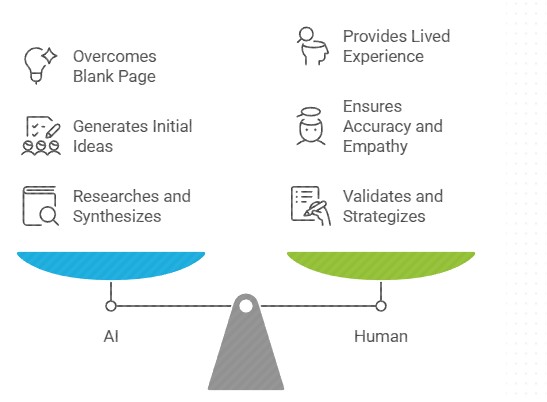
The right role for AI in a B2B content engine is acceleration, not replacement, use it to pressure-test briefs, synthesize research, and generate derivative formats, while keeping strategy, voice, and final review human.
AI excels at overcoming the blank page problem. It generates initial ideas, suggests headlines, drafts outlines. But AI lacks lived experience and contextual understanding required for true insight.
Content created entirely by AI reads as generic because AI operates on statistical probability rather than truth or lived expertise. It averages out distinctive voices into middle-of-the-road phrasing. The result feels corporate and bland even when grammatically correct.
Here’s where AI actually helps: Use it to pressure-test your ideas. Feed your content brief into an AI tool and ask “what questions does this outline fail to answer” or “what objections might a skeptical reader raise.” This front-end validation saves hours on editing later by catching structural problems early.
AI functions best for research synthesis. It can scan dozens of sources and extract relevant data points, saving you hours of manual reading. A marketer researching “B2B content optimization trends” can use AI to summarize 10 industry reports in minutes, identifying common themes and conflicting findings that deserve deeper investigation.
Content intelligence tools like Parse.ly use machine learning to surface insights about audience behavior. Which headlines generate clicks. Which article lengths maximize scroll depth. Which calls-to-action convert readers into leads. This data-driven approach removes guesswork from editorial decisions.
According to CMI’s 2025 benchmarks, 81% of B2B marketers now use generative AI tools, but only 19% have integrated AI into their daily workflows, and just 4% say they highly trust AI outputs. The takeaway: AI adoption is widespread but systematization is rare. Teams that build deliberate AI workflows, rather than using AI ad hoc, gain the efficiency advantage without the quality risk.
The limitation: AI misses cultural nuance, subtext, and emotional weight. It fails to grasp industry in-jokes. It cannot anticipate how certain phrasings might offend or confuse specific audiences. It can hallucinate facts or confidently state incorrect information when training data contains errors.
Human oversight remains necessary to inject empathy and ensure accuracy. You are the strategist. AI is the research assistant and first-draft generator.
Build a Template and Prompt Stack
A template and prompt stack removes decision fatigue from content production, giving small teams a repeatable starting point for every asset type, from content briefs to social posts to email sequences.
Decision fatigue kills small teams. Every piece of content shouldn’t require starting from zero.
Implement a templated workflow that standardizes repeatable processes:
Standard content briefs that specify:
- Target keywords
- Audience personas
- Required word counts (and approximate tokens for AI processing)
- Competitive analysis
- Success metrics
Distribution checklists that ensure every asset follows the same promotion path across:
- Owned channels (email, website)
- Earned reach (communities, partnerships)
- Paid amplification (sponsored content, social ads)
Recurring formats for podcasts, videos, and written content reduce production time by establishing predictable structures. A weekly podcast following a consistent interview format requires less planning than reinventing the structure each episode.
Newsletter templates with predefined sections, industry news, original analysis, resource recommendations, allow writers to focus on content rather than layout decisions.
See our detailed breakdown of top distribution channels for B2B content marketing to build the distribution half of your template stack.
Speed Up Production With Automation
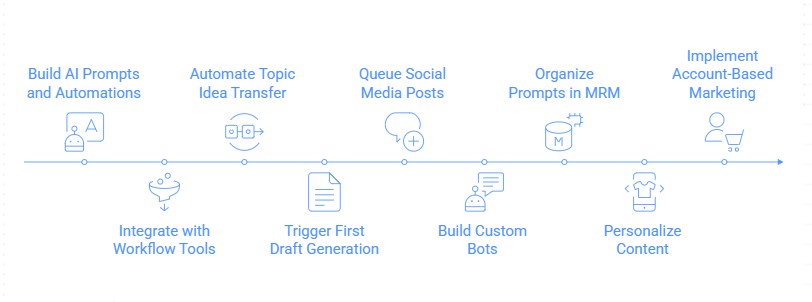
Build a stack of AI prompts and automations that handle routine tasks. Use Zapier or similar workflow automation tools to:
- Automatically send topic ideas from Slack to your project management system
- Trigger first draft generation in Google Docs when a content brief is approved
- Queue social media posts when a blog publishes
These automations create a content engine that runs with minimal manual intervention once initial setup completes.
Build custom bots or prompt chains for specific tasks:
- Meta description generator: Receives a blog post URL, returns 3 optimized options under 160 characters
- Bias checker: Reviews draft content, flags potentially exclusionary language or unsupported claims
- Brand compliance bot: Ensures new content adheres to documented voice guidelines
Marketing Resource Management systems organize these templates and prompts in a centralized library accessible to all team members. Platforms like Contently and Skyword provide template libraries where teams can store approved frameworks for case studies, product comparisons, how-to guides, and thought leadership articles.
Content automation for B2B extends to personalization at scale. Template systems populate custom variables, company name, industry, pain points into standardized frameworks.
Account-Based Marketing platforms use these techniques to create personalized buyer journey automation where each account receives content tailored to their specific challenges and stage in the sales cycle.
Measure Efficiency Over Output
Measure your B2B content engine on pipeline influence and lead quality, not pageviews. In a zero-click search environment, traffic metrics are a lagging indicator that often obscures whether content is actually driving revenue.
Raw traffic numbers look impressive in reports but fail to predict revenue. The era of zero-click searches means users increasingly get answers directly in search results or social feeds without visiting your site. Search engines display featured snippets, knowledge panels, and AI-generated summaries that satisfy user intent without click-through.
Pageviews are becoming a less reliable success indicator.
According to CMI’s 2025 research, 56% of B2B marketers say it’s hard to connect content efforts to ROI, and the same number struggle to track how customers move through the journey. This is not a data problem. It’s an attribution architecture problem that gets solved when you integrate your CMS with your CRM from the start.
Focus on Influenced Pipeline and revenue attribution. This requires integrating your CMS with your Customer Relationship Management system to track which content pieces prospects consumed before converting.
Marketing automation platforms from HubSpot, Marketo, and Salesforce enable multi-touch attribution modeling that assigns credit to each content interaction along the buyer journey. Use our Content Marketing ROI Predictor to model the expected return before committing to a content investment.
Small teams should track 5 efficiency metrics:
- Lead quality measured by sales-accepted lead rates
- Engagement depth tracked through scroll depth and watch time
- Content velocity showing production time from brief to publication
- Cost per lead compared across content types
- Pipeline influence calculating revenue tied to content interactions
These metrics reveal whether your content engine generates qualified opportunities efficiently rather than just producing outputs.
Yes, publishing frequency correlates with lead generation. Companies publishing 11+ posts monthly generate 4 times more leads than companies publishing fewer than 4 posts monthly according to Content Marketing Institute data. But correlation doesn’t prove causation.
The success factor is consistency and strategic targeting rather than sheer volume. A consistent rhythm of 2–4 high-quality, targeted pieces per month represents the minimum viable velocity for seed-stage teams. Enough momentum to build audience habits without burning out small teams.
Content analytics platforms like Parse.ly track engagement patterns that predict conversion. Repeat visits. Long session durations. Consumption of BOFU content. These signals indicate purchase intent. B2B content analytics reveal behavioral differences between tire-kickers and serious buyers, allowing you to prioritize content that attracts high-intent audiences.
Demand generation programs measure content performance through pipeline metrics that connect marketing activity directly to revenue outcomes. Gartner and Forrester research emphasizes that successful B2B marketing ties content investment to business results:
- Marketing Qualified Leads (MQLs) that convert to Sales Qualified Leads (SQLs)
- Average deal size influenced by content consumption
- Sales cycle length for content-engaged prospects versus those who skip educational content
Don’t Let Tech Kill Your Brand Voice
Your brand voice is what AI cannot replicate at scale, document it explicitly so every piece of content, whether drafted by a human or an AI tool, passes the same authenticity test.
AI can reduce content production costs significantly. But it poses a risk of creating generic “good enough” content that erodes trust.
AI-generated content often lacks personality because AI trains on massive datasets that average out distinctive voices. The result feels corporate and bland even when grammatically correct. Missing the quirks and perspective that make brands memorable.
AI lacks the ability to grasp subtext, sarcasm, and emotional weight in communication. It interprets language literally. Misses irony. Misses cultural references. Misses tonal shifts that human readers process instinctively.
This limitation results in content that feels robotic, particularly in industries where humor, irreverence, or strong opinions differentiate brands. Technical accuracy without personality fails to build the trust and affinity that convert readers into customers.
According to HubSpot’s 2026 State of Marketing Report, 61% of marketers agree that brand taste and point of view are more important than ever when AI and humans work together on content. The teams that invest in documenting their voice now are building a durable competitive asset. Those that don’t are producing content that sounds like everyone else using the same AI tools with the same default prompts.
Document your voice clearly. Define what you always say and never say. Create explicit guidelines that train both human writers and AI tools.
Voice documentation should specify:
- Preferred terminology (customers vs. users vs. clients vs. partners)
- Sentence length preferences (short punchy sentences vs. longer analytical ones)
- Formality level (casual vs. professional)
- Opinion stance (neutral observer vs. opinionated leader)
This documentation becomes the rubric for evaluating whether content sounds like your brand.
Maintain a human-in-the-loop for final review to ensure accuracy and empathy. AI can hallucinate facts or miss the mark on cultural tone. Human editors catch factual errors where AI might confidently state incorrect statistics. They identify phrasing that might offend specific audiences. They add the finishing touches that elevate competent content into compelling content.
Digital Asset Management systems store approved brand assets, logos, color palettes, fonts, photography styles, voice examples, that serve as reference points for content creators. Marketing teams using tools like Adobe Experience Manager can enforce brand consistency by requiring all content to pass through approval workflows where brand guardians verify adherence to documented standards before publication.
Content personalization technology enables brand voice to adapt to different audience segments while maintaining core consistency. An enterprise software company might use a more technical voice when addressing IT directors but simplify language for business executives. Adjusting complexity without abandoning the fundamental personality that defines the brand.
Build Once, Repurpose Always
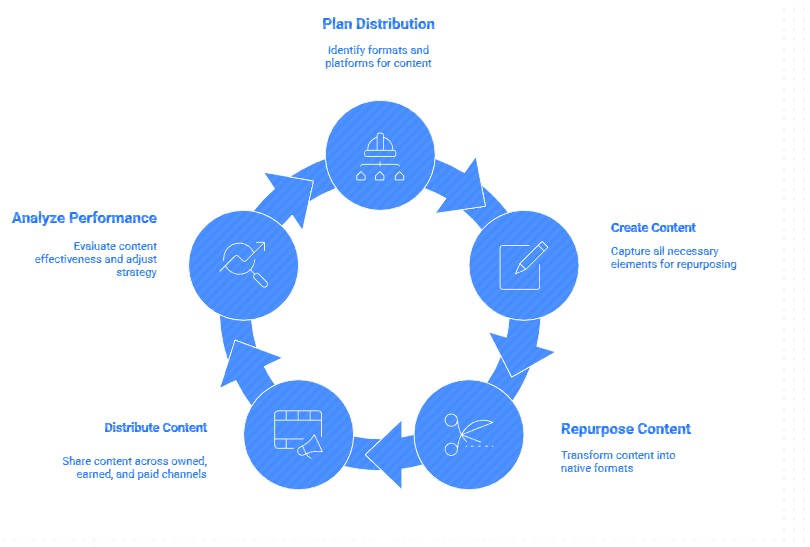
Every piece of B2B content should be designed for repurposing from the first outline, not as an afterthought after publishing. Plan the derivative assets before you write the original.
Adopt a distribution-first mindset by planning how an asset will be shared before you create it. This planning phase identifies which formats and platforms will receive versions of the content. You ensure the original creation process captures all necessary elements, quotes, statistics, visuals, examples, that support multiple formats.
Creating content without a repurposing plan wastes opportunities to extend reach and maximize return on production investment.
Don’t just redistribute links by posting the same URL across platforms. Repurpose the content by transforming it into native formats optimized for each platform’s consumption patterns and algorithmic preferences.
Turn a 2,000-word blog post into:
- A LinkedIn carousel with 10 slides summarizing key points
- A Twitter thread with 8–12 posts expanding on a single insight
- A 60-second video highlighting the most compelling statistic
- An email newsletter segment offering deeper analysis with a CTA directing readers to the full piece
Short-form video is now the highest-ROI content format across both B2B and B2C, with LinkedIn video watch time growing 36% year-on-year in 2025 (HubSpot State of Marketing, 2026). Every webinar and long-form video your team produces should generate at least 3–5 short clips as a standard operating procedure, not as an optional extra.
A 30-minute webinar should generate 12–15 content assets immediately upon finishing:
- Blog post recapping key takeaways
- 3–5 highlight video clips for social media (each 30–90 seconds)
- Quote graphics featuring memorable statements
- Infographic visualizing data presented
- Podcast episode extracted from the audio track
- Newsletter segments distributed across 2–3 weeks
This systematic repurposing turns a single production effort into weeks of content distribution.
Create a distribution checklist for every asset type ensuring you systematically hit:
- Owned channels: Email lists and website properties
- Earned reach: Industry communities and partnerships
- Paid amplification: Sponsored content and social advertising
The checklist prevents teams from creating content that publishes once and gets forgotten.
Content Syndication for Extended Reach
Content syndication for B2B extends reach by republishing content on third-party platforms that expose your expertise to new audiences. Platforms like Medium, LinkedIn Articles, and industry-specific publication networks allow repurposing of blog content to audiences who might never visit your website.
B2B content syndication agreements often include lead generation components where republished content includes gated downloads or newsletter signups that capture audience contact information.
Partner ecosystem content networks amplify reach through co-marketing arrangements. Complementary companies cross-promote each other’s content to their respective audiences. A marketing automation vendor and a CRM provider might collaborate on a joint webinar. Each company promotes to their customer base and repurposes the content through their own channels. These partnerships provide access to qualified audiences that trust the recommending brand.
Technical content syndication engines automate distribution by connecting content repositories to multiple publishing endpoints. When a new blog post publishes on your primary website, automation workflows can trigger:
- Republication to Medium
- Cross-posting to LinkedIn
- Excerpt distribution via email
- Social media scheduling across platforms
These systems ensure consistent execution of distribution strategies without requiring manual effort for each piece.
AI Accelerates Strategy, It Doesn’t Replace It

AI is a production accelerator, not a strategy generator. The teams winning in 2026 are using AI for drafts, formatting, and research synthesis, while keeping audience insight, competitive positioning, and creative direction human-led.
AI serves as a tool for velocity, not a substitute for strategy. AI can automate grunt work tasks like summarizing research documents, fixing grammar and spelling errors, generating meta descriptions, coding technical SEO fixes for website markup, and reformatting content for different platforms.
These automation capabilities free human marketers to focus on high-level strategy and creative differentiation, the work that actually separates successful brands from forgettable ones.
AI helps execute a model of efficient production where standardized processes and continuous improvement drive operational excellence. Like Toyota’s manufacturing system that eliminated waste through systematic optimization, AI-powered content operations reduce the friction and redundancy that slow production.
But the strategic decisions regarding what to create, who it’s for, and how it differentiates from competitors must remain human-led to ensure relevance and competitive positioning.
What AI Cannot Replace
The strategic components AI cannot handle:
- Audience insight that comes from customer conversations
- Competitive differentiation based on deep market understanding
- Brand positioning that reflects company values and vision
- Partnership decisions requiring relationship context
- Creative direction that pushes boundaries rather than following conventions
These high-value activities require human judgment, empathy, and the ability to synthesize disparate information into coherent strategy.
AI levels the playing field for content output. It’s equally easy for any company to produce grammatically correct, adequately researched content at scale. This democratization means volume and technical proficiency no longer serve as competitive advantages.
Your competitive edge comes from the human insight and strategy driving the machine. The unique perspective. Controversial opinions. Proprietary research that only your team can provide.
According to CMI’s 2026 research, teams winning in 2026 aren’t playing with prompts or churning out more content, they’re building stronger fundamentals, then letting AI add velocity to those efforts.
The 61% of B2B marketers increasing spend in 2026 are prioritizing AI tools (45%), events (33%), and owned media like website, blog, and email (32%). The bottom of that list at 9% is human resources. That’s the mistake. Better technology won’t save mediocre strategy.
A 2-person content team using AI effectively can match the output volume of a 5-person team using traditional methods. Though the strategic oversight and creative direction still require human expertise.
Content strategy frameworks from thought leaders and research organizations like Gartner, Forrester, and SiriusDecisions (acquired by Forrester) emphasize that technology should serve strategy rather than drive it. The most successful content operations use AI for execution while investing human time in audience research, message development, and performance analysis.
Putting It All Together
Building a scalable B2B content engine requires:
Starting with content goals not outputs to avoid the content factory trap
Creating modular content from the start through Topic Clusters and the Big Rock strategy
Using AI as a thought partner that pressure-tests ideas rather than a ghostwriter that replaces creativity
Building a template and prompt stack that removes decision fatigue
Measuring efficiency over output by tracking Influenced Pipeline rather than vanity metrics
Protecting brand voice through documented guidelines and human-in-the-loop review
Adopting build once repurpose always distribution practices
Recognizing that AI accelerates strategy rather than replacing it
The content engine operates most effectively when small teams focus on minimum viable velocity: 2–4 targeted pieces per month. Prioritize BOFU topics that capture existing demand over TOFU awareness plays that require longer nurture cycles.
This approach aligns content goals with revenue outcomes. Every piece serves a documented purpose in moving prospects through the buyer journey toward closed deals.
Marketing automation platforms, Content Management Systems, and content intelligence tools from vendors like HubSpot, Marketo, Salesforce, Adobe Experience Manager, Contently, Skyword, DivvyHQ, and Parse.ly provide the technological foundation for content engine operations. These systems enable workflow automation, performance tracking, and distribution coordination that allow small teams to operate efficiently.
The role in marketing content shifts from pure creation to strategic orchestration. Marketers function as editors and strategists rather than writers and producers. AI handles the grunt work of drafting, formatting, and basic optimization. Humans provide the insight, differentiation, and quality control that turn adequate content into assets that build trust and drive revenue.
Success comes from recognizing that content marketing must serve business objectives rather than existing for its own sake. Every piece should answer “how does this help us reach our ICP” and “what specific outcome should this produce.” Content that fails these tests dilutes focus and wastes resources better invested in high-impact assets that move needles on pipeline and revenue.
The competitive advantage in modern B2B content marketing emerges not from who produces the most content or who adopts AI fastest. It comes from who combines human strategic insight with technological efficiency most effectively. Organizations that document their voice, systematize their workflows, measure what matters, and maintain creative control while leveraging AI for acceleration build sustainable content engines that generate results without burning out their teams.
Frequently Asked Questions
What is a B2B content engine?
A B2B content engine is a systematic, repeatable workflow for creating, repurposing, distributing, and measuring content, without starting from scratch each time. Unlike ad-hoc publishing, a content engine treats content as a compounding asset: each piece feeds into the next, and every major asset generates multiple smaller derivatives. For small teams, the engine typically runs on a documented content brief process, a repurposing playbook, and a measurement framework tied to pipeline rather than pageviews.
How many pieces of content should a small B2B team publish per month?
For most small B2B teams, 2–4 high-quality, strategically targeted pieces per month is the minimum viable velocity. This is enough to build consistent audience habits and search authority without burning out a team of two or three. Volume matters less than consistency and topic targeting, a focused team publishing two BOFU-first pieces per month will outperform a team pushing out 10 generic posts that don’t connect to buyer intent.
How do you build a content engine with a small team and no budget?
Start with five steps: (1) Pick one anchor format, usually a long-form blog post or newsletter. (2) Write a content brief before every piece to eliminate revision cycles. (3) Use AI for outlines, meta descriptions, and social post variations, not for strategy or final copy. (4) Repurpose before creating anything new: every published piece should generate at least five derivative assets. (5) Audit quarterly to cut what isn’t working before the backlog grows. The tools can be free; the system is what makes it work.
What is the difference between a content engine and a content calendar?
A content calendar is a scheduling tool, it tells you what to publish and when. A content engine is the system that produces, repurposes, distributes, and measures that content. You can have a full content calendar and still have no engine if there is no repeatable brief process, no repurposing playbook, and no measurement framework. A content engine makes the calendar sustainable.
What metrics should I use to measure a B2B content engine?
Track five efficiency metrics: (1) lead quality measured by sales-accepted lead rates, (2) engagement depth via scroll depth and watch time, (3) content velocity from brief to publication, (4) cost per lead by content type, and (5) pipeline influence, the revenue tied to content interactions. Avoid using pageviews as a primary success indicator, particularly as AI-generated search overviews reduce click-through rates on informational queries.
How does AI fit into a small B2B team’s content engine?
AI is a production accelerator, not a content strategist. Use it for first-draft outlines, research synthesis, meta description generation, headline testing, and reformatting assets across platforms. Do not use AI for competitive differentiation, brand positioning, customer insight, or final editorial decisions. According to CMI’s 2025 data, 81% of B2B marketers now use generative AI, but only 19% have integrated it systematically into workflows. The teams gaining the efficiency advantage are the ones with deliberate AI playbooks, not the ones using it ad hoc.
Recommended Tool: AWeber
If you’re building a B2B email list alongside your content marketing, AWeber is the most reliable option for small teams. Free up to 500 subscribers, with inbox placement rates that consistently outperform most competitors.
Affiliate disclosure: Some links in this post are affiliate links. If you sign up through them, I may earn a small commission at no extra cost to you.
