

What Is AI Content Governance for B2B Marketing (and Why You Need It in 2026)
AI content governance is the system of policies, approved tools, audit steps, and review cadences you use to keep AI-produced content accurate, on-brand, and safe to publish. In 2026 every B2B team touches AI, but most have no rules for it. An independent global survey by Genesys found that 35% of tech executives say their organization has little or no formal AI governance policy in place, even as AI is now baked into the content workflow. That gap is not an IT problem. It is a content-team problem, and it is costing you accuracy, trust, and search visibility.
Here is the tension most B2B marketers feel. You are under pressure to produce more content with a small team, so AI looks like the answer. But you have likely seen what happens without guardrails: a hallucinated statistic, a fabricated source, a client detail pasted into a public tool, a post that reads like every other AI post and ranks nowhere. This guide gives you a working system to fix that. It is built for the 2 to 10 person marketing team that does not have a legal department, a CISO, or a governance committee to lean on.
What most guides miss: the resources that rank for “AI governance” are written for enterprise IT and legal teams. They talk about OAuth scopes, Business Associate Agreements, and DLP posture tools like Microsoft Purview. That advice does not help a managing editor deciding whether a writer may use Claude to draft a paragraph, or how to check that a quoted statistic is real before publish. This post fills that gap with a lean, content-specific system you can adopt this week.
Why Ungoverned AI Content Is Expensive (the Case for a Policy)
The cost of ungoverned AI is not theoretical. It shows up in four concrete places: factual errors that damage credibility, leaked data that creates legal risk, generic content that fails to rank, and a slow erosion of buyer trust. Each one compounds the others.
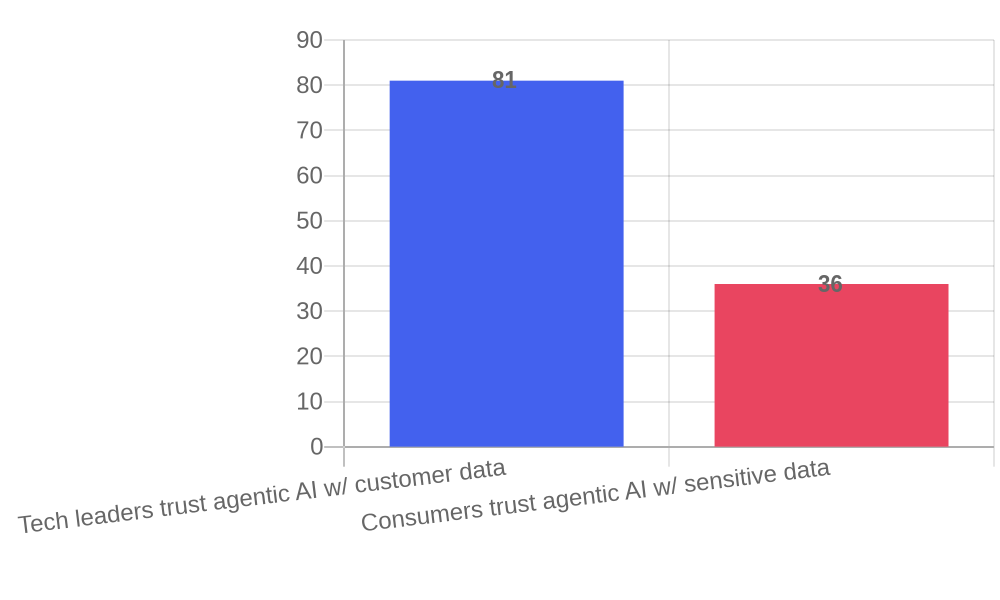
Start with the trust math. Genesys found an 81% to 36% split: most technology executives trust agentic AI systems with sensitive customer data, but only about a third of consumers share that trust. If your buyers do not trust AI-produced content, publishing it without oversight pushes them away, not toward you.
Netwrix’s 2026 Data and Identity Security Report found that 72% of organizations report rising identity-related risks to sensitive data driven directly by AI and automation adoption. A prompt that includes a client name or a confidential roadmap is a latent breach.
The third cost is the one content teams feel first: the expertise illusion. Marketers who lean on AI for writing without review publish shallow, generic posts. Those posts carry what the research calls content debt, and they fail to engage B2B buyers who can tell the difference between a real point of view and a language-model average. On the positive side, governed, authoritative thought leadership is worth real money. IBM and the Content Marketing Institute value high-authority B2B thought leadership at up to $107 million in enterprise decision-making influence. That value only survives if the content is credible, which requires governance.
Governance isn’t just about compliance. It’s about ensuring AI systems actually work as intended, stay fair, and remain adaptable as regulations evolve.
James Kavanagh, AI governance practitioner, on responsible-AI policy
Finally, AI search raises the stakes for getting content right. Google now serves AI Overviews in more than 100 countries to over 1 billion users. If a machine reads your content and finds a contradiction or a broken claim, you lose the citation, not just a ranking. Governance is the difference between being cited and being ignored.
The P.A.C.T. Framework for Lean AI Content Governance
AI governance guides for enterprise teams are overbuilt for a small marketing department. So I built a lighter system. It maps to your actual workflow rather than to a corporate risk register. I call it the P.A.C.T. framework, and it has four parts: Policy, Approve, Check, and Track.
P stands for Policy. Define what AI may and may not do in your content operation, and who owns it. A one-page scope beats a 15-page corporate document for a small team. Set a traffic-light boundary: green for vetted tools with non-sensitive data, yellow for conditional use that needs editor review, red for things that are never allowed.
A stands for Approve. Vet the writer-facing AI tools your team actually uses, without an IT committee. Approve Jasper, Claude, Grammarly, and any browser extension, document why you approved each one, and verify the training opt-out setting so you are not feeding your drafts into a model you do not control.
C stands for Check. Run a pre-publish audit on every AI-assisted piece. Verify each statistic has a named source, confirm quotes are real, check for leaked data, and have a subject matter expert review technical claims. This is the step that protects your credibility.
T stands for Track. Keep the system alive with a review cadence. Re-check your policy quarterly, attest AI service accounts monthly if they hold high privilege, and spot-check a sample of published AI posts for errors. Governance that is not reviewed decays into a paper exercise.
This is the original framework this guide rests on. The rest of the post walks through each letter as an action you can take.
Step 1: Write a One-Page Policy (P in P.A.C.T.)
You do not need a 15-page governance policy. Netwrix recommends 10 to 15 pages for mid-market security and compliance teams, but that is overkill for a 5 person marketing team. A single page that answers four questions is enough to start. Who owns AI content governance? Which writing use cases need editor approval? What data is off-limits? How do you disclose AI use?
Here is a worked example. Imagine a SaaS company with a 4 person content team. The managing editor owns governance. The policy says writers may use approved AI tools to outline, brainstorm, and copyedit without extra sign-off. Drafting a full paragraph or any content that makes a factual claim about pricing or product capability requires editor review, and any claim about the customer’s industry must be verified by a subject matter expert before publish. Client names and confidential roadmap details are red: they never enter a public AI tool. Every AI-assisted published asset carries a disclosure note in the byline metadata.
Write that down, share it, and treat it as living. The value is not the document. It is that your team now has an answer when a writer asks, “can I use this?” instead of guessing.
The minimum viable AI content policy for a lean B2B team has four clauses: a named owner, a list of use cases that need editor approval, a red line on confidential data, and a disclosure rule for published assets. One page beats fifteen pages when your team is small.
Step 2: Vet and Approve AI Tools Without IT (A in P.A.C.T.)
Enterprise guides tell you to route every tool through OAuth consent reviews and a steering committee. A lean team cannot do that, so you need a lighter vetting pass built around what content teams actually need to check. For each AI tool your writers want to use, answer four questions: What will it be used for? Does it touch sensitive or client data? Can you turn off model training on your prompts and uploads? Who is accountable for checking its output?
Use a simple traffic-light model. Green tools are approved for everyday use with non-sensitive data, like summarizing research or polishing grammar. Yellow tools are approved but conditional, such as drafting publishable copy that must go through the pre-publish audit. Red is anything that would expose client data or make autonomous decisions for you, which is not approved for a content team.
The AI Governance Framework from AIGA codifies governance into 67 tasks, but for your team the single most valuable task is deciding which tools are green, which are yellow, and which are red.
A practical detail most people miss: check the training data setting. Many AI tools can be configured to not use your prompts and files for model training. If you plan to paste client research into a tool, that toggle is the difference between a safe workflow and a data leak. Verify it, and document it in your tool register.
Step 3: Run a Pre-Publish Audit (C in P.A.C.T.)
This is the step that protects your credibility, and it is the part enterprise guides cover worst. They say “keep a human in the loop” and stop. Here is a concrete fact-check protocol you can run on every AI-assisted B2B piece.
Go through the checklist from top to bottom. For each statistic, the writer must produce a named source with an organization and a year, and the link must resolve. If a claim about your customer’s industry exists nowhere in your brief, treat it as a hallucination until proven otherwise. Quotes must name a real person with a title and role; a fabricated testimonial is a career-ending mistake if it ships. Check for leaked client data by scanning the draft for any confidential names, figures, or project details that should not be public.
Run a strong style pass (the same one we use to audit AI-generated content for factual errors) to catch what I call the expertise illusion: generic, rule-of-three padding and overstated certainty that makes content read as AI-written. On b2bcontentos.com, that means a humanizer pass that strips banned phrases and confirms every claim traces to a source. Finally, confirm the post links to its cluster’s authoritative pillar, because internal linking is part of governing where your content fits, not just how it reads.
A pre-publish AI content audit verifies four things before any post goes live: every statistic has a named source that resolves, every quote is real and attributed, no confidential client data leaked from prompts, and a subject matter expert reviewed the technical claims. Do this on every AI-assisted piece.
Step 4: Disclose and Track (T in P.A.C.T.)
Disclosure is the piece most B2B teams skip, and it is the fastest way to rebuild buyer trust in an AI-saturated feed. Decide how you handle AI use and say so. Full disclosure for a fully AI-drafted piece. A lighter note for partial use, like brainstorming or grammar polish. Where you put it matters too: a byline note, a page metadata line, or a transparency page. Encryption is not the issue here; honesty is.
Tracking keeps the whole system from rotting. Set a review cadence that matches your risk. The AI Governance Practitioner Program recommends quarterly or semi-annual policy reviews early in rollout, and every 6 to 12 months once you mature. Cloud Security Alliance guidance for non-human identities is stricter: quarterly access reviews at minimum, monthly attestation for high-privilege agents. Even on a small team, add these two calendar items: a quarterly policy re-read and a monthly re-check of your approved tool list and service accounts.
What Most Teams Get Wrong About AI Content Governance
The biggest mistake is treating governance as an IT compliance exercise instead of a content-operations habit. Teams either write a 15-page policy nobody reads, or they skip governance entirely and hope. Both fail. The 35% of organizations with no formal policy and the teams that drown in a policy nobody follows are the same failure from different directions.
The second mistake is assuming “human in the loop” means “a human looked at it.” A quick read for typos is not governance. Governance means a structured audit with a pass or fail on each claim, a named approver, and a record you can point to. Without that, the human review is a ritual, not a control.
The third mistake is ignoring disclosure. In an environment where buyers are increasingly skeptical of AI content, an undetected fabricated quote or a hidden AI contribution destroys more trust than any efficiency gain is worth. Transparency is not a legal nicety. It is how you keep credibility.
What to Do Next
You do not need to build a department to start governing AI content. Do these three things this week. First, download the AI Content Governance Checklist for B2B Teams
, open the Scope and Policy tab, and answer the four questions there with your team. Second, run the Tool Vetting tab and decide green, yellow, or red for every AI tool your writers currently use. Third, pick one published AI-assisted post and run the Pre-Publish Audit tab against it as a dry run.
That dry run will show you exactly where your process breaks, and it requires no buy-in beyond your own team. Once you have a working policy, a tool register, and an audit you trust, add the review cadence so the system stays honest. If you want the underlying thinking, read our guide to B2B content governance for small teams and the human-in-the-loop AI content workflow that this checklist operationalizes.
Frequently Asked Questions
Is AI content governance the same as AI data governance or enterprise AI governance?
No, though they overlap. Enterprise and data governance cover the whole organization’s AI systems, risk registers, and compliance. Content governance is narrower: it covers the policies, tools, audits, and disclosure rules for content your marketing team produces. Most published guidance is for the enterprise level. This framework is scoped to content operations.
Do I need a legal team to write an AI content policy?
No. A lean B2B team can write a working one-page policy covering the four essentials: a named owner, editor-approved use cases, a red line on confidential data, and a disclosure rule. Legal review helps for regulated industries like healthcare or finance, but it should not block you from starting with the basics.
What happens if I do not disclose AI use on a published post?
The risk is to your trust and your standing with AI search engines. If a buyer or a chatbot detects undisclosed AI content and finds it inaccurate, the credibility cost outweighs any short-term efficiency. Disclosure rules vary by context, and treating partial use (brainstorming, grammar polish) differently from full generation is the practical standard.
How do I train AI to match my brand voice under governance?
Governed tools should be configured on your own style guidance and tested against your existing on-brand posts, not used with generic system prompts. Approval in the tool register should note the brand configuration. Then the pre-publish audit checks the output against your tone standards, not just factual accuracy.
Can AI tools be trusted with client or sensitive data?
Only tools that let you opt out of model training, and only where you have verified the vendor’s data handling. For anything beyond non-sensitive drafting, treat confidential client data as red and keep it out of public AI tools entirely. When in doubt, do not paste it in.
