

Why Content Governance Feels Like an Enterprise Problem
Content governance keeps your brand consistent, your claims accurate, and your workflow fast. Most guides on it are written for companies with a content council, a legal reviewer, and a six-figure software budget. If you run B2B content with one to four people, those guides tell you to hire roles you do not have and buy tools you cannot afford.
The gap shows up in the numbers. Nearly 80% of B2B marketers say they have a content marketing strategy, but only 43% have actually written it down (Acrolinx, 2026). Among the most successful companies, that documentation rate climbs to 60%. Documentation is governance’s foundation, and most small teams never build it because the only templates they find assume an enterprise org chart.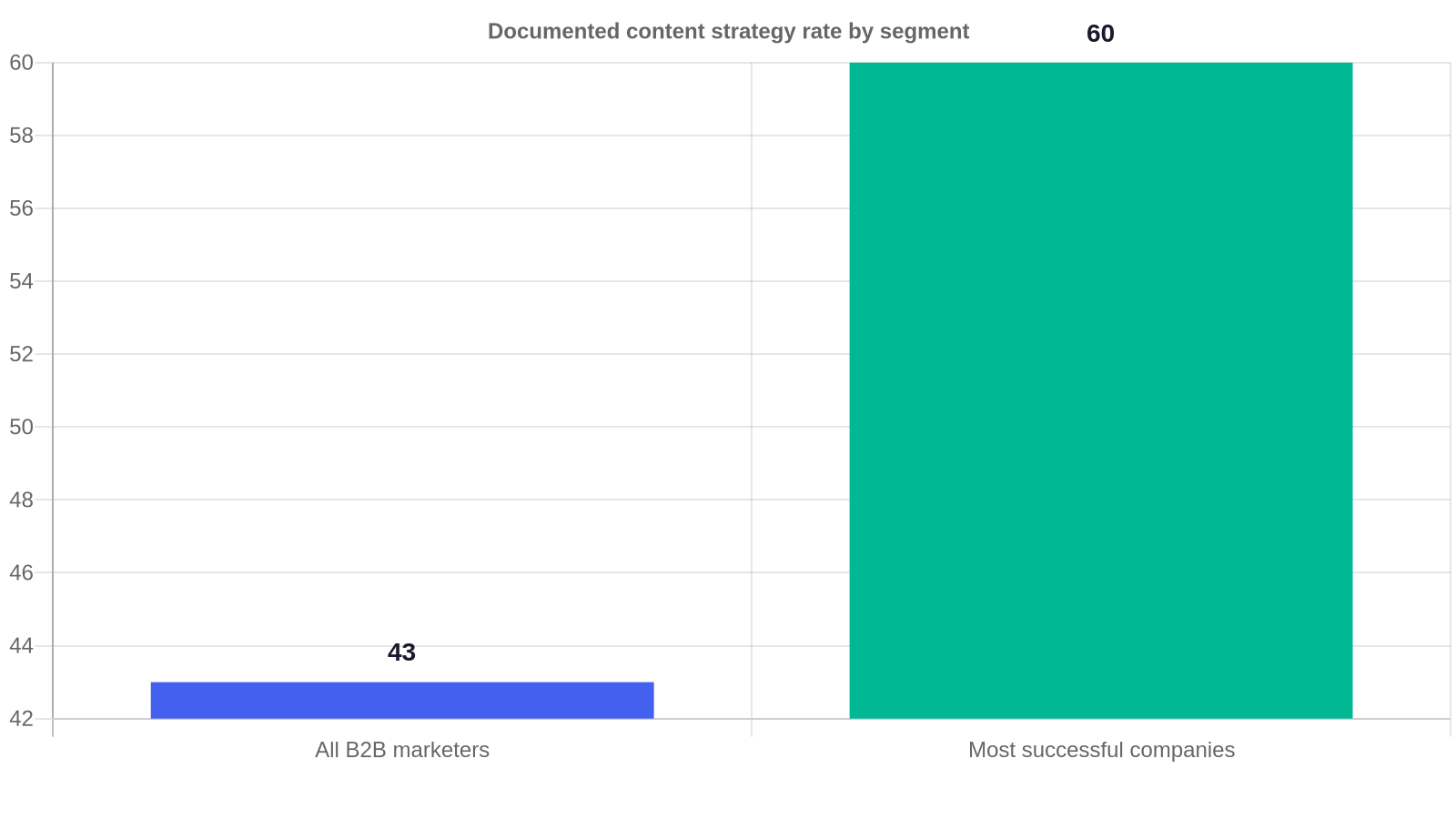
Here is the truth that fixes everything: content governance is not a department size. It is a set of repeatable rules. A two-person team can run the same control loops as a twenty-person team, it just applies them with lighter-weight tools and overlapping roles. This guide walks you through a lean governance model that works without enterprise software, with a worked example, a decision matrix, and a checklist you can download.
What Content Governance Is (and What It Is Not)
Content strategy decides what you create, why you create it, and for whom. Content governance decides how that content gets created, approved, stored, and maintained over time (Pantheon.io). If strategy is your destination, governance is your traffic rules. Without rules, the fastest teams end up with off-brand content, outdated claims, and a mess of half-finished drafts.
Governance has four jobs:
- Consistency: one voice, one set of standards across every channel.
- Accuracy: claims are checked, facts are sourced, no unverified numbers go live.
- Speed: clear roles and approval paths mean content does not sit waiting for a decision.
- Compliance: regulated claims, data privacy, CAN-SPAM, and accessibility are handled by someone.
Generative AI makes the accuracy job harder. Over 90% of marketers now use generative AI weekly, and more than half say it improved their work (Contentful, 2026). AI content needs its own governance layer, which is why a lean model must cover both human-written and AI-assisted content. I cover that specifically in the AI section below.
The Lean Governance Framework: 3 Policies, 4 Filters, 1 Routine
Most governance frameworks are built around enterprise roles. I named this one the 3-4-1 framework because it scales down to a solo operator and up to a five-person team. Three written policies define the standard. Four filters run every piece of content through a quality gate. One weekly routine keeps the whole thing alive. That is the entire model.
Here is the framework as a diagram:
The framework works because it separates the standard from the process. The three policies are the standard: they rarely change. The four filters are the process: every asset passes them before it publishes. The routine is the maintenance: it catches the decay that static policies miss. That last part is where most teams fail, because a governance document saved as a PDF on a server quietly stops being enforced. Your policies only work if they live in the places where your team actually creates content.
The Three Policies, in Plain Terms
Policies are one page each. Do not write a fifty-page manual nobody reads. Write three short, specific documents:
- Brand voice policy: your tone, your banned words, your messaging pillars, your target reader. This is the document a writer or an AI prompt references before drafting.
- Accuracy and sourcing policy: what counts as a verifiable claim, how a stat gets a source and a year, who checks the numbers before publish.
- AI use and approval policy: which tasks AI can speed up, which content tiers need human approval, and how AI outputs are logged.
Each policy sets a measurable standard. For example, the accuracy policy can set a target like “every published stat traces to a named source with a year” and the voice policy can specify “no more than one adjective per benefit claim.” Measurable beats vague.
The Solo and Small-Team RACI: Managing 6 Roles with 1 to 4 People
Enterprise guides list five core roles: content creators, editors and reviewers, approvers, content strategists, and content managers (Pantheon.io). On a small team, one person holds all five hats plus a legal and a specialist hat. If you are the entire content function on your own, our 90-day plan for a one-person content team lays out how to keep the volume up without losing the guardrails. The goal is not to hire for each role. The goal is to assign each responsibility to a named person so nothing falls through the cracks.
This decision matrix shows how the five enterprise roles map onto realistic small-team sizes. Use it to assign ownership before your next project, not after a fire starts.
| Responsibility | 1 person | 2 people | 3 to 5 people | AI assist |
|---|---|---|---|---|
| Create (drafts, SEO) | You | Writer | Writer(s) | First draft, outline |
| Edit (tone, clarity) | You, after a pause | Other person | Editor | Style pass, not final |
| Fact-check and source | You + external check | Editor | Editor or SME | Flag claims, verify manually |
| Approve (final sign-off) | Second person (or boss) | The other person | Strategist or exec | Never |
| Strategize (calendar, KPIs) | You | Lead | Strategist | Topic research |
| Manage (workflow, deadlines) | You | Lead | Manager | Task tracking |
The most dangerous cell is the Approver row on a one-person team. When you are the writer and the approver, you tend to approve your own mistakes. The fix is the “separate hat” rule: write, step away for at least a few hours, then return to edit and approve as if you are a different person. For factual claims, ask a colleague in a neighboring function, or the person in the company who knows the product, to sanity-check the specific claim. You do not need a legal department to verify a customer quote or a pricing figure, you need one knowledgeable second set of eyes.
The Zero-Budget Governance Stack
You do not need Acrolinx, an enterprise CMS, or a GTM enablement platform to govern content well. You need to make the free tools you already use enforce your standards. Three tools cover almost everything for a small team:
- Google Docs: version control, comments, and a clear folder structure give you a lightweight staging pipeline. Setup: a “Drafts”, “In Review”, “Approved”, and “Published” folder set, plus a naming convention like
2026-08-blog-governance-guide. - Trello or Asana: a Kanban board enforces your workflow stages. Setup: columns for Ideas, In Brief, Drafting, In Review, Approved, Published. Move cards through the columns so nothing skips a stage.
- Slack or Teams: a review-queue channel notifies approvers the moment content is ready, so nothing sits waiting.
Here is a comparison of an enterprise stack versus a lean stack, so you can see what you are actually trading away:
- Content governance platform (Acrolinx style)
- Enterprise CMS with approval modules
- Sales enablement + asset lineage tool
- Dedicated governance lead and content council
- Deep API integration across the martech stack
- Google Docs + folders (staging pipeline)
- Trello/Asana board (workflow stages)
- Slack/Teams review channel
- Overlapping roles + one accountable owner
- Manual checklists integrated into CMS
The lean stack gives you roughly 80% of the control at zero setup cost. You lose the automated, organization-wide enforcement and the deep analytics. You gain the ability to start today. For a small team, starting today beats a perfect rollout next quarter.
AI Content Governance for Small Teams
This is the section most governance guides get wrong. What “most guides miss” is that AI content governance is a different practice from general AI governance. General AI governance manages model selection, risk frameworks, and system development. AI content governance focuses narrowly on the output artifact and its trail: the prompt, the model version, the source documents, the reviewer, and the disclosure label (Snowflake, 2026). You do not need a data science team to govern AI content, you need a logging habit and a risk tier.
Use a three-tier review model so your approvals match the stakes of the content:
Point: spot review, log the prompt. No gatekeeper needed.
Point: human brand-voice check, source validation, editor approval before publish.
Point: subject-matter expert sign-off, retained audit trail.
The danger on a lean team is medium-risk content treated as low-risk. A blog post with a pricing claim or a customer quote is medium or high, not low. Before you publish anything that makes a claim about your product, your customers, or your competitors, a human must verify it against a source.
Here is the minimal AI output log you keep for any high-stakes AI-assisted asset (Snowflake’s model, simplified):
- Model name and version (for example, GPT-4 or Claude 3.5 Sonnet).
- Prompt input: the exact text you gave the model.
- Source documents: what you asked it to ground the answer in.
- Reviewer: the human who edited and approved it.
- Disclosure: whether you label it as AI-assisted, which matters under rules like the EU AI Act’s Article 50 transparency obligations.
Two specific AI risks deserve a direct warning. First, prompt pasting: when an employee drops customer records, contracts, or proprietary strategy into an external AI tool, that can be an IP and security leak (Snowflake, 2026). Decide what data is safe to paste before people start pasting. Second, copyright residue: AI output can mimic the recognizable style or structure of protected material. A human review catches that the same way it catches tone drift, which is one more reason the medium-risk review tier matters.
For a full framework on where AI belongs in your content workflow, see our guide to AI agents for B2B content marketing.
A 1-Page Content Intake and Review Workflow
“Random acts of content” is the phrase content teams use for unsolicited, unplanned, off-brand requests. They happen when there is no intake process. The fix is a one-page intake and review workflow that funnels every request through the four filters: on-message, fact-checked, on-brand, approved.
Here is the workflow as a step-by-step process:
- Request. Anyone submits a content idea through a short intake form: objective, target audience, key message, call to action. This is the Content Brief. It takes ten minutes and it filters out weak requests early.
- Triage. The lead reviews it against the editorial calendar and the strategy. Does it serve a current goal? If yes, proceed. If no, reject it with a reason or park it on a backlog.
- Assign. The request becomes a card on the board (Drafting column) with a named owner and a deadline. A brief without an owner and a deadline is a wish.
- Draft. The creator writes to the brand voice policy and the accuracy and sourcing policy. AI can produce the first draft.
- Filter 1, on-message. Does it match the brief and the strategy? Cut anything that drifts.
- Filter 2, fact-check. Every claim has a source. Every stat has a source and a year. Flag anything unverifiable for removal.
- Filter 3, on-brand. Read it against the voice policy. Remove banned words, tighten tone.
- Filter 4, approve. The approver signs off. On a two-person team this is the second person. On a solo team, it is a second set of eyes on the claims plus a fresh pass after a pause.
- Publish and log. Publish, record the URL and approval, and move the card to Published.
Here is how the filters prune a real example. Suppose your company, a B2B HR software firm, gets a request to publish “5 AI HR Trends for 2026.” The requester wants it out this week. Your brief comes back with no objective and no audience. Filter 1 catches it: without an objective it cannot be judged on-message, so it goes back for a one-line objective. When it returns with “generate demo requests from HR leaders at 200+ employee companies,” it clears Filter 1. The draft cites “AI adoption is exploding” with no source, so Filter 2 strips that line and the writer finds a sourced stat (for example, the 90% weekly GenAI usage figure). Filter 3 tightens the on-brand voice. Filter 4 gets a sign-off from whoever owns the HR vertical. The piece publishes on the board, and the whole cycle took three working days instead of three weeks, because the filters worked before the content hit the CMS.
That walked example shows the practical payoff: filters are not bureaucracy, they are the difference between shipping one strong piece and publishing five weak ones. When you need the mechanics of mapping these stages into your own production system, read our B2B content workflow template.
What Most Small Teams Get Wrong About Governance
Over several audit engagements, the same mistakes appear again and again. Here are the four that cost the most:
- They treat governance as a one-time document. A strategy written once and saved as a PDF is where governance dies. It stops being enforced the day after it is written. Governance is a daily habit, not a deliverable.
- They approve their own work with no second set of eyes. The solo writer who also approves misses their own hallucinations, tone drift, and unsupported claims. The separate-hat rule is non-negotiable.
- They apply the same review weight to everything. Reviewing a brainstorm and a pricing webpage with the same process slows you down and still misses the high-stakes claim. Risk-tiered review, not blanket review, is the answer.
- They let AI output skip the filters. AI drafts are faster, so teams rush them live. That skips fact-checking and brand review exactly when hallucinations are most likely.
One unnamed organization found the consequences in a live audit: only 6% of its content had been reviewed before publishing, against a goal of 75% (Acrolinx, 2026). Another audit showed terminology compliance at 44% overall and as low as 12% in sales content, a number the team pushed toward a 70% target by the following February (Acrolinx, 2026). Those are not exotic failures. They are what happens when governance is a folder on a drive instead of a routine.
The 20-Minute Friday Governance Routine
Sustainability is the part every guide mentions and few teach. You need one recurring routine that prevents governance from decay. Book 20 minutes every Friday and run these three checks:
- Alignment (2 minutes): scan the week’s published content against the calendar and the strategy. Did everything serve a goal?
- Accuracy sweep (12 minutes): spot-check this week’s published claims. Are the stats sourced? Are any now outdated? Fix or flag anything broken.
- Housekeeping (6 minutes): move stuck board cards, close approvals, and update the AI output log. Check that nothing is sitting in “Review” without an owner.
The routine matters more than any single policy because it is the feedback loop. A one-page strategy plus a weekly review beats a fifty-page manual read once a year. This is why the 3-4-1 framework puts a single routine at the core rather than a library of documents. If you want to formalize the wider operating rhythm, the B2B content operating system guide ties governance to the full production cycle.
Governance Questions, Answered
Is content governance only for large companies?
No. Governance is a set of rules, not a headcount. A two-person team runs the same control loops as a large team, with overlapping roles and free tools. What changes is the weight of each control, not the need for them.
How do I govern AI content without a legal team?
Use the three-tier review model. Verify every factual claim against a source, log the prompt and model for high-stakes assets, and get a human sign-off before anything with a customer or pricing claim publishes. You do not need legal for that. You need a habit.
What is the fastest complete governance setup?
One day. Write three one-page policies, set up a review board with four columns, and book the Friday slot. That is the entire 3-4-1 framework, and it fits in a single afternoon if you keep each page short.
How do I stop sales from using outdated decks?
Make the “net new or updated asset” the only version with an “Approved” label, put that label in a shared location everyone opens, and retire old versions by moving them to an “Archive” folder. On a lean team, a shared drive with clear labels beats a sales enablement platform.
Should every stat in every post have a source and a year?
For claims that could be challenged, yes. Data points you use to make an argument should trace to a named source with a year so a reader or a future you can verify it. Common knowledge can skip the citation, but borderline claims cannot.
What is the difference between content strategy and content governance?
Strategy says what, why, and for whom. Governance says how it gets created, approved, stored, and maintained. Strategy without governance produces random acts of content; governance without strategy produces rules with no direction. You need both, and they are not the same document.
What To Do Next
Start your governance model today, not after the next content fire. Here is your order of operations:
- Write the three one-page policies (brand voice, accuracy, AI use). Reuse your existing style and strategy documents rather than starting cold.
- Set up the review board with the four columns and move this week’s content through it.
- Book the Friday 20-minute routine.
- Assign every responsibility in the RACI matrix to a named person, even if that person is you wearing different hats.
To make step one fast, download the Lean B2B Content Governance Checklist below. It turns the three policies, the four filters, the RACI matrix, and the Friday routine into a checklist you can copy and start using immediately.
Lean B2B Content Governance Checklist (.zip)
A fillable checklist for the 3 policies, 4 filters, RACI matrix, and Friday routine. Built for 1-5 person teams.
