
What AI-Driven B2B Personalization Actually Changes
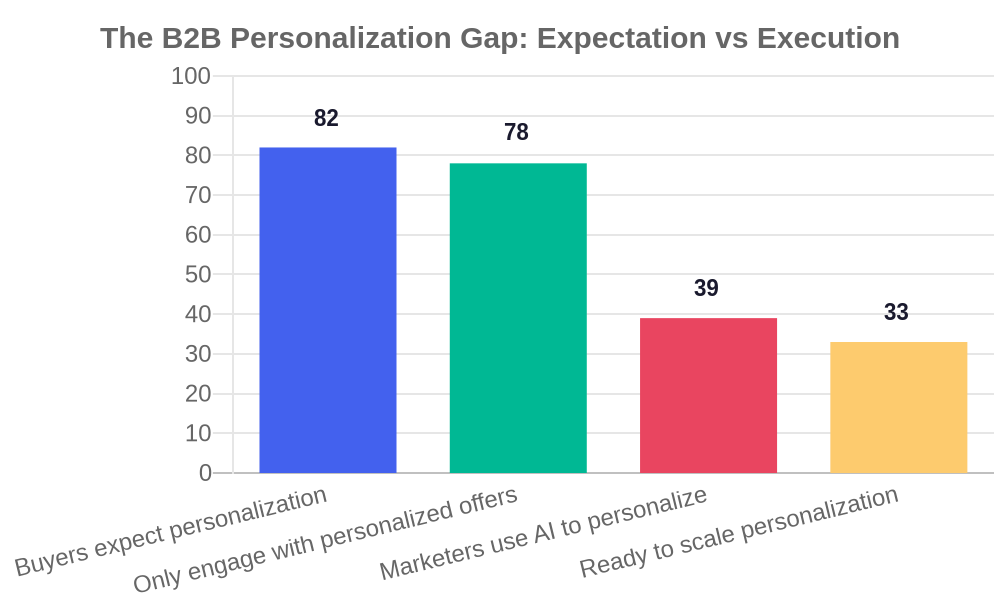
AI-driven B2B personalization finally makes buyer-level content affordable, but only 39% of B2B marketers use AI for it while 82% of buyers expect it. That gap is the opportunity. This guide shows you how to scale ABM content that converts without burning out your creative team or chasing 1:1 for every account.
Most B2B teams treat personalization as a naming trick. They swap in a first name, change the subject line, and call it done. That is segmentation pretending to be relevance. Real AI personalization changes what content a buyer sees, which section they read first, and what outcome you position for their specific environment. Done right, the numbers are hard to ignore. Demandbase’s analysis shows companies that execute personalization correctly see a 10% to 15% revenue lift, and effective website personalization produces 50% higher form submissions and 60% longer time on site.
The catch is that most guides miss the hard parts. They tell you to generate more content and swap more names, but they ignore the trust or “overwhelm” paradox, the compliance void, and the way buyers now research with AI. This post covers what the top-ranking pages skip.
Why B2B Personalization Is Not B2C E-Commerce
B2B personalization runs on a different engine than B2C, and teams that borrow retail tactics get stuck. B2C optimizes for single behaviors like cart abandonment and browsing history. B2B buying involves 6 to 10 stakeholders who evaluate a solution over a multi-month cycle, so the unit of personalization is the account and its buying committee, not one individual.
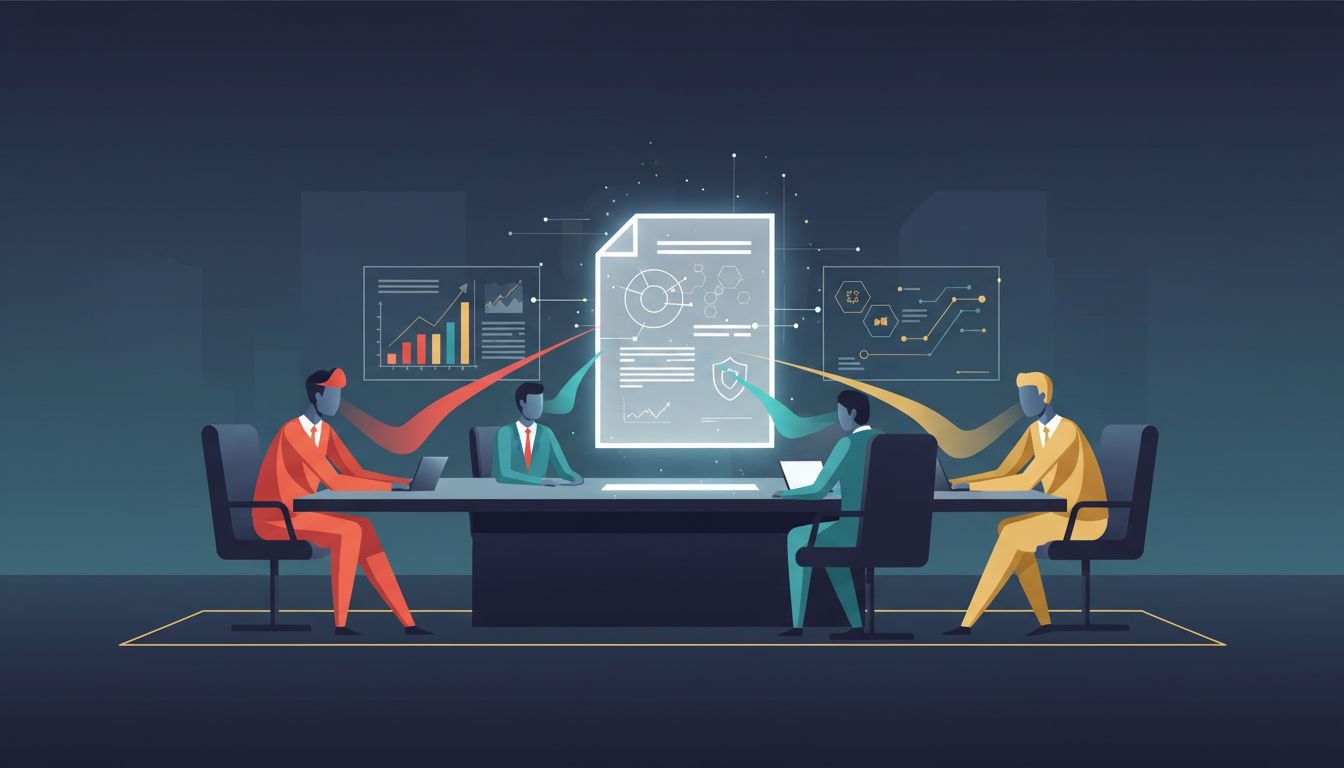
The commercial stake is higher, but so is the complexity. A CFO wants ROI and risk reduction. An IT lead wants security and integration. An end user wants workflow and adoption detail. A single static asset cannot serve all three. That is why the best B2B personalization today multi-threads one document, using dynamic fields and conditional sections so each stakeholder sees the proof that matters to them.
This account-level reality is what separates B2B from B2C. When you build for the buying committee instead of the individual, you stop optimizing vanity clicks and start optimizing for the group that actually decides.
The New Risk Most Teams Ignore: Personalization Overwhelm
Personalization is not an unalloyed good, and the data proves it. Gartner data cited by Demandbase shows that for 53% of buyers, personalization created a negative experience in their most recent purchase journey. Buyers exposed to hyper-personalization were 2x more likely to feel overwhelmed by information and 2.8x more likely to feel rushed.
Scaling personalization without restraint actively repels prospects. The paradox is real: the more you fire tailored content at a buyer, the more you risk pushing them to disengage. Restraint is a feature, not a bug. Personalization should reduce the amount of irrelevant information a buyer must wade through, not multiply the total volume of messages they receive.
What most guides miss: the goal is relevance, not volume. A personalized experience that surfaces the single right proof point beats a barrage of thirty tailored touches.
The 90-Day ABM Personalization Framework
Here is a named framework you can run with. The 90-Day ABM Personalization Framework moves you from zero to buyer-level relevance in three phases, and it is built around the three ABM tiers rather than 1:1 for every account.
The framework works because it starts with one template and one set of accounts instead of pretending you can personalize everything at once. A minimum viable program with one personalized content template connected to your CRM can be deployed to your top 50 accounts in four to six weeks. A full three-tier program with automated dynamic personalization and CRM-connected analytics takes three to four months. Both timelines are realistic, and they give you a roadmap instead of a cliff.
How to Multi-Thread the Buying Committee in One Asset
The single highest-impact move in B2B personalization is structuring one asset to serve every stakeholder in the buying committee at once. Most teams create separate decks for each persona, which multiplies production and drifts out of sync. Multi-threading keeps one source of truth.
Here is how a modular master document is structured. You define dynamic text blocks and conditional sections that render based on the viewer. The CFO path leads with ROI proof and risk reduction. The IT path leads with security, compliance, and integration. The end-user path leads with workflow, usability, and adoption. Each reader sees a document tailored to their concern, but you maintain only one asset.
The value shows up in real outcomes. OneAdvanced generated over GBP 3 million in influenced pipeline using Salesforce and Turtl’s approach to personalized content across ten sectors. Telenet reached an 88% conversion rate and booked 4x more meetings in 60 days using personalized ABM. Kantar drove a 550% increase in marketing-attributed revenue with the same approach.
This is the practical tool for multi-threading. It is the difference between producing one asset per persona and producing one asset that covers an entire committee. The former scales by adding people. The latter scales by adding conditions, and that is what makes buyer-level personalization feasible without creative burnout.
Data, Consent, and the Compliance Void
Personalization only works on clean data, and most teams do not have it. Data silos are the biggest challenge for 68% of organizations, and 98% of organizations report that poor data quality impedes AI success. Only 39% of B2B marketers use AI for personalization, largely because they lack the data foundation.
The first-party data deficit is severe. Only 45% of B2B marketers use named-account data. Usage drops for basic first-party signals like form-fills (31%), engagement history (30%), and buyer stage (29%). You cannot personalize what you do not store.
The cookie-less shift makes this worse. With third-party cookies phased out, direct first-party data and real-time CDP identity resolution are survival requirements. There is no shortcut back to third-party tracking.
On the compliance front, the gap is alarming. Only 17% of sales organizations have a formal AI ethics policy. Automated AI outreach at scale runs real legal risk: GDPR fines up to EUR 20 million or 4% of annual global revenue, and CCPA penalties up to USD 7,500 per intentional violation. Enterprise personalization needs built-in data minimization and strict role-based governance, not just a slick tool.
What most guides miss: compliance is a design constraint, not an afterthought. Build data minimization into the personalization workflow from day one, and you avoid the catastrophes that come from mass automated outreach with no oversight.
AI Personalization vs. Basic Segmentation: Use This Decision Matrix
Use this matrix to decide whether a given touch deserves full personalization or just segmentation. It saves your team from over-engineering low-value touches.
Worked example: an industrial equipment company with 300 target accounts split them by value. For the top 40 accounts they used AI personalization with buying-committee multi-threading and doubled qualification conversion while lifting sales conversions 25%. For the remaining 260 long-tail accounts they used simple segmentation and preserved margin. Both groups improved, but the budget went where the revenue was.
The Step-by-Step Workflow to Launch Personalization This Quarter
Here is the workflow your team can run this month, from data to live asset in five steps.
- Run the 5-question readiness audit. Is contact data clean? Does data flow automatically between CRM and ad platforms? Have you mapped the buying committee of priority accounts? Are sales and marketing aligned on a shared target list? Is there a named owner to interpret outputs? If you fail two or more, fix the data before buying tools.
- Pick your top 50 accounts and one asset. Choose the highest-value accounts and a single report or landing page to personalize. One template, one source of truth, one outcome to test.
- Build the modular master with conditional paths. Add dynamic blocks for the CFO, IT, and end-user paths. Define the variables that change (proof points, sections, outcome) rather than static text.
- Connect it to CRM and deploy. Use batch variable injection and CRM trigger logic so the right version reaches the right stakeholder. Deploy to the top 50 accounts in four to six weeks.
- Measure account-level outcomes, then expand. Track account engagement, stage velocity, and content influence on closed revenue. When the MVP proves out, add the one-to-few and one-to-many tiers.
Worked mini-example: a fictional but realistic logistics software vendor named FreightOS targeted 50 accounts. In step one, its audit found data silos between its marketing platform and Salesforce, so it spent two weeks on cleanup. In step three it built one modular report with an ROI path for COOs, a security path for IT, and an integration path for ops leads. In step five it saw the COO path outperform by 41% on time spent, and it used that signal to expand the one-to-few tier for its vertical. The method is demoable, not abstract.
Running the Three ABM Tiers in Parallel Without Adding Headcount
The trap is assuming personalization means 1:1 for every account. It does not. Mature ABM programs run three tiers at once, each with a different depth of personalization, and together they cover the whole target list without multiplying your headcount.
Tier one: one-to-one strategic plays. These target a handful of named, high-value accounts. They get full buyer-level personalization with custom research, hand-built conditional assets, and direct sales involvement. They are expensive per account, so you reserve them for the accounts that justify the cost.
Tier two: one-to-few verticalized campaigns. These cluster accounts by industry or tier, then personalize the shared template for each cluster’s specific regulatory and commercial context. You get most of the relevance at a fraction of the per-account cost, and this tier is where AI content generation pays for itself.
Tier three: one-to-many scaled programs. These use dynamic personalization and CRM trigger logic across the long tail. Variables swap in automatically, intent signals decide who sees what, and human review focuses on exceptions rather than every asset. This is the tier where modular masters and batch injection earn their keep.
Running all three tiers at once is expected of a mature program, and the roadmap supports it. The MVP starts in tier one with your top 50 accounts. Once the modular master and CRM triggers are stable, you expand to tier two and tier three. The framework keeps all three tiers fed from one asset library, so scale never means tripling the writing team.
Where to Start: A Worked Example That Makes the Method Concrete
Consider a fictional but realistic cybersecurity vendor, VertexDefend, that sells to mid-market technology companies. Its buying committee includes a CISO focused on compliance, a CTO focused on integration, and a procurement lead focused on total cost of ownership.
VertexDefend ran the readiness audit first and found its CRM data was clean but its ad account was disconnected, so it fixed that flow before anything else. Then it built one modular master report with three conditional paths: a compliance path for the CISO with audit and regulatory checklists, an integration path for the CTO with architecture and API detail, and a cost path for procurement with TCO benchmarks and pricing scenarios.
It deployed that single report to its top 50 accounts through a real-time CDP and CRM trigger logic. Inside 60 days, the CISO path saw the deepest engagement, which told the sales team where product objections lived. VertexDefend then built a verticalized tier-two variant for its two highest-volume industries. The whole program ran on one content manager and one demand-gen lead because the modular master removed the need for bespoke assets. That is the demonstrated shape of the method, and it transfers to any B2B team, whatever you sell.
The Next Frontier: Packaging Content for AI-Assisted Buyers
Your buyers are now researching with AI, and most guides miss this entirely. Buying committees use AI tools to compare vendors behind closed doors, and machine-readable content is becoming a survival requirement. If an AI agent cannot parse your page and quote it in a shortlist, your brand gets excluded before a human ever sees it.
This is the AI-to-AI buying loop. It means structuring content with clear headings, direct answers, extractable stats, and schema so both a human buying committee and an AI research agent can surface your claims. The same inline snippets and FAQ schema that help you rank help AI systems cite you.
Practical steps: answer the searcher’s question directly in the first sentence of each section, keep key numbers in plain text, and markup FAQs with structured data. Your personalization should extend to how machines discover you, not just how humans experience you. Pair this with our guide on standing out when everyone uses AI, because the buyers an AI shortlists are the ones whose content is structured to be found.
Drop the vanity metrics. A high open rate on a single email does not prove account readiness. Account-level metrics connect your personalization to pipeline, which is what your CFO and your CRO both require.
What Most Teams Get Wrong About Personalization
Here are the four errors that sink most B2B personalization programs.
1. They mistake adoption for strategy. 91% of B2B marketers use AI in their ABM programs, but only 19% have a formal execution plan. Marketers rate their generative AI maturity at just 2.3 out of 5. Buying a tool is not a strategy.
2. They personalize the wrong unit. They optimize for a single individual instead of a buying committee. A page that converts an individual who has no budget authority is an empty win.
3. They scale volume instead of restraint. Hyper-personalization that overwhelms the buyer produces negative experiences for 53% of buyers. Your goal is fewer, more relevant touches.
4. They skip compliance until it bites. Only 17% of sales teams have AI ethics policies. The fine and reputation risk of mass automated outreach is real and growing.
Frequently Asked Questions
What is the difference between segmentation and personalization?
Segmentation groups accounts by broad firmographics like company size and sends the same content to everyone in the group. Personalization changes what each account sees, which section they read first, and which outcome you position. Segmentation is a starting point; personalization is the execution layer that makes each high-value account feel understood.
How much personalization does a small B2B team actually need?
Start with buyer-level personalization for your top 50 named accounts and segmentation for the long tail. A minimum viable program with one personalized template connected to your CRM deploys in four to six weeks. Do not try to personalize everything at once. The ROI concentrates in your highest-value accounts.
What data do I need before starting AI personalization?
You need clean firmographic data, a mapped buying committee for priority accounts, and either first-party behavioral data or intent signals. Only 39% of B2B marketers have the data foundation to use AI for personalization, so fixing data silos first is the highest-impact move. In a cookie-less world, a real-time CDP for identity resolution is increasingly essential.
How do I keep personalization from feeling creepy or overwhelming?
Apply restraint. For 53% of buyers, over-personalization creates a negative experience. Personalize to reduce irrelevant information, not to tag every interaction. Use the buyer’s explicit signals and limit the number of tailored touches. Transparent data practices build trust, not gimmicks.
Can AI-personalized outreach violate GDPR or CCPA?
Yes, if you scale it without governance. GDPR fines can reach EUR 20 million or 4% of annual global revenue, and CCPA penalties reach USD 7,500 per intentional violation. Only 17% of sales teams have AI ethics policies. Build data minimization, consent management, and role-based access into the workflow from the start.
What metrics should I track for B2B personalization?
Track account-level metrics: Account Engagement Rate, Stage Velocity, Content Influence on Closed Revenue, and Win Rate by Personalization Tier. These connect personalization to pipeline. Open rates and click-through rates are vanity metrics that do not prove account readiness.
What To Do Next
Run the 5-question readiness audit this week, fix your highest-value data silo, and pick your top 50 accounts. Build one modular master document with conditional paths for the CFO, IT, and end-user. Deploy it in the next four to six weeks, measure account-level outcomes, then expand to the one-to-few and one-to-many tiers.
Pair this guide with our B2B content marketing strategy for the operating plan and our repeatable content engine for the production system. For the trust side of personalization, read how to make your content stand out in the AI era. And see what the numbers say when teams get personalization right.