

Confident AI content is shipping across the B2B web with a factual error rate that most teams never measure. An AI accuracy audit is a repeatable process to find and fix those errors in what your team already publishes, before buyers or AI search engines cite something wrong.
This guide gives you a working audit procedure, not a warning. You will learn the four kinds of sub-factual errors AI produces, why a normal proofread misses them, a named three-layer framework your editors can use this week, and a step-by-step workflow with a worked example. A full checklist is included as a downloadable spreadsheet.
What counts as a factual error in AI content
A factual error is any claim that is wrong, unverifiable, stale, or misattributed, even when the sentence reads smoothly. Most teams only look for the obvious inventions. The costly ones hide as four distinct types.
The four kinds of sub-factual errors
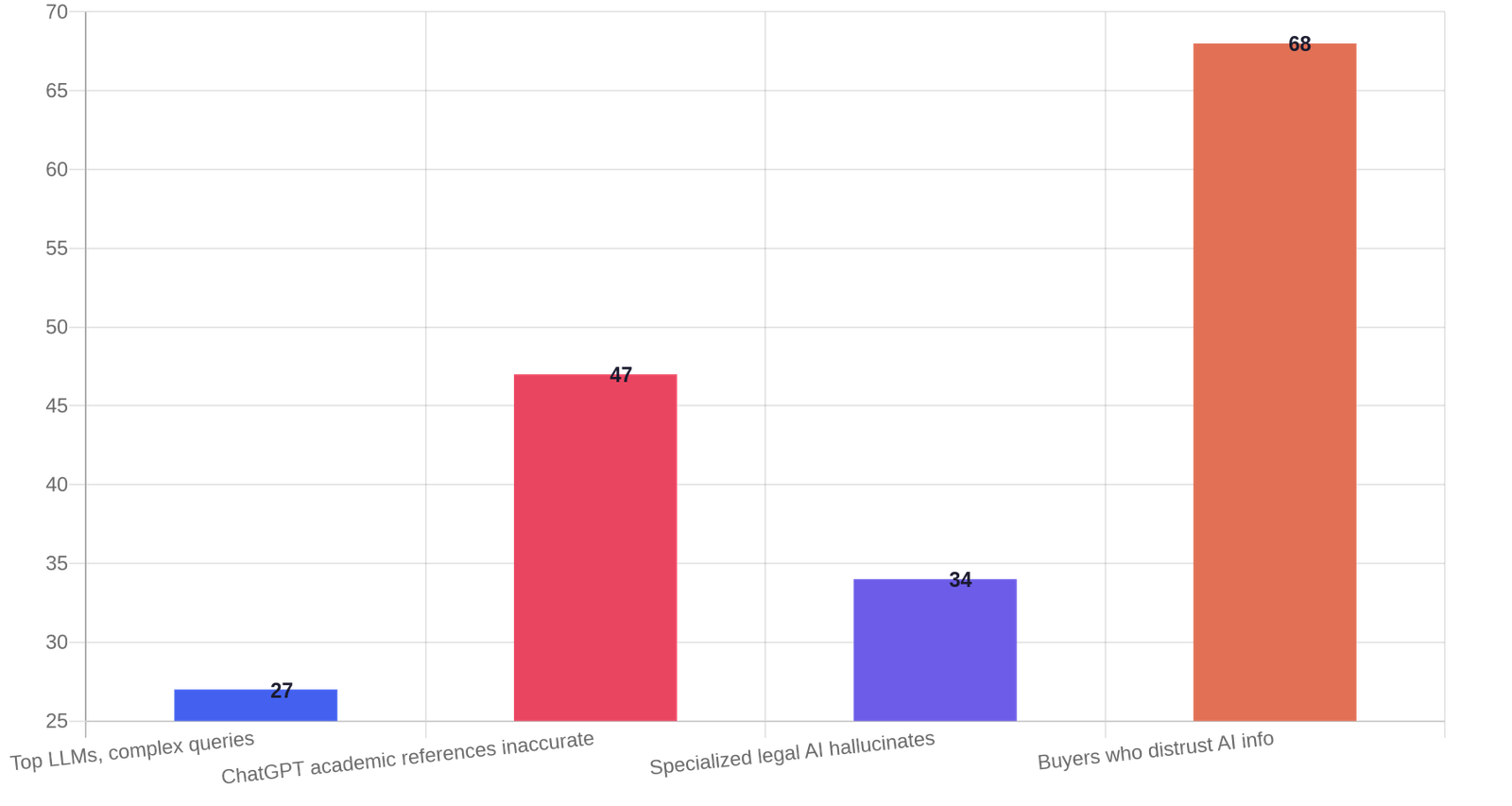
Fabrication. The model invents a stat, study, citation, or case study that does not exist. University researchers catalog the ways AI can give wrong answers, omit information, and make up fake entities. A National Institutes of Health review found that up to 47% of ChatGPT-generated references were inaccurate, and in one trial only 7 out of 115 generated references were authentic and accurate. This is the highest-risk error because it reads as perfectly sourced.
Conflation. The model merges or confuses two similar entities: two companies, two products, two versions of a policy. Air Canada’s chatbot in 2024 invented a bereavement fare refund policy that did not exist. A Canadian tribunal ruled the airline was responsible for its chatbot’s output and ordered it to pay the fare difference. The risk is not the single sentence; it is that a reviewer skims a plausible but wrong product attribute past the gate.
Staleness. The claim was true once but is no longer true. Prices, headcounts, features, and “as of” dates decay fast in B2B. A Microsoft Start travel guide once listed the Ottawa Food Bank as a tourist hotspot and told visitors to arrive on an empty stomach. An entertaining example, but the same mechanism quietly ships an outdated pricing page.
Misattribution. The model attaches a claim to the wrong source, or turns a paraphrase into something that looks like a direct quote. A hallucinated citation is worse than none, because it grants false authority to a fabricated fact.
None of these require a dramatic failure. In the 2023 Google Bard launch, the model stated the James Webb Space Telescope took the first pictures of a planet outside our solar system. The milestone had been reached sixteen years earlier. The single error erased roughly $100 billion of market value in a day. Your team will not lose $100 billion over a typo, but every confidently wrong stat carries the same shape of risk.
What most teams get wrong about AI accuracy
Most teams treat AI errors as a proofreading problem. They are not. A proofread checks grammar, flow, and spelling. which your human-in-the-loop review process should enforce Here are the four failures that show up in almost every team that starts scaling AI output.
They trust confidence as a signal of accuracy. Language models are well calibrated to sound authoritative, not to be correct. IBM defines AI hallucinations as outputs that sound plausible but are factually wrong. A 2023 Nature paper used the phrase “hallucinations are confident inaccuracies.” The confidence is the problem. Readers and editors both relax when a sentence reads fluently, and fluency has no correlation with factual accuracy. You must separate style quality from factual quality and audit them as independent dimensions.
They only fact-check the numbers they can see. A stat with a percentage sign invites scrutiny. A vague claim with no number, like “industry leaders are moving toward,” ships unchecked every time. In B2B content, the damaging claims are often the qualitative ones: positioning statements, feature benefits, compliance guarantees, and “most companies” assertions that carry no citation marker.
They never check recency. A correct 2022 stat about a market that changed in 2024 is a factual error in 2026. Staleness is the most common silent error in published B2B content, and it compounds because content governance and refresh cycles are slow Measure your worst-performing posts and you will find “as of 2022” paragraphs still ranking.
They audit drafts, not the live page. Errors get caught in review and then reintroduced on publish, or the on-page schema contradicts the visible copy. The audit must run on what actually renders, not on the Google Doc that came out of the model.
Here is the reframe that changes the outcome: treat a factual error as the result of holes in three layers lining up, not as a single mistake by a careless model. Fixing one layer rarely fixes the pipeline. You close the gaps across all three.
The Layer Audit: a three-layer framework for catching AI errors
Build every AI content review on three stacked layers: Source, Claim, and Frame. An error ships only when a hole in all three layers lines up. Audit each layer with a distinct test, and the holes stop aligning.
Apply the Layer Audit in risk order. High-risk content (pricing, compliance, regulated claims, testimonials) requires all three layers checked by a human against primary sources. Medium-risk content (blog posts, how-tos) requires Source and Claim checked, with Frame reviewed for overwriting. small-team content governance keeps the decision lightweight
What most guides miss is that the layers are not a checklist you run once. They are a filter you run at content type boundaries. The same claim crosses the Source layer cleanly at draft time, then the page goes through a refresh, and the Frame layer silently resets with new headlines and title tags. Re-audit at every publish boundary.
How to run an AI content accuracy audit: a six-step workflow
Run this workflow quarterly on your live library and on every new AI-assisted draft before it publishes. Each step has a pass, fail, and fix action so the audit is a procedure, not a vibe.
Step 1: Inventory and risk-tier your AI content
Audit everything, but not equally. Pull your post list and tag each URL by risk tier. High-risk pages are pricing, product spec sheets, compliance, testimonials, and anything with legal or financial consequence. Medium-risk pages are blog posts, how-tos, and comparison guides. Low-risk pages are internal docs and email sequences.
Worked example. Take a fictional B2B security vendor, SecureTrack. Its blog published 40 posts last quarter, most AI-assisted. Its editors tier 6 pages as high risk (two pricing pages, a SOC 2 overview, a compliance FAQ, two customer stories). They audit those six first, every quarter, against primary sources. The 34 medium pages get a Source and Claim pass. Two support pages never get a pass because their risk is low.
Step 2: Run the Source pass on every claim
For each claim that cites a source, statistic, study, or named entity, do the open-the-link test, the core of any serious fact-checking workflow for AI output. Open the citation. Confirm the number appears there. Confirm the year is right. For a claim with a number but no source, treat it as a flag, not a pass. For a claim with no number but an authority assertion (“research shows”), flag it for either a real source or a rewrite that drops the assertion.
This is where the NIH finding matters: up to 47% of AI-generated academic references were inaccurate. That means you cannot trust a citation until you open it. A citation that resolves to the wrong page, or to a page that does not contain the claim, is a fabrication and must be cut or replaced with a real source.
Step 3: Run the Claim pass on correctness and recency
For every number, date, price, headcount, and percentage, confirm it is both true and current. Ask: is this still true in 2026? Is the “as of” date on the page? Would a reader act on this number and be misled? If the market or product changed, the stat is stale even if it was once accurate.
Press on the qualitative claims too. “Leaders are moving to unified platforms” is a claim. It needs a source or it needs softening to “some teams are consolidating tool stacks.” Unsupported superlatives are factual errors in the Frame layer because they overstate.
Step 4: Surface-proof names, quotes, and links
Every company name, product name, person, and direct quote gets verified. Confirm spelling, entity, and context. Verify that every internal link resolves to a real page on your site, not a guessed slug, and that every external link returns a working page at the right URL. A broken or misattributed link in an AI-assisted post is a credibility leak you can fix in minutes.
Step 5: Scan for AI’s stylistic tells that hide errors
Run a separate pass for semantic drift and AI hyperbole. AI output flattens toward generic authority: “open up,” “revolutionary,” “game-changing,” “seamlessly.” These fillers are not themselves wrong, but they mask the absence of a verifiable claim and they make the content read as machine-generated. Soft-censor them. If a bold claim survives the Source and Claim passes and gets rewritten in your brand voice, keep it. If it was only there to sound important, cut it.
Step 6: Fix, log, and feed errors back upstream
Correct each error you found, record the type and the layer that failed, and log it where your prompts and guidelines live. This is the step most teams skip, and it is the one that compounds. If you audit three times and every error is a fabricated citation, change the reviewer’s process, not just the sentence. Feed the error pattern into your model instructions: add a negative constraint such as “if a risk is not explicitly mentioned in the source, do not infer it.”
A 2024 Stanford study found that combining retrieval-augmented generation, reinforcement learning from human feedback, and systemic guardrails cut hallucinations by 96%, part of the practical guidance MIT offers on addressing AI hallucinations and bias. The audit is the systemic guardrail on your side of the model. It converts a model weakness into a team process.
Decision matrix: when must a human verify every claim
Not every piece of content deserves the same verification depth. Use this matrix to route work by risk and consequence, so you protect high-stakes pages without burning editorial time on low-risk ones.
Use the rule of consequence. If being wrong is expensive or harmful to a buyer decision, route the page to high. If being wrong is mildly embarrassing, route it to low. The matrix keeps your most trusted pages airtight and your throughput fast everywhere else.
What the audit does for AI search visibility
An accuracy audit is also an AI search strategy. Generative engine optimization (GEO) research shows that content with structural clarity and verifiable statistics can lift a brand’s visibility inside AI Overviews and AI search answers by up to 40%. Errors do the opposite: an AI model that finds a wrong stat in your content is less likely to cite you, and a hallucinated citation actively trains the model away from your site, which is why building credibility in the AI era starts with accuracy. An accuracy review belongs in any solid B2B content marketing strategy alongside your distribution plan.
AI search engines favor pages that answer the core query directly in the first 20 to 30 words, a pattern called Bottom Line Up Front, or BLUF. They also prize extractable facts over vague prose. Every sourced statistic in your content is a candidate for a citation. Every wrong one is a liability. Auditing for accuracy is therefore not a cost center; it is the mechanism that makes your content eligible to be pulled into AI search answers.
Prevent errors at the model level before you audit them away
An audit catches errors after they exist. You cut most of them earlier by changing how the model generates in the first place. The two levers that matter in production are grounding and constraint, and both are cheap to set up.
Ground the model in a closed knowledge base. Retrieval-augmented generation forces the model to answer from a curated set of your approved sources instead of whatever it learned during training. Point it at your brand guide, your product documentation, and your verified-stat library. A 2024 Stanford study measured that combining RAG with reinforcement learning from human feedback and systemic guardrails reduced hallucinations by 96%. The single biggest lever is telling the model which facts are allowed.
Lower the temperature for factual output. The temperature parameter controls how random the output is. For factual, well-defined drafts, set it low, in the range of 0 to 0.3, to get focused and consistent text. Reserve high temperature, around 0.7 to 1.0, for open-ended brainstorming where variety is the point. Teams that leave the temperature at the default for every task are tuning their factual content for creativity they do not want.
Add negative constraints, not just instructions. A prompt that says “be accurate” does little. A constraint that says “if a statistic is not explicitly present in the provided source, do not state it, and mark this as [UNSOURCED]” changes behavior, because it gives the model a defined fallback. Negative constraints are the mechanism that stops the model from producing or passing along an invented claim.
When you set these up, keep the Layer Audit running anyway. Grounding and constraints cut error rates dramatically, but they do not reach zero. The national guidelines and academic reviews cited above describe a 96% reduction, not elimination. You still need the Source and Claim passes as the final gate, and you still need to re-check that a fresh prompt or a new model version did not silently reset your grounding.
Changes also fail silently. A team updates a product spec, forgets to update the knowledge base the model reads, and the model keeps citing the old spec. The audit is how you catch that mismatch. When you find it, update the knowledge base, not just the sentence, so the corrected fact flows into the next draft.
Make the audit a repeatable team routine
The audit scales only if it is a routine, not a heroic cleanup. Assign a named owner, set a cadence, and keep a running error log. Without these, the procedure drifts and the errors return.
Assign a named accuracy owner. One person owns the audit for the library, even on a two-person team. They schedule the quarterly pass, decide which pages drop into high risk, and hold the error log. Ownership matters because an audit with no accountable owner quietly becomes a checklist nobody runs.
Set a cadence and stick to it. Quarterly for the full library, on every change for high-risk pages, and a Source and Claim pass on every AI draft before publish. A calendar of four audit weeks a year is easier to defend than a vague “we will check things regularly.”
Keep a categorized error log. Record each error by type (fabrication, conflation, staleness, misattribution) and by the layer it slipped through (Source, Claim, Frame). After two cycles you will see a pattern: this team is heavy on stale process pages, that team is heavy on fabricated citations from legal content. Feed the pattern back into prompts and guidelines, and the same error stops recurring.
The second-order benefit compounds. Every verified stat in your content becomes evidence an AI search engine can safely cite. Every error you remove from your live pages stops teaching the model a false fact about your brand. An accuracy audit is the cheapest long-term investment your content operation makes, because it protects the one asset that determines whether the next buyer or the next AI agent trusts what you publish.
Frequently asked questions
How often should we run an AI content accuracy audit?
Run a full audit quarterly on your live library, and a pre-publish Source and Claim pass on every AI-assisted draft. Content that changes often, like pricing or product pages, should be audited on every change, not on the calendar.
Do we need a tool to detect AI errors, or can humans do it?
You need both. Detection tools flag likely hallucinations and unsupported claims, but they produce false positives and they cannot judge whether a specific claim is true in your context. The human audit verifies against primary sources. Treat the tool as a triage filter, never as a verdict.
What is the single highest-risk error in AI B2B content?
The fabricated citation, where the model invents a source that sounds real. It reads as authoritative, survives a casual review, and undermines trust if a buyer or an AI search engine exposes it. Audit every citation by opening the link.
How do we stop AI from writing wrong statistics in the first place?
Lower the model’s temperature for factual output, ground it with retrieval-augmented generation against a closed knowledge base, and add negative constraints to prompts that forbid unsourced claims. Then verify what is left, because no prompt fully eliminates error. The audit remains the backstop.
Is auditing worth it for a small team with a high content volume?
Yes, if you risk-tier. A two-person team can audit the small set of high-risk pages fully and apply a lighter Source pass to the rest. The cost is concentrated where being wrong is expensive. Without risk-tiering, the audit either gets skipped or eats your entire budget.
Can an accuracy audit improve our rankings?
Indirectly, yes. Accurate, verifiable content is more likely to be cited by AI search engines, and clean internal and external links support your existing SEO. The direct driver is a better citation profile, not a ranking boost, so treat accuracy as a trust investment that compounds.
What to do next
Start small. Pick your five highest-risk published pages and run the Source pass on them this week. Open every citation, confirm every number, flag every unsourced claim. Then fix what you find and log the error type. In the next cycle, add the Claim pass and the Frame review. Wrap the whole procedure in a checklist and reuse it on every draft.
Download the AI Content Accuracy Audit Checklist to run the Source, Claim, and Frame passes with a scored pass, fail, or N/A column and a risk-tiering guide built in.
