

What Is B2B Video Content Marketing (and Why Lean Teams Should Care in 2026)
B2B video content marketing is the practice of producing and distributing video assets that move a B2B buyer from awareness to decision, and in 2026 it is not a nice-to-have, it is table stakes. 91% of businesses now use video as a marketing tool, up from 61% in 2016, and the share of buyers who say quality video directly shapes their trust in a brand sits at 89% (Wyzowl, 2026). Yet most small content teams stall here because they assume video means cameras, studios, a video department, and a five-figure budget. That assumption is wrong, and it is the single biggest reason lean B2B teams never get a video program off the ground.
The good news is this: you do not need a production crew to capture most of the value. 96% of buyers have watched an explainer video to understand a product or service, 70% of B2B buyers engage with video during their purchase journey, and 63% prefer a short video over a text article, ebook, or sales call when researching a new offering (Wyzowl, 2026; Vidyard). Video outperforms static content across nearly every B2B metric you care about, and the modern toolchain has driven production costs down sharply. This guide gives you a decision framework for choosing what to make first, a two-hour production workflow that works without a video team, and a revenue-driven way to measure whether any of it matters.
What most guides miss: the pages that rank for “B2B video marketing” are mostly written by video vendors. Loom and Atlassian want you to believe async screen recording is the answer. TestimonialHero wants you to buy testimonial videos. Storykit wants you to buy their text-to-video AI. None of them give you an objective, resource-aware way to pick what to make with three people and a modest budget. This post does. It is built on the SERP-gap insight that lean teams need a prioritization method, a lightweight production system, and a revenue attribution model, not a single vendor’s format.
Why B2B Video Wins Where Text and Static Content Fall Short
Video wins in B2B because it compresses the three things B2B buying demands: comprehension, trust, and emotional recall. B2B purchases are high-ticket, multi-stakeholder, and research-heavy, and video handles that load better than text does. 95% of executives say video builds organizational trust, and 88% of consumers report being convinced to buy after watching a brand video (Brightcove; Wyzowl, 2026). Companies that use video strategically grow revenue 49% faster year over year than those that do not (Vidyard).
Consider the numbers that map most directly to pipeline:
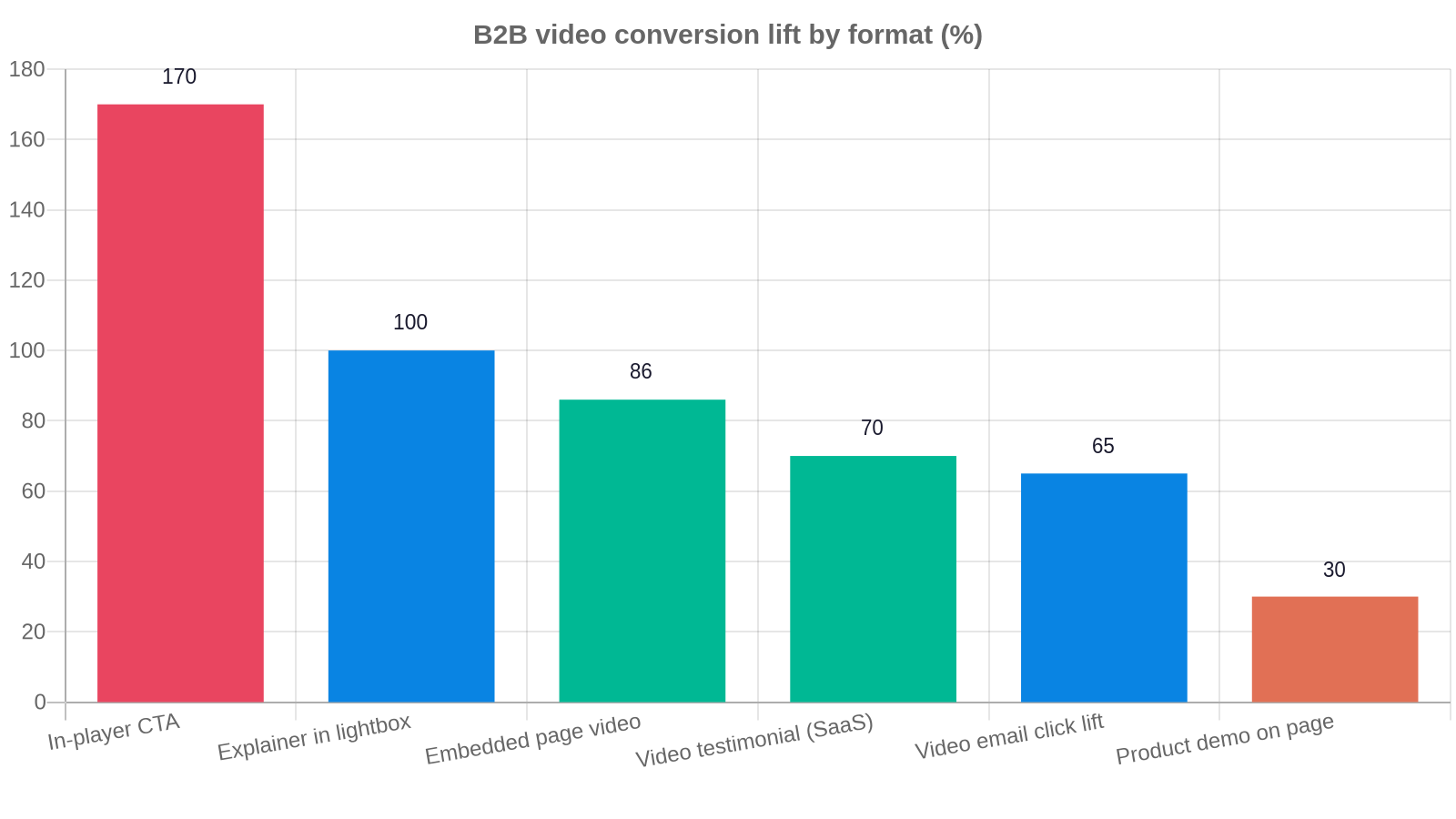
- Conversion: landing pages with an embedded video convert at 86% higher rates than text-only pages, and B2B SaaS explainer pages can exceed a 100% lift (Digital Applied, 2026).
- Lead generation: video content boosts B2B lead conversion rates by 54% (OptinMonster, 2025).
- Engagement and retention: video on a website page lifts visitor dwell time by 80%, and video content achieves a 95% message retention rate versus 10% for text (Digital Applied, 2026; LinkedIn Creative Labs, 2025).
- Platform reach: video posts on LinkedIn get 5x more engagement than static posts, and 65% of B2B companies say they have gained customers directly from LinkedIn video (LinkedIn, 2025).
The catch is that these returns only appear when video is done deliberately. The proportion of marketers reporting positive ROI from video actually dropped from 93% to 82% in the latest data (Wyzowl, 2026). The reason is not that video stopped working. It is that an influx of low-quality, poorly structured video, produced by teams trying to scale output without a strategy, quietly eroded trust. 89% of buyers say production quality directly affects their trust in the brand. A scattergun approach of posting whatever video you can quickly make is not better than no video at all. It can be worse.

The Funnel-Velocity Framework: Which Video to Make First (and Why Most Teams Get This Backwards)
The fastest way to a working B2B video program is to prioritize by funnel velocity, not by production glamour, and the counter-intuitive rule is start at the bottom of the funnel, not the top. Most teams believe they should begin with a glossy top-of-funnel brand film that “tells the story.” That single flagship video is the most expensive asset you can produce, and it is the slowest to influence pipeline, because brand-funnel video targets people who are not yet in a buying mode. Vendors and agencies push this one-off cinematic film for an obvious reason: it is their most profitable project. For a lean team it is often a budget-draining mistake.
Here is the decision matrix that removes the guesswork. Score each video type on funnel velocity (how directly it moves an in-market buyer toward a decision) and resource cost (what it takes to produce with a small team), then make bottom-of-funnel assets first because they convert in-market buyers fastest.
The matrix exists because real lean teams run out of budget and steam before video ever reaches the funnel stages that drive revenue. A demo and a testimonial act on buyers who are already evaluating you. They are cheap, fast, and convert existing intent. By contrast, a single $30,000 brand film captures anonymous reach, and you often cannot measure what it did. When you hear a colleague say “we need a brand video,” the honest reply is: “first let’s convert the buyers we already have with a demo and a testimonial, then we earn the story budget.”
The 2-Hour Production Workflow: How a Lean Team Ships Without a Video Department
A reliable video workflow for non-video staff comes down to decoupling the script from the asset, and it takes about two hours per finished piece once you have a repeatable system. 59% of organizations now produce video entirely in-house, 53% of business video projects run on budgets under $5,000, and 63% of video marketers use AI tools to accelerate production (Wyzowl, 2026; Lemonlight, 2025). You are not behind for lacking a crew. You are behind only if you lack a system. Here is the step-by-step workflow to publish your first three videos in a week.
- Write a script-first hook, problem, solution, and CTA in under 150 words per minute. Solve one customer pain point in 60 to 90 seconds. Never open with your product name and a feature list. Open with the buyer’s problem stated in their words, because the first 8 seconds decide 60% to 70% of mid-point retention (Foundry, 2026).
- Design for sound-off viewing. Up to 74% of social feed video is watched without audio, and adding captions lifts B2B completion rates by 28% (LinkedIn Creative Labs, 2025; Wyzowl, 2026). Put high-contrast on-screen text under a 60 to 90 second script, not a two-minute wall of talking.
- Capture with tools you already own. For a product demo, record the screen at native 4K with a clean cursor and a clear narration track. For a testimonial, use a laptop or phone camera plus a cheap lavalier microphone and soft natural light. Do not buy a cinema camera in month one.
- Edit in one pass with AI assistance. AI editing tools save an average of 3.5 hours per video, a 28% reduction in edit time, and cut median production costs by 40% (Digital Applied, 2026). Auto-generate captions, cut long pauses, normalize audio, and export both a 16:9 master and a 9:16 vertical cut.
- Atomize every master into mini-assets. A single 30-minute webinar should become 3 to 5 short-form clips, transcript-derived text posts, and an embedded web summary. 53% of marketers plan to repurpose written material into video, and the same logic runs in reverse: repurpose video into clips (Blue Noda, 2023).
A worked example. Say you are a three-person team at a SaaS company. On Monday you record a 4-minute product walkthrough with your lead product manager using screen capture. On Tuesday you edit it into a 60-second hero explainer plus two 20-second social clips, and you caption all three. On Wednesday you post the full version to YouTube, the clips to LinkedIn, and you embed the 60-second cut on your pricing page. Contractors like Loom popularized this exact pattern for async outreach, and it is directly portable: one capture session, four publishable assets, no video department.
Video SEO: The Technical Work That Competitors Ignore
For a video to earn organic search visibility, the page hosting it must tell search engines exactly what the video contains, and most B2B teams skip this entirely because the vendor guides never mention it. Search engines and AI answer engines cannot parse a raw video file. They rely on structured data markup. Every page with an embedded video should carry a valid VideoObject JSON-LD schema with the mandatory fields name, description, thumbnailUrl, and uploadDate, and an optional transcript makes the content quotable in Google AI Overviews and generative search (Semrush, 2026; Indirap, 2026).
Two other technical decisions shape video performance on the page itself:
- Embedding matters as much as the video. Explainers and demos in a lightbox modal player convert at up to +100% versus a non-video page, while an inline embed lifts conversion by about +69%, and an auto-playing ambient background loop on a lead-gen page can be net negative, between -10% and +5%, because it fights your forms for attention (Foundry, 2026).
- Format and platform fit drive reach. Vertical 9:16 video lifts click-through rates by 24%, while widescreen 16:9 cinematic video drives a 140% completion-rate increase on connected TV and large screens (LinkedIn Creative Labs, 2025). Native uploads to LinkedIn outperform external links, and YouTube is still the #1 platform, used by 82% of video marketers (Wyzowl, 2026).
None of this is glamorous, which is exactly why it is a gap. The highest-ranking competitor pages sell a story and skip the schema, the embed type, and the aspect-ratio split. Do the unglamorous technical work and you out-optimize pages with far bigger production budgets.
How to Measure Video ROI Tied to Revenue, Not Vanity Metrics
Video ROI only counts if you connect it to pipeline, and the way to do that is to layer three tiers of measurement instead of reporting view counts. 67% of marketing teams still track the top tier alone, watch time and impressions, which proves nothing to a CFO (Wyzowl, 2026). The tiered model gives you a defensible answer:
- Tier 1, engagement: play rate, completion rate, retention curve, and dwell time. These tell you if the creative is good. Drop-off in the first 8 seconds means a weak hook; drop-off near 120 seconds means the script is too long (Foundry, 2026).
- Tier 2, conversion: form fills, demo bookings, and gated downloads driven by the video player on the page. This is where the 86% landing-page conversion lift appears.
- Tier 3, revenue: pipeline velocity, influenced pipeline, and closed-won revenue attributed through your CRM. Connect the video player to HubSpot or Salesforce, then trigger a sales alert when a prospect watches more than 75% of a product demo (Vidyard). Sales teams that use video in outreach close deals at 31% higher rates (Vidyard).
The single number to report is influenced pipeline, not views. If a demo video sits on a high-intent page and the page’s conversion rate moves from 2.9% to 4.8%, that is your story. If a testimonial on a free-to-paid flow lifts conversion from 27% to 46%, that is a 70% relative improvement you can defend in any budget meeting (Foundry, 2026). Tie video to those outcomes and you will never again be asked what video “does.”
What Most Teams Get Wrong With B2B Video
Most B2B teams get video wrong in one of two ways, betting everything on a single flagship film, or tracking views instead of revenue, and both kill the program before it can compound. The flagship-film mistake is the “one big campaign” trap. A single cinematic brand video is a cost center, not a growth engine, because B2B buyers need an average of seven touchpoints before they will consider a new vendor (the classic rule of seven). One film cannot create those touchpoints. A steady cadence of lower-cost, targeted micro-videos, each solving one problem for one audience, compounds trust and recall far more reliably than one expensive splash.
The second mistake is measuring the wrong thing. When you report only view counts and impressions, you are reporting activity, not impact, and you will lose the budget when leadership asks what the video generated. Teams that tie video to pipeline report 49% faster revenue growth and win the argument to scale (Vidyard). A third, quieter mistake is gating everything. Gating a broad top-of-funnel explainer adds friction, shrinks reach, and fills your CRM with low-quality contacts. Keep foundational explainers and product walkthroughs ungated to maximize search visibility and trust, and reserve gates for dense, high-value assets like a proprietary benchmark report.
What To Do Next
Start your B2B video program in the next seven days with three concrete actions. First, record one 60-second product walkthrough for your highest-intent landing page, embed it in a lightbox, and add VideoObject schema. Second, film one customer testimonial focused on a measurable outcome, not vague praise, and place it on your pricing or comparison page. Third, set up the three-tier measurement model in your video platform and CRM so you capture influenced pipeline from day one, not just view counts.
Then go deeper with the related playbooks on this site. The B2B content repurposing strategy shows how to feed the video pipeline from the written content you already own, and the distribution channels guide lists the highest-value places to publish every clip. If you are still building the overall content system, start with the B2B content marketing strategy as your pillar. Video works best when it is one channel in a deliberate, full-funnel engine, not a separate one-off project.
Frequently Asked Questions
Do we need a big budget to start B2B video marketing?
No. In-house production is standard, with 59% of organizations producing video entirely in-house and 53% of projects running under $5,000 (Wyzowl, 2026; Lemonlight, 2025). Start with screen-recorded demos and customer testimonials, both cheap to produce, and add AI tools that cut median production costs by 40%.
How long should a B2B video be?
Keep social-feed clips under 30 seconds, product overviews around 60 to 90 seconds, and in-depth demos at 2 to 4 minutes. Completion rates drop sharply at the two-minute mark, the “Two-Minute Cliff,” so cut ruthlessly once you pass 90 seconds (Foundry, 2026).
Which video format drives the most ROI?
Marketers rank short-form video as the #1 ROI format at 49%, followed by long-form at 29% (HubSpot, 2026). But for pipeline, bottom-of-funnel assets like product demos and testimonials convert in-market buyers fastest, which is why this guide prioritizes them first.
Is video worth it for a B2B company that sells a complex product?
Especially yes. Complex products benefit most because 96% of buyers watch explainer and product videos to understand offerings, and 95% of executives say video builds trust. Video compresses comprehension that dense text and sales calls cannot match (Wyzowl, 2026; Brightcove).
Should we gate our videos to capture leads?
Only gate high-value, dense content like proprietary benchmark reports or advanced technical masterclasses. Keep foundational explainers, demos, and testimonials ungated to maximize reach and search visibility. A “give before you gate” pattern, a free 60-second summary that auto-advances to a gated deep dive, balances reach with lead capture (SproutVideo).
How do we prove video ROI to our CFO?
Report influenced pipeline, not views. Connect the player to your CRM and track demo bookings, form fills, and closed-won revenue. A landing page with embedded video converting at 86% higher rates is a number any CFO understands (Digital Applied, 2026).
