
Quick Answer: What are the best B2B content marketing case studies to learn from?
The most cited B2B content marketing case studies include HubSpot (blog-led SEO growth to 7M monthly visitors), Drift (conversational marketing category creation), Gong (data-driven content using their own platform insights), and Intercom (Inside Intercom blog with product-led content). Each succeeded by owning a specific content format or topic niche rather than trying to cover all of B2B marketing broadly.
Disclosure: Some links in this post are affiliate links. If you sign up through them, I may earn a commission at no extra cost to you. I only recommend tools I believe are genuinely useful.

B2B content marketing has historically had a reputation for being dry, overly technical, and, frankly, a bit boring. For decades, the B2B space has been dominated by hyper-rational advertising that treats its audience as emotionless robots, focusing purely on mechanical sales tactics rather than brand building.
But a shift is happening. Today’s top B2B brands are realizing that business buyers are still human beings. According to a study by the Content Marketing Institute and MarketingProfs, 91% of B2B marketers are using content marketing. However, as the space becomes more crowded, competition to stand out requires creativity, emotional connection, and strategic long-term thinking.
If you are looking for inspiration to revamp your strategy, you are in the right place. In this comprehensive guide, we will dive into the 11 Best B2B Content Marketing Case Studies to Copy. We will break down exactly what these brands did, the incredible ROI they achieved, and how you can replicate their success to build your own revenue-generating content engine.
Table of Contents
The State of B2B Content Marketing: Trends & Stats to Know
Before we dive into the B2B Content Marketing Case Studies, it is crucial to understand the landscape. Why do some campaigns generate billions in pipeline while others fall flat?
Research from LinkedIn’s B2B Institute and WARC reveals that the most effective B2B marketing requires “Creative Commitment”, a composite measure of the media budget, duration, and number of media channels applied to a campaign. Campaigns become significantly more effective as they spend more, run longer, and spread across more channels.
However, many marketers are making critical measurement mistakes. Data shows that the average B2B sales cycle is 6+ months long, yet 77% of marketers measure return on investment (ROI) during the first month of a campaign. Only 4% of marketers measure ROI over 6 months or longer.
As we look toward the future, B2B budgets are shifting. Here is a breakdown of where B2B marketers expect their organization’s investments to increase in the coming year:
[Graph: Where B2B Marketers Expect Investments to Increase in 2025]

Videos                     ██████████████████████████████ 61%
Thought Leadership         ██████████████████████████ 52%
AI for Optimization        ████████████████████ 40%
Paid Advertising           ████████████████████ 40%
AI for Content Creation    ███████████████████ 39%
In-person Events           █████████████████ 35%
Webinars                   ████████████████ 32%
Building Online Community  █████████████ 27%
Digital Events             ██████████ 21%
Audio Content              ██████████ 20%

*Source: 15th Annual Content Marketing Survey: Content Marketing Institute/MarketingProfs
To capitalize on these trends, let’s explore 11 brilliant examples of B2B content marketing that hit the mark, drove massive ROI, and became strategic assets for their companies.
1. Xerox: The “Get Optimistic” Targeted Magazine Campaign
The Campaign
To connect with 30 of its top accounts, Xerox created a highly targeted “Get Optimistic” campaign. Instead of sending generic whitepapers, they partnered with Forbes to create a custom magazine that offered relevant, high-level business tips tailored to C-suite executives. They paired this physical asset with a targeted microsite.
The Results
The results were staggering. 70% of the targeted companies interacted with the microsite, and readership increased by 300-400% compared to previous email campaigns. Ultimately, it added 20,000 new contacts, generated over 1,000 scheduled appointments, and yielded an unbelievable $1.3 BILLION in pipeline revenue.
How to Copy It
This is Account-Based Marketing (ABM) at its finest. If you are targeting enterprise clients, abandon the generic PDF downloads. Partner with established, credible publishers (like Forbes) to create premium, co-branded thought leadership. By focusing intensely on a small, high-value audience with high-quality content, you can drive massive pipeline growth.
2. Gong: Data-Driven “Gong Labs”
The Campaign
Gong is a revenue intelligence platform that analyzes sales calls and emails. Instead of writing generic “how to sell” blog posts, they built an entire content program around the proprietary data extracted from their own platform. “Gong Labs” publishes findings from millions of real sales conversations, revealing the exact phrases that correlate with higher close rates or the ideal talk-to-listen ratios of top performers.
The Results
Gong’s content routinely earns hundreds of thousands of page views and massive earned media coverage. Because the insights are backed by exclusive datasets, sales leaders trust them implicitly. Furthermore, their sales reps use this content in active deals to shift conversations from opinion to undeniable evidence.
How to Copy It
Look at the proprietary data your software or service generates. If your product captures unique data, anonymize it and turn it into thought leadership. Original research earns 3-4x more backlinks than opinion-based content.
3. HubSpot: The “Website Grader” Free Tool
The Campaign
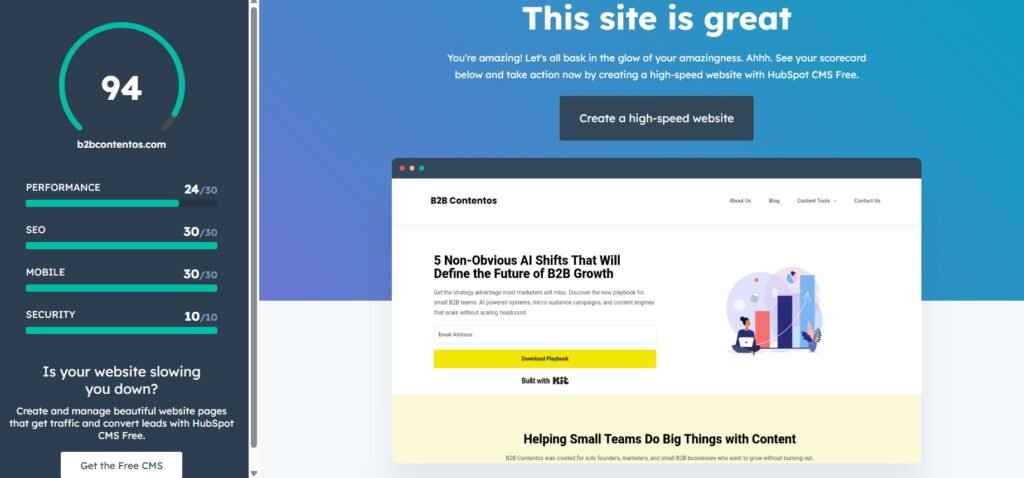
HubSpot is famous for its inbound marketing blog, but one of its greatest content assets isn’t an article, it’s a free tool. Launched in 2007, the “Website Grader” allows users to enter a URL and instantly receive a score on their site’s performance, SEO, mobile readiness, and security.
The Results
The tool has been used by millions of sites and has driven consistent, scalable top-of-funnel lead volume for over a decade. It provides immediate, personalized value for free while seamlessly putting HubSpot in front of buyers actively thinking about improving their websites.
How to Copy It
Content doesn’t always mean text or video. Engineering-as-marketing is a powerful B2B strategy. Build a free, low-friction tool that does a specific job your buyers want done. Once the tool highlights a gap or problem in the prospect’s current setup, position your paid product as the natural solution.
4. Volvo Trucks: The “Live Test Series” (Epic Split)
The Campaign
Commercial trucks are highly technical B2B products. However, Volvo decided to bypass the boring spec sheets and instead prove their product’s precision in a surprising, highly emotional way. They launched the “Live Test Series,” culminating in a video of action star Jean-Claude Van Damme performing an “epic split” between two reversing Volvo trucks.
The Results
This campaign was an absolute masterclass in B2B fame creation. It was viewed over 100 million times, written about in over 20,000 news stories, and generated an earned media value of over $170 million. More importantly for the business, it drove 85% awareness among commercial truck buyers and increased purchase intent by more than 40%.
How to Copy It
As the LinkedIn B2B Institute notes, B2B brands must balance short-term sales activation with long-term, emotional brand building. Demonstrate your product’s benefits in surprising, original ways. If you want people to share your work, it must push the boundaries of originality to reach broad audiences, which ultimately builds deep trust among your actual buyers.
5. SunGard: Surviving the IT Zombie Apocalypse
The Campaign
SunGard Cloud needed to create awareness among highly technical IT professionals, an audience historically numb to standard corporate messaging. Instead of a standard whitepaper on disaster recovery and cloud backup, they created a zombie-themed survival campaign.
The Results
The creative pivot paid off massively. By injecting pop-culture humor into a dry topic, the zombie-themed effort exceeded download rate benchmarks by 300%, achieved a 5.7% email open rate, and generated over 20 highly qualified enterprise leads.
How to Copy It
Don’t be a boring business. IT professionals, executives, and managers are still consumers who enjoy entertainment. Use playful themes, humor, or pop-culture references to make your direct marketing stand out and catch your audience off-guard.
6. Drift: Naming and Owning “Conversational Marketing”
The Campaign
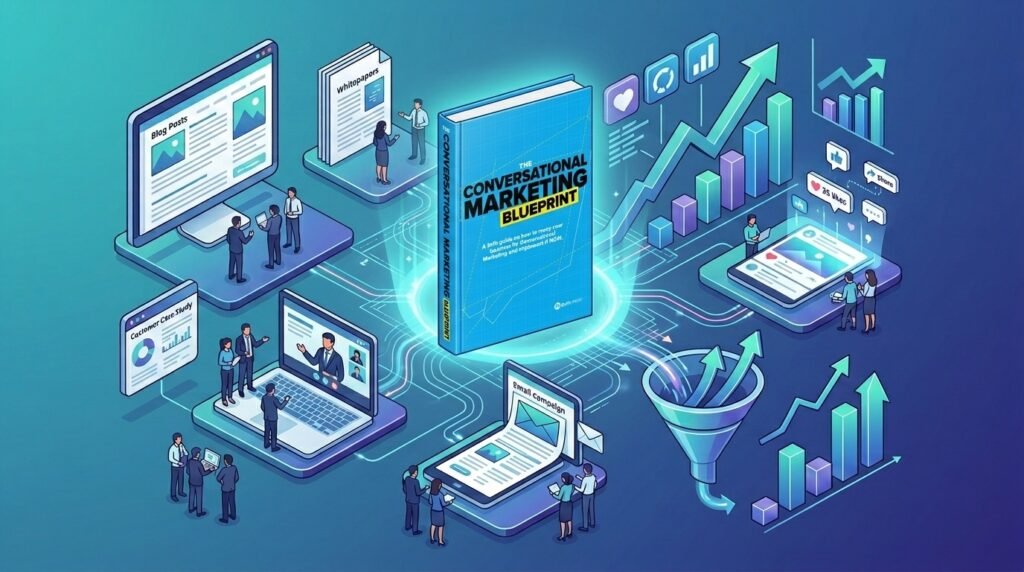
Drift didn’t just want to compete in the live-chat software space; they wanted to invent a new category. Starting around 2016, they embarked on a sustained content effort to coin and popularize the term “conversational marketing”. They wrote a book, launched a dedicated podcast, and aligned all their blog content around this single narrative.
The Results
By naming the category, Drift captured the majority of the market value and gained first-mover advantage for every keyword in that cluster. Buyers began searching specifically for “conversational marketing” rather than generic chat tools, positioning Drift as the undisputed thought leader.
How to Copy It
If your product fundamentally changes how work is done, don’t use your competitors’ terminology. Create and define a new category. However, remember that a single blog post does not create a category; it requires relentless repetition across multiple formats (text, audio, events) over several years.
7. American Express: Small Business Saturday
The Campaign
Following the 2008 global financial crisis, American Express wanted to help small business owners recover and survive against big-box retailers. They launched “Small Business Saturday” in 2010, a national event held between Black Friday and Cyber Monday, encouraging consumers to patronize local shops.
The Results
The campaign transcended B2B marketing to become a cultural phenomenon. It drove 74% awareness among Americans, was tweeted about by President Obama, and was made an official national day by the US Senate. By 2019, 110 million consumers participated. The genius? The more tills rang at local stores, the higher the transaction volume for American Express.
How to Copy It
Champion a purpose or cause. Go to bat for your customers and communities in an original way. B2B brands that create initiatives everyone can participate in achieve a level of public stature and fame that creates massive downstream trust and revenue.
8. Deloitte Insights: The “Resource Hub” Model
The Campaign
Deloitte provides consulting and professional services across a massive cross-section of industries (government, tech, finance, etc.). Because their audience is so broad, they created “Deloitte Insights,” an educational content center. It curates long-form reports, webcasts, podcasts, and case studies tailored to specific industries and roles.
The Results
Deloitte Insights functions as an information moat. By serving as an in-depth “resource hub,” they have established Deloitte as the ultimate authority for business solutions. It allows them to organize an overwhelming amount of knowledge into discoverable, easily navigable microsites.
How to Copy It
If your company serves multiple distinct buyer personas, do not mix all your content into one generic blog feed. Separate your buyer personas and create dedicated knowledge centers or microsites for each.
9. Unbounce: “Page Fights” Live Video Critiques
The Campaign
Unbounce, a landing page software provider, partnered with conversion optimization company Conversion XL to create an engaging microsite called “Page Fights”. Instead of written teardowns, they hosted live video streams where panels of optimization experts ruthlessly (and constructively) critiqued user-submitted landing pages in real-time.
The Results
Though it ran for just one year, the unscripted, electric energy of the live critiques set Unbounce apart from an increasingly crowded written content landscape. It portrayed the brand and its experts as candid, genuine, and highly knowledgeable.
How to Copy It
Diversify your channels. Written content is vital for SEO, but incorporating video can drive up to 49% faster revenue growth. Live video, in particular, humanizes your B2B brand and keeps the human attention span engaged far longer than a standard whitepaper.
10. CB Insights: The Hilarious Tech Newsletter
The Campaign
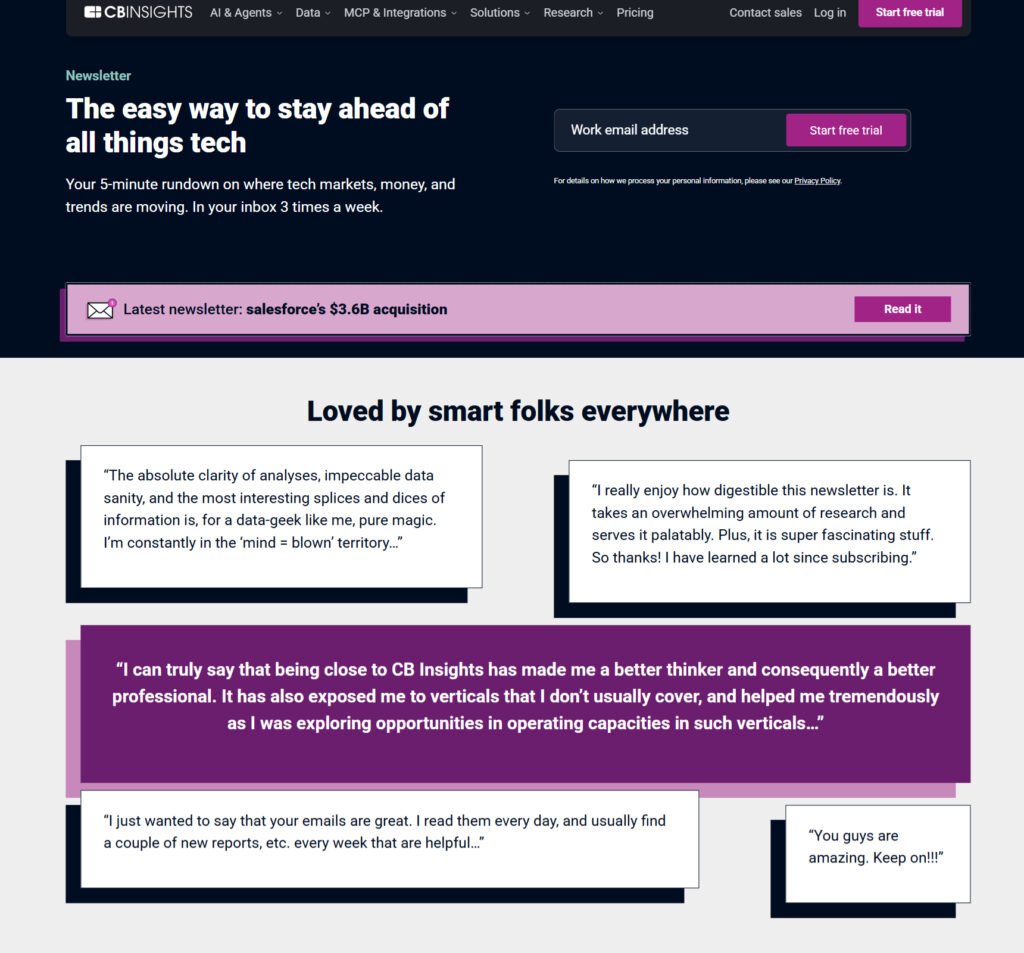
CB Insights provides market intelligence and data on tech and venture capital, a traditionally highly serious space. However, their newsletter is famous for breaking the corporate mold. They combine heavy, complex business topics and data with a dash of humor, clever memes, and witty subject lines (like “so sad: tough to have a VC dad”).
The Results
It has become a must-read, go-to resource for busy professionals who want to stay informed easily. The humor acts as a hook, keeping open rates extraordinarily high while delivering the $147 million venture capital data the audience actually needs.
How to Copy It
Don’t be afraid to show some personality. Respect your reader’s intelligence but make the reading experience enjoyable. Use witty subject lines and conversational tones, but ensure that the core value, the data, the insights, the education, is always present and highly relevant to your buyer’s goals.
11. IBM: “Let’s Build a Smarter Planet”
The Campaign
During the 2008 global financial crisis, IBM needed to pivot from being viewed as an old-school IT hardware company to an innovator solving the world’s most complex problems. They launched the “Let’s Build a Smarter Planet” brand platform, shifting their target audience from IT managers to national, city, and business leaders. They published deep insights into how emerging tech could fix energy grids, healthcare, and traffic.
The Results
The campaign fundamentally repositioned the company. In 2010 alone, the initiative generated $3 billion in revenue and double-digit growth from more than 6,000 client engagements. Ultimately, it drove an astounding $11 billion increase in brand value and delivered significant gains in brand trust and market perception.
How to Copy It
Address key brand weaknesses head-on. If your brand is viewed as outdated, prove your ongoing relevance by aligning your content with future-facing, global solutions. Don’t just talk about product features; talk about how your product integrates into the future of your customer’s industry.
Key Takeaways: How to Execute Your Own B2B Content Strategy
These 11 campaigns prove that B2B marketing does not have to be a race to the bottom of generic listicles. To build content that functions as a strategic asset, you must follow the principles of the B2B Effectiveness Ladder, moving from simple “Response Triggers” (short-term clicks) to “Strategic Assets” (versatile, enduring platforms that drive multi-year revenue).
Here is your cheat sheet for copying the masters:
- Invest in Original Research: As seen with Gong and Salesforce, proprietary data is an information moat. It earns 3-4x more backlinks than opinion pieces and creates content competitors cannot steal.
- Build Free Tools: Like HubSpot’s Website Grader, interactive tools provide low-friction lead capture because they do a job the buyer actually wants done.
- Be Opinionated and Challenge the Status Quo: Don’t write neutral content. Companies like Refine Labs and Intercom succeed because they take a clear stance on what is broken in their category and educate buyers on a better philosophy.
- Use Emotion and Humor: Whether it’s CB Insights’ memes, SunGard’s zombies, or Volvo’s epic split, B2B buyers are human. Emotional campaigning is the best way to build connection and brand fame at scale.
- Target the Full Funnel: Do not measure everything by 30-day ROI. Balance your budget with 54% spent on short-term sales activation (Bottom of Funnel SEO, targeted ABM) and 46% on long-term, broad-reaching brand building.
- Publish Off-Domain Content: To reach new audiences, consider platforms like Medium or co-publishing with credible industry magazines (like Xerox and Forbes) to tap into built-in distribution networks.
Final Thoughts

The most successful B2B marketers build systems, not just one-off campaigns. Their content serves a specific job for a specific buyer, distribution is built into the format, and it reflects a strong point of view.
If you are ready to stop playing it safe and want to start building category-defining content that generates serious pipeline, learn from these examples. Take bold risks, use your proprietary data, and remember to keep it human.
