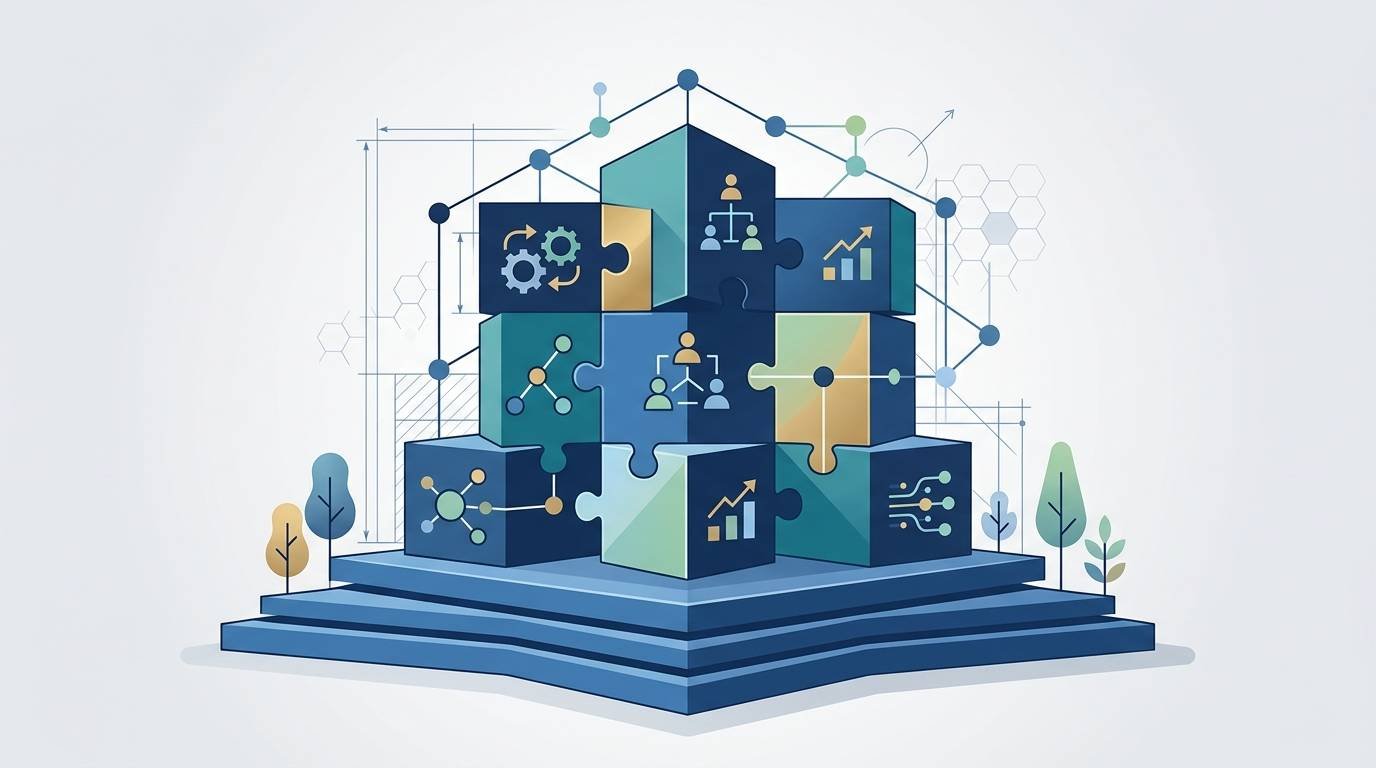

Quick Answer: What is a B2B marketing strategy framework?
A B2B marketing strategy framework consists of four components: ICP definition (industry, company size, role, pain point), channel strategy (SEO, LinkedIn, email, partnerships), content mapping (awareness, consideration, decision content per persona), and measurement (pipeline contribution, not just traffic). The most effective B2B frameworks connect every marketing activity to a measurable pipeline outcome, with clear attribution between content and closed deals.
B2B marketing is often too messy. You have too many channels, too many opinions from sales, and a budget that never seems quite big enough.
I spent years throwing random tactics at the wall. Some stuck. Most did not. What saved my sanity, and my marketing budget, was building a repeatable b2b marketing strategy framework.
This is not a theoretical model from a textbook. It is a practical system you can use to organize your thoughts, get your team on the same page, and actually drive revenue. You do not need a massive budget or a team of fifty people to make this work. You just need a clear plan of action.
Why You Need a B2B Marketing Strategy Framework

Before we build one, let us define what it is. A marketing framework is simply a structured plan that guides your marketing decisions. It tells you who you are targeting, what you are saying to them, where you are going to say it, and how you will measure success.
Without a clear structure, you end up chasing every new trend. One week you are trying to make viral videos. The next week you are spending thousands of dollars on cold emails. This leads to wasted budget and a tired marketing team. A good framework keeps you focused. It acts as a filter. If a new idea does not fit into your framework, you do not do it. This simple discipline can save you months of wasted effort.
According to the basic principles of strategic planning, which you can read about on Wikipedia, having a structured approach is what separates successful organizations from those that fail. In B2B marketing, this structure prevents you from committing random acts of marketing.
Step 1: Define Your Ideal Customer Profile (ICP)
Many B2B companies target everyone who might have money. This is a huge mistake. If you sell to everyone, you sell to no one. Your messaging becomes bland. Your ads get expensive because you are targeting too many people. You need to define your Ideal Customer Profile. This is different from a basic buyer persona. An ICP defines the actual companies you want to sell to, not just the people inside them.
Look at your best current customers. Ask yourself these questions.
- What industry are they in?
- How many employees do they have?
- What is their annual revenue?
- What software do they already use?
- What major pain points do they face every day?
For example, if you sell payroll software, do not just target any company with employees. Target companies with 50 to 200 employees that are growing fast and using manual spreadsheets. That is a specific profile. It gives your sales and marketing teams a clear target.
To make this practical, let us break down the three layers of a great ICP.
Firmographics
This is the basic data about the company. Think of it as demographics for businesses. It includes company size, location, industry, and revenue. If you sell enterprise security software, your firmographics might be companies in the financial sector with over one thousand employees based in North America.
Technographics
This is the technology the company already uses. If your software integrates with Salesforce, your ICP should include companies that use Salesforce. If they use a competitor’s product, that is also valuable technographic data. It helps you tailor your messaging to explain why they should switch.
Intent Data
This tells you if a company is actively looking for a solution. Are they searching for reviews of your competitors? Are they visiting your pricing page? Combining firmographics, technographics, and intent data gives you a highly accurate target list.
Once you know the company profile, you can look at the actual people inside those companies. These are your buyer personas. In B2B sales, you rarely sell to just one person. You usually have to convince three or four people. You might need to talk to the finance manager, the IT director, and the CEO.
Each of these people cares about different things. The finance manager wants to save money. The IT director wants security. The CEO wants growth. Your marketing must speak to all of them.
Step 2: Create Sharp Positioning and Messaging
Once you know who you are talking to, you need to decide what to say. This is where positioning comes in. Positioning is how you want your product to live in the minds of your buyers. Most B2B websites look exactly the same. They use words like “user-friendly” and “flexible.” These words mean nothing to a busy buyer. If your competitor can copy the text on your homepage and paste it on theirs without changing anything, your positioning is weak.
You need to find your unique value. Why should a customer choose you instead of your competitor? Why should they choose you instead of doing nothing at all? Doing nothing is often your biggest competitor in B2B sales. Here is a simple way to write your positioning.
Our product is for [specific target audience] who are unhappy with [current alternative]. Our product is a [product category] that provides [key benefit]. Unlike [competitor], we offer [unique differentiator].
Keep it simple. Avoid jargon. If a twelve-year-old cannot understand what your company does after reading your homepage, you need to rewrite it.
Let us look at a real example. Imagine a company that sells project management software. Instead of saying “We offer a collaborative platform for project delivery,” they could say “We help construction managers track materials and labor costs on the job site.” The second option is specific. It immediately tells the reader if the product is for them.
Step 3: Map the B2B Buying Process
The B2B buying process is slow. It can take months, sometimes even a year. Buyers do not see an ad, click a button, and buy a fifty-thousand-dollar software package. They research. They compare. They talk to colleagues. Your b2b marketing strategy framework must cover every stage of this path. We can break this path down into three main stages.
The Awareness Stage
In this stage, the buyer has a problem but might not know your product exists. They might not even know there is a solution to their problem. They are searching for answers on Google. They are asking friends on social media. Your goal here is to help them understand their problem. Do not try to sell your product yet. Create educational content. Write blog posts that answer their specific questions. Create simple calculators or templates.
The Consideration Stage
Now, the buyer knows their problem and is looking at different ways to solve it. They are comparing different types of software or services. Your goal is to show them why your category of solution is the best choice. Create comparison guides. Host webinars. Write case studies that show how you helped a similar company solve the exact same problem.
The Decision Stage
The buyer is ready to buy. They have narrowed down their choices to you and one or two competitors. They need that final push to choose you. This is where you offer product demonstrations, free trials, or custom proposals. Show them exactly how your product will work in their business. Make it easy for them to say yes.
Step 4: Choose Your Channels Wisely
You cannot be everywhere. If you try to run paid ads, do SEO, post on five social media networks, host a podcast, and send cold emails all at once, you will fail. Your efforts will be spread too thin. Pick two or three channels and do them really well. How do you choose? Go where your customers already are.
If you sell to corporate lawyers, they probably are not looking for software on TikTok. They are more likely to read industry newsletters or search on Google. If you sell to creative directors, they might spend a lot of time on LinkedIn or Instagram.
Let us look at the most common B2B marketing channels.
Search Engine Optimization (SEO)
SEO is a great long-term channel. When buyers have a problem, they search for it. If your website shows up on the first page of Google, you get free, highly targeted traffic. To start, find the keywords your buyers are searching for. Use tools like Google Search Console to see what terms people are already using to find you. Write helpful, clear content that answers those search queries. Do not stuff keywords into your text. Write for real people.
LinkedIn Marketing
LinkedIn is the main social network for B2B. It is where professionals go to talk about work. You can use LinkedIn in two ways: organic posts and paid ads. Organic posting requires you or your team to share useful thoughts regularly. This builds trust. Paid ads on LinkedIn are expensive, but they offer incredible targeting. You can target people by their exact job title, company size, and industry.
Email Marketing
Email is still one of the most effective B2B marketing channels. Once you get someone’s email address, you can talk to them directly without worrying about social media algorithms. Send regular, helpful emails. Do not just send sales pitches. Share your latest blog posts, industry news, or helpful tips. Keep your emails short, personal, and easy to read.
Account-Based Marketing (ABM)
If you sell very high-value deals, you might want to use ABM. Instead of marketing to a wide audience, you select a small list of target accounts. You might choose fifty companies that fit your ICP perfectly. You then create highly personalized marketing campaigns specifically for those fifty companies. This is a highly focused approach that requires close coordination between your sales and marketing teams.
Step 5: Build a Lead Capture and Nurturing System
Traffic to your website is useless if those visitors leave and never return. You need a way to capture their contact information. This is usually done with a lead magnet. A lead magnet is a valuable piece of content that you give away in exchange for an email address. It could be an ebook, a template, a checklist, or a free tool.
Make sure your lead magnet is highly relevant to your audience. If you sell accounting software, a guide on “How to prepare for tax season” is a great lead magnet. A guide on “How to boost employee morale” is not. Once you have their email, you must nurture them. This means sending them a series of automated emails over several weeks. These emails should build trust and slowly guide them toward a sales call or product demo.
Here is a simple email sequence you can use.
- Deliver the lead magnet and introduce your brand.
- Share a helpful tip related to the lead magnet.
- Share a case study of a customer who solved a major problem using your product.
- Offer a free consultation or product demonstration.
Keep your emails conversational. Write them as if you are emailing a colleague. Avoid heavy design templates. Plain text emails often get higher reply rates because they look like they came from a real person.
Step 6: Measure the Metrics That Actually Matter
Many marketers waste time tracking vanity metrics. These are numbers that look good on paper but do not actually help your business grow. Examples include social media likes, page views, and email open rates. Instead, focus on metrics that connect directly to revenue. Here are the main metrics you should track in your b2b marketing strategy framework.
Marketing Qualified Leads (MQLs)
An MQL is a lead that fits your ideal customer profile and has shown interest in your product. For example, someone who downloaded your lead magnet and works at a target company.
Sales Qualified Leads (SQLs)
An SQL is a lead that the sales team has talked to and agreed is a good fit for a sales conversation. This is a much stronger indicator of marketing success than just raw lead numbers.
Customer Acquisition Cost (CAC)
This is how much money you spend to get one new customer. To calculate this, divide your total marketing and sales spend by the number of new customers you got in a specific period. You want to keep this number as low as possible while still growing.
Customer Lifetime Value (LTV)
This is how much money a customer spends with your business over their entire relationship with you. In B2B, you want your LTV to be at least three times higher than your CAC. If your CAC is one thousand dollars, your average customer should bring in at least three thousand dollars in profit. To learn more about how to present these numbers to your leadership team, read our guide on B2B marketing metrics that matter to your CEO.
How to Put This B2B Marketing Strategy Framework Into Action Today

Do not try to build this entire system in one day. It takes time. Start small and build on your success. Here is what you should do next.
1) Talk to three of your best customers. Ask them why they bought from you and what problems you solved for them. This will give you the raw data you need for your ICP and messaging.
2) Look at your website. Rewrite the main headline so it clearly states who you help and how.
3) Pick one marketing channel. Commit to publishing content on that channel twice a week for three months.
By focusing on these practical steps, you will build a solid foundation that actually grows your business. Stop chasing every new marketing trend and start building a system that lasts.
Recommended Tool: AWeber
If you’re building a B2B email list alongside your content marketing, AWeber is the most reliable option for small teams. Free up to 500 subscribers, with inbox placement rates that consistently outperform most competitors.
Affiliate disclosure: Some links in this post are affiliate links. If you sign up through them, I may earn a small commission at no extra cost to you.
