

Content marketing for tech startups is the practice of creating and distributing technically credible, audience-specific content that attracts developers, executives, and enterprise buyers, and converts that attention into pipeline and revenue.
Unlike traditional marketing, it maps content to each stage of a long B2B buying cycle while building brand authority across search engines, AI platforms, and industry communities.
For startups competing in crowded SaaS and enterprise tech markets, a structured content marketing strategy creates several compounding advantages.
Content marketing for tech startups works best when educational content, developer resources, and thought leadership are aligned with the enterprise buying journey.
The most important benefits include:
- Compounding organic traffic that steadily reduces paid acquisition costs
- Thought leadership that builds credibility and shortens enterprise sales cycles
- Developer trust earned through utility-first documentation, tutorials, and technical guides
- AI visibility, as large language models increasingly cite authoritative brand content in generated answers
- Measurable pipeline contribution when attribution is implemented correctly
Modern content marketing for tech companies spans multiple growth channels simultaneously. Key use cases include search engine optimization (SEO), Generative Engine Optimization (GEO), product-led growth through developer content hubs, executive education via white papers and case studies, community engagement on platforms like Reddit and Stack Overflow, and multi-channel distribution through newsletters and social media.
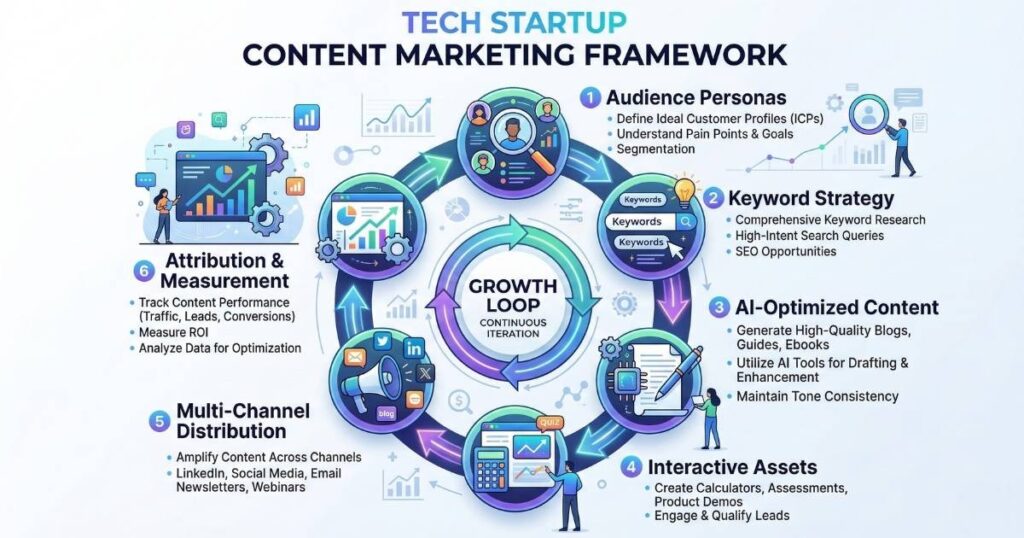
A complete content marketing strategy for tech startups typically includes seven core components: audience persona engineering, high-intent keyword strategy, AI-ready content engineering, interactive content assets, subject-matter expert (SME) workflows, distribution orchestration, and multi-touch attribution measurement.
Today, content strategy extends far beyond keyword rankings. The digital ecosystem increasingly operates as a winner-takes-all environment, where brands must be cited, recommended, and synthesized by AI systems such as ChatGPT and Google AI Overviews. Generic, AI-generated filler content is rapidly losing effectiveness.
The startups that win combine AI-driven production efficiency with authentic human expertise, using subject-matter experts to produce credible thought leadership that both search engines and AI systems trust.
Understanding the B2B Tech Funnel & Audience
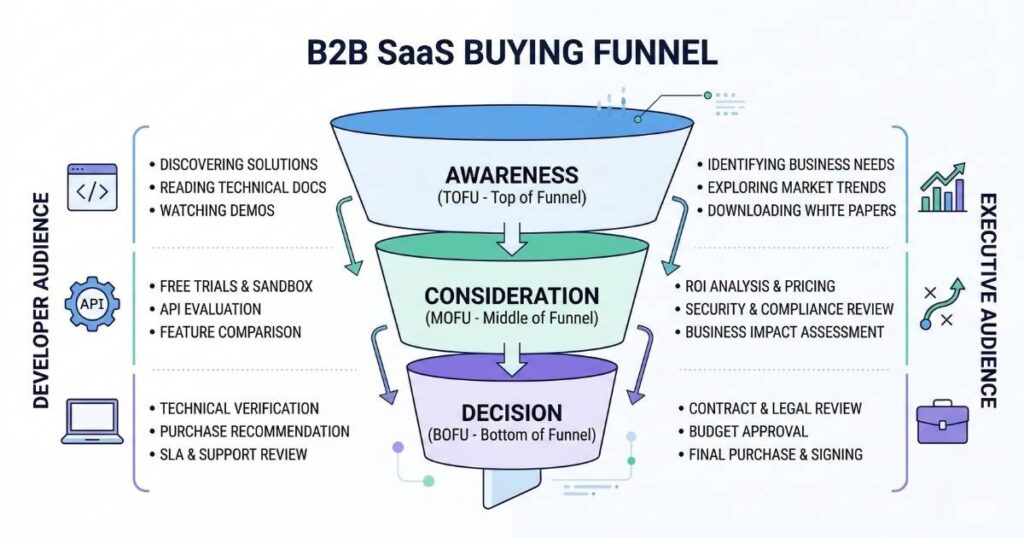
B2B tech content marketing operates very differently from B2C marketing because the buying process is longer, more complex, and involves multiple stakeholders.
Research from Gartner shows that the average B2B buying group now includes 6 to 10 decision-makers, each representing different functional priorities.
At the same time, B2B sales cycles in enterprise technology often range from 6 to 18 months, depending on deal size and procurement complexity.
Because of this multi-stakeholder environment, content marketing for tech startups must address both technical and executive audiences simultaneously.
- Technical stakeholders (developers, engineers, architects) evaluate product feasibility and implementation risk.
- Business stakeholders (CTOs, VPs, and procurement leaders) evaluate return on investment, operational impact, and vendor reliability.
According to research from Google and CEB, B2B buyers complete over 60% of their research before contacting a sales team, making educational content a primary influence on vendor selection.
The Developer Persona
Developers often act as technical gatekeepers in B2B technology purchases. They are typically skeptical of marketing claims and prioritize content that demonstrates practical value.
Developer audiences tend to value:
- Working code examples
- API documentation and SDK guides
- Architecture diagrams
- Transparent error handling documentation
- Clear explanations of product limitations
Companies such as Stripe and Twilio built massive developer adoption by investing heavily in documentation, tutorials, and sample code, rather than traditional promotional messaging.
Developer-focused content hubs, API documentation libraries, and technical tutorials often outperform traditional marketing pages because developers prefer self-service product exploration before engaging with a vendor.
The Executive Persona (CTOs and VPs)
Executive decision-makers approach content from a different perspective.
Instead of implementation details, they focus on business outcomes, risk management, and strategic alignment.
Content that performs well with executive audiences includes:
- Case studies showing measurable ROI
- Cloud migration success stories
- Cybersecurity risk reports
- Data privacy and regulatory compliance insights
- Industry benchmarks and market analysis
Executives rarely read full technical documentation. Instead, they prefer summaries that translate product capabilities into financial or operational impact.
For example, rather than highlighting API performance metrics alone, content aimed at executives should explain outcomes such as:
- reduced infrastructure costs
- faster deployment cycles
- improved customer retention
- increased operational efficiency
Bridging the Technical–Executive Gap
Successful B2B tech content connects these two audiences within a single content ecosystem.
One effective approach is layered content design, where technical depth and business context coexist in the same resource. This can include:
- Executive summaries at the beginning of technical articles
- Architecture diagrams paired with ROI explanations
- Flowcharts translating technical processes into business outcomes
- Case studies combining engineering insights with financial impact
For example, a technical founder article explaining a distributed data architecture could include:
- a developer-focused section with code examples and system diagrams
- an executive summary outlining cost savings, scalability benefits, and operational impact
This layered approach ensures that both technical evaluators and business decision-makers can extract the information they need from the same piece of content.
High-Intent Keyword Strategy for SaaS
A high-intent keyword strategy for SaaS begins with the Jobs to Be Done (JTBD) framework: identifying the specific problems your product solves and then reverse-engineering the language buyers use at each stage of awareness.
Many startups make the mistake of chasing high-volume generic keywords. While these terms generate traffic, they often lack purchase intent and contribute little to pipeline growth. In contrast, high-intent keywords align with the buyer’s decision journey, making them far more valuable for B2B SaaS companies.
According to research by HubSpot, businesses that prioritize intent-driven content and bottom-funnel keywords see significantly higher conversion rates compared to purely informational traffic.
To structure keyword targeting effectively, SaaS content strategies typically map keywords across three stages of the funnel.
Top of Funnel (TOFU)
TOFU keywords capture informational intent from users who are problem-aware but not yet evaluating specific solutions.
Examples include:
- “how to reduce customer churn”
- “why SaaS onboarding fails”
- “customer retention strategies for SaaS”
The primary goal at this stage is education and awareness. Content should focus on helping readers understand the problem while introducing your brand as a credible authority. Typical conversion actions include newsletter subscriptions, downloadable resources, or webinar sign-ups.
Middle of Funnel (MOFU)
MOFU keywords reflect commercial intent, where users are aware of potential solutions and actively researching vendors.
Examples include:
- “best project management tool for remote teams”
- “CRM software for SaaS startups”
- “Salesforce alternatives for startups”
At this stage, content should focus on product comparisons, feature explanations, and use-case guides that position your solution as a credible option.
Bottom of Funnel (BOFU)
BOFU keywords capture transactional intent from users close to making a purchase decision.
Common BOFU search patterns include:
- “[Competitor] alternatives”
- “[Product] pricing”
- “[Product] vs [Competitor]”
- “[Product category] for enterprise teams”
These pages should prioritize conversion-focused elements, such as:
- customer testimonials
- ROI calculators
- product demos
- free trial offers
Although BOFU keywords typically have lower search volume, they generate the highest pipeline value per visit because the searcher is already evaluating vendors.
For early-stage startups with limited resources, prioritizing BOFU comparison pages and competitor-alternative content often delivers faster revenue impact before expanding into broader TOFU educational content.
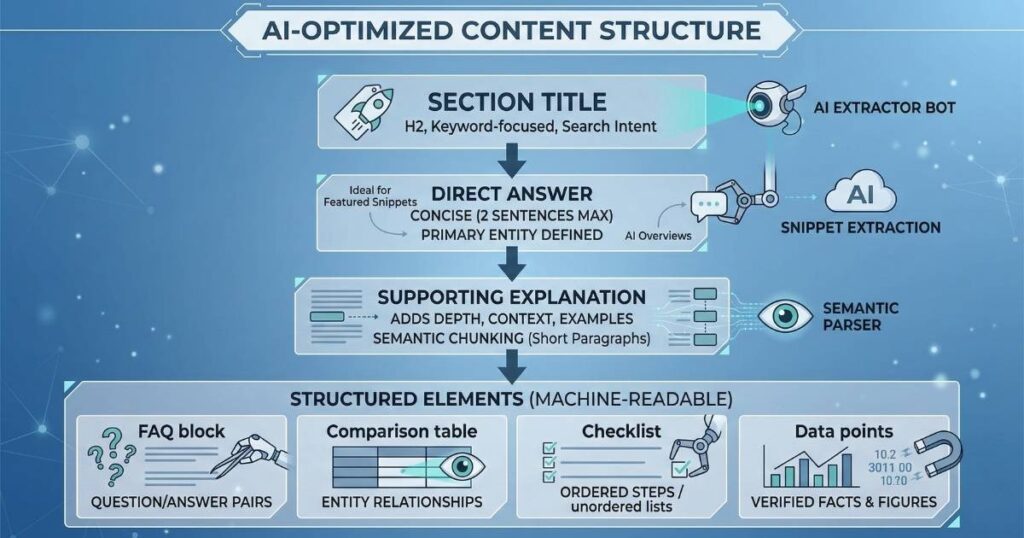
Content engineering for the generative era means structuring articles, landing pages, and documentation so that AI systems can extract, synthesize, and cite information accurately.
Unlike traditional search engines that primarily rank pages, modern AI systems increasingly generate answers directly from multiple sources. As a result, content must be structured for clarity, factual density, and authoritative signals, not just narrative flow.
Research from Google on helpful content and AI-powered search experiences indicates that well-structured, fact-rich content is more likely to be surfaced in AI summaries and answer features.
Prioritize Fact-Dense Openings
High-performing technical content often places key definitions, statistics, or conclusions within the first 50–70 words of a section.
This approach improves both:
- Search snippet eligibility
- AI extractability for answer generation
For example, sentences that include specific numbers, named frameworks, or clearly defined concepts are easier for AI systems to identify and cite than paragraphs that build slowly toward a conclusion.
Structure Content for “Answerability”
AI-driven search experiences increasingly prioritize content that can function as a self-contained answer.
One effective structure is:
- Direct answer (1–2 sentences)
- Supporting explanation
- Structured elements, such as:
- comparison tables
- short checklists
- FAQ blocks
- step-by-step lists
- comparison tables
These structured elements make it easier for both readers and AI systems to extract useful information.
For example, FAQ sections are frequently used by search engines to generate featured snippets and AI summaries.
Build Off-Site Authority Signals
AI systems evaluate more than just on-page content. External credibility signals also influence whether a brand is considered a trustworthy source.
Maintaining accurate and active profiles on industry platforms such as:
helps reinforce brand legitimacy.
Participation in technical communities like Reddit and Stack Overflow can further strengthen authority by creating independent references to your brand and expertise.
For tech companies targeting developer audiences, documentation quality, developer advocacy, and transparent technical resources often play a significant role in building this ecosystem credibility.
Content Format vs. AI Extractability
| Content Format | AI Extractability | Best Use |
| FAQ Blocks | High | BOFU, product pages |
| Comparison Tables | High | MOFU, alternatives pages |
| Long-form narrative | Medium | Thought leadership, TOFU |
| Video transcripts | Medium (with schema) | YouTube SEO, onboarding |
| Interactive tools | Low (requires indexing) | Lead capture, ROI calculators |
The Interactive Content Revolution
Interactive content has become one of the most effective ways to capture attention and generate qualified leads in B2B technology markets.
According to research from Demand Metric and Ion Interactive, interactive content generates roughly 52% more engagement than static content because it allows users to actively participate rather than passively consume information.
For tech startups operating in crowded SaaS categories, this engagement advantage can translate directly into higher-quality leads, stronger product understanding, and faster sales cycles.
Several interactive formats consistently perform well in B2B technology marketing.
1. ROI Calculators
ROI calculators are among the most powerful lead-generation tools because they provide personalized financial insights before a sales conversation begins.
Industry research from Forrester shows that buyers increasingly expect quantified business value before engaging with vendors. ROI calculators help deliver this proof early in the evaluation process.
For example, a data infrastructure platform might allow prospects to estimate:
- hours saved in engineering time
- infrastructure cost reductions
- expected productivity gains
This type of personalized output helps procurement teams and executives justify the purchase internally.
2. Quizzes and Product-Fit Assessments
Interactive assessments help qualify leads by identifying the user’s specific challenges, maturity level, or use case.
Examples include:
- “Which data architecture fits your startup?”
- “How scalable is your current DevOps pipeline?”
- “What CRM stack fits your SaaS growth stage?”
These assessments can recommend relevant product tiers, feature bundles, or onboarding paths, making them useful for both marketing and product-led growth strategies.
3. Interactive Product Tours
Interactive product tours and guided demos help reduce time-to-value, especially for developer-focused SaaS products.
Instead of requiring a full onboarding session, prospects can explore:
- product interfaces
- core workflows
- key integrations
Platforms such as Appcues and Pendo have popularized interactive product tours as a way to accelerate adoption and reduce support ticket volume.
4. Configuration Tools and Technical Calculators
Technical buyers often benefit from configuration tools that translate infrastructure requirements into product recommendations.
Examples include:
- cloud infrastructure cost calculators
- API usage estimators
- architecture configuration tools
These tools help technical teams visualize how a product fits into their existing system architecture, which can significantly improve confidence during the evaluation phase.
Progressive Disclosure: The UX Principle Behind Interactive Content
Most successful interactive assets rely on a UX principle known as progressive disclosure.
Instead of requiring contact information immediately, users first receive partial value, such as:
- a preliminary ROI estimate
- the first stage of an assessment
- a limited product configuration result
Only after delivering this value does the system request additional information.
This approach reduces friction and typically improves lead quality because users who choose to provide their details have already demonstrated genuine interest in the solution.
Operationalizing the Content Machine: SMEs and AI
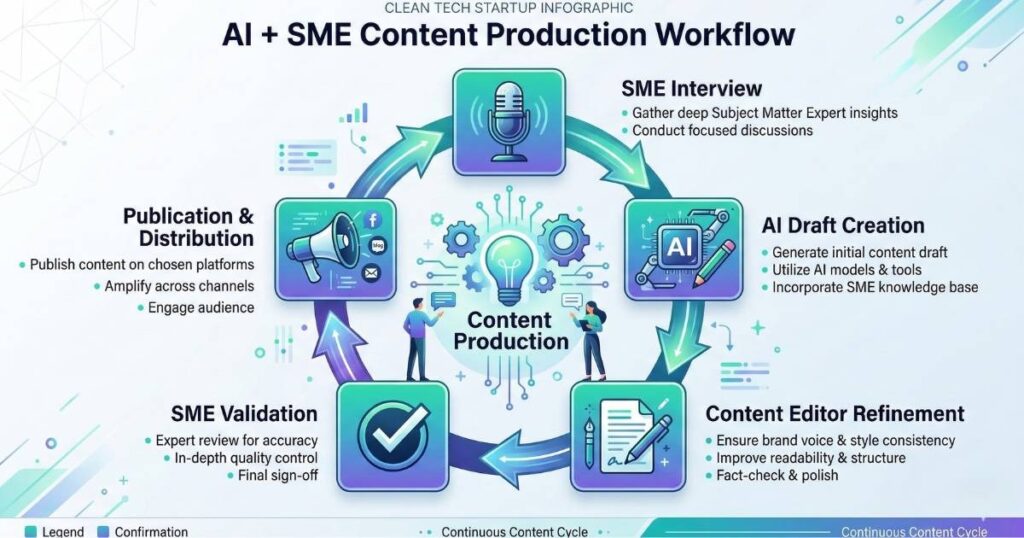
One of the most common bottlenecks in tech startup content production is access to subject matter experts (SMEs). Engineers, product leaders, and technical founders often possess the most valuable insights but rarely have the time to write long-form content.
A practical solution is the SME-as-Validator model, where experts validate content rather than drafting it from scratch.
Instead of asking SMEs to produce full articles, content teams can use a structured workflow that captures expert knowledge efficiently.
The SME-as-Validator Workflow
A typical workflow includes three steps:
- Record a structured SME interview
Conduct a 20–30 minute interview covering the topic, common customer objections, edge cases, and real-world implementation examples. - Draft the content using the transcript
A content strategist or AI-assisted writing tool converts the interview transcript into a structured article, incorporating the expert’s insights and examples. - Return the draft for expert validation
The SME reviews the draft for accuracy, adds nuance where needed, and flags any technical edge cases. In this model, the expert acts as a validator rather than the primary writer.
This approach allows startups to scale technical content production while maintaining the credibility and accuracy that developer audiences expect.
Companies with strong founder-led or engineer-led thought leadership often see stronger engagement because the insights come directly from practitioners rather than generic marketing copy.
How AI Supports the Content Production Workflow
AI tools can significantly accelerate several stages of the content creation process when used alongside human expertise.
Common applications include:
- Topic discovery by analyzing customer support conversations, product documentation, and search data
- Draft optimization to align content with search intent and keyword clusters
- Content repurposing, such as converting long-form articles into LinkedIn posts, newsletter summaries, or short video scripts
- Quality checks, including identifying missing definitions, weak headings, or unclear explanations
However, human oversight remains essential. Editors and subject matter experts ensure that content maintains technical accuracy, brand voice consistency, and ethical standards, particularly when discussing sensitive areas such as data privacy, regulatory compliance, or emerging technologies.
For example, companies operating in regulated markets must ensure that educational content referencing frameworks like the Digital Personal Data Protection Act, 2023 accurately reflects legal requirements.
Human Expertise Remains the Core Advantage
The most effective content programs combine AI efficiency with human expertise.
AI can assist with research, structuring, and distribution, but authentic thought leadership still comes from practitioners who understand the technology, the customer problems, and the industry context.
By pairing AI-assisted workflows with SME validation, tech startups can build a scalable content engine that produces credible, technically accurate resources trusted by both search engines and developer communities.
Distribution Orchestration: The Multi-Channel Flywheel
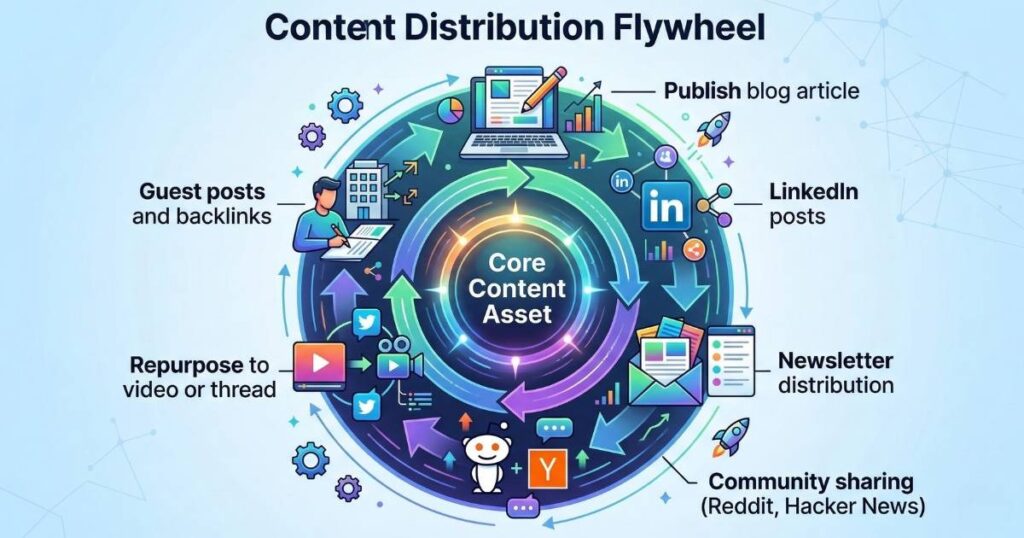
For many tech startups, the biggest mistake in content marketing is the “publish-and-pray” approach, publishing an article and waiting for organic traffic to appear.
In reality, content without a distribution strategy often reaches only a small fraction of its potential audience. Research from Orbit Media Studios and Content Marketing Institute consistently shows that active promotion significantly increases content reach and engagement compared to passive publishing alone.
Successful tech startups treat distribution as a structured, multi-channel flywheel, where each major content asset is launched and amplified across several platforms over time.
One practical approach is a 6-week launch playbook designed to maximize the visibility of a single high-value content asset.
Phase 1: Pre-Launch (Weeks 1–4)
The goal of the pre-launch phase is to build anticipation and audience awareness before publication.
Effective tactics include:
- Sharing the research process, insights, or early findings on LinkedIn
- Contributing value-first answers on communities such as Hacker News, Indie Hackers, and Reddit
- Identifying industry influencers, newsletter editors, and community moderators who regularly cover your topic
This phase helps ensure that when the content launches, there is already an engaged audience ready to share and discuss it.
Phase 2: Launch Day (Week 5)
Launch day focuses on coordinated distribution across multiple channels.
Common launch strategies include:
- Publishing the content across company channels such as LinkedIn and email newsletters
- Sharing in relevant technical communities and founder forums
- Launching related tools, research, or reports on Product Hunt
Outreach to industry newsletters can significantly expand reach. Popular newsletters such as TLDR Tech or Morning Brew’s technology editions reach large audiences of developers, founders, and tech professionals through sponsorships or editorial placements.
Phase 3: Post-Launch Amplification (Week 6)
After the initial release, the focus shifts to content repurposing and ongoing distribution.
A single long-form article can typically generate five to seven derivative assets, such as:
- a X thread summarizing key insights
- a LinkedIn carousel explaining the framework
- a short-form video summary
- a guest post pitch to a niche publication
- an email sequence for existing subscribers
Tracking engagement across these channels helps inform future content strategy and identify which platforms generate the highest-quality traffic.
Platform Strategy by Audience
Effective distribution strategies align with where each persona already spends time online.
For example:
Developers and technical audiences often discover content through
- GitHub
- Stack Overflow
- Hacker News
Executives and decision-makers more commonly engage through
- LinkedIn feeds
- curated industry newsletters
- market analysis reports
Enterprise buyers also frequently evaluate vendors through independent review platforms such as G2 and Capterra, making these profiles important extensions of a company’s content marketing ecosystem.
The Role of Emerging Channels
Visual platforms are also gaining traction for B2B storytelling. For example, Instagram can help startups build brand familiarity through:
- behind-the-scenes product development content
- founder storytelling
- culture and team insights
While these channels may not directly generate enterprise leads, they can strengthen brand awareness and community engagement, particularly among younger developers and startup audiences.
Measurement and the Economics of Tech Content
B2B technology buying journeys involve numerous interactions across marketing channels. Research from Demand Gen Report shows that enterprise buyers often engage with 20–30 marketing touchpoints before making a purchase decision.
Because of this complexity, traditional last-touch attribution models are often inadequate for tech startups. Last-touch attribution assigns 100% of conversion credit to the final interaction before a deal closes, which systematically undervalues early-stage content such as educational blog posts, reports, or webinars that initiated the relationship months earlier.
To understand the true revenue impact of content marketing, B2B organizations typically use multi-touch attribution models.
Key Attribution Models for B2B Content Marketing
Several attribution models are commonly used to evaluate content performance across long buying cycles.
Linear Attribution
Credit is distributed equally across every touchpoint in the buyer journey.
This model is often useful for startups establishing an initial attribution baseline.
Time-Decay Attribution
More credit is assigned to interactions that occur closer to the conversion event.
This approach works well when sales teams play a strong role in late-stage deal closing.
U-Shaped Attribution
Approximately 40% of credit is assigned to the first interaction, 40% to the lead conversion event, and the remaining 20% distributed across middle interactions.
This model is commonly used in inbound-led marketing programs.
W-Shaped Attribution
Credit is distributed across three critical milestones:
- first interaction
- lead conversion
- opportunity creation
Each milestone receives significant weight, while the remaining credit is distributed across other touchpoints. This model is often used by companies with sales-assisted enterprise deals.
Key Performance Indicators for Tech Startup Content Marketing
While pageviews and traffic growth provide useful signals, effective B2B content programs ultimately measure revenue impact.
Three metrics are particularly important.
LTV:CAC Ratio
The ratio between customer lifetime value (LTV) and customer acquisition cost (CAC) is a core SaaS efficiency metric.
According to benchmarks from OpenView Venture Partners and ProfitWell, healthy SaaS businesses typically aim for an LTV:CAC ratio between 3:1 and 5:1.
Content-led acquisition strategies often improve this ratio because organic channels reduce paid acquisition costs while attracting higher-intent users.
Pipeline Contribution
Content should influence a meaningful share of total pipeline. Many mature B2B marketing teams report 30–60% of pipeline influenced by content-driven inbound channels, according to studies from Content Marketing Institute.
This metric can be tracked by:
- tagging inbound leads with their first-touch content source
- attributing pipeline value to the marketing channel that generated the lead
- monitoring which content assets influence opportunity creation
Deal Velocity and AI Visibility
Beyond lead generation, content can accelerate the sales process by educating buyers before they speak with sales teams.
Marketing teams can measure this by tracking:
- time-to-close improvements in CRM data
- content engagement by opportunity stage
- share of voice in AI-generated answers
As AI-powered search tools grow more influential, monitoring brand mentions and citations across AI-generated responses is becoming an emerging indicator of organic visibility in the generative search ecosystem.
In Summary
Content marketing for tech startups is no longer just about publishing blog posts. Modern content marketers for tech startups are no longer just writers. They act as orchestrators, combining data, AI efficiency, and human expertise to build compounding digital assets that serve developers, executives, and enterprise buyers simultaneously.
An effective content marketing strategy begins with strong foundations: audience persona engineering, high-intent Jobs to Be Done (JTBD) keyword mapping across the funnel, and content engineered for both search engines and generative AI systems (GEO). High-performing programs also invest in interactive assets such as ROI calculators and product tours that drive deeper engagement than static blog posts.
Scaling this strategy requires SME-validated production workflows, multi-channel distribution through structured launch playbooks, and multi-touch attribution models that connect content activity directly to pipeline and revenue.
Ultimately, startups that consistently deliver credible, expert-driven content build the authority that attracts buyers, earns AI citations, and establishes long-term category leadership.