

A B2B editorial calendar is a planning document that maps out every piece of content your team will create, publish, and distribute, organized by date, topic, keyword, owner, and funnel stage.
To build one, you need three things: a clear content strategy, a spreadsheet or tool to house the calendar, and a repeatable workflow your team will actually follow. Done right, your editorial calendar becomes the operational backbone of your entire content program.
Table of Contents
What Is a B2B Editorial Calendar (And Why It’s Not the Same as a Content Calendar)

A B2B editorial calendar is a structured planning system that schedules content by publish date, keyword, author, funnel stage, and distribution channel, giving your entire marketing operation a single source of truth.
Most people use “editorial calendar” and “content calendar” interchangeably, but there is a real difference worth knowing. A content calendar tells you what to post and when. An editorial calendar tells you why, linking each piece back to a business goal, a target keyword, an audience segment, and a place in the funnel.
For B2B teams, where content has to serve a 3-to-12-month buying cycle, that strategic layer is not optional. You need to know whether a blog post is designed to generate awareness at the top of the funnel or move a deal forward at the bottom, because those goals require completely different content.
The bottom line: If your “calendar” is just a list of blog titles and dates, you have a content schedule, not an editorial calendar. Building the full version takes one extra afternoon and will change how effectively your content drives pipeline.
Why Your B2B Team Needs an Editorial Calendar Now
The case for an editorial calendar is not about staying organized for its own sake. It is about the direct impact on your content’s performance and your team’s output.
According to CoSchedule, marketers who proactively plan their projects are 356% more likely to report success than those who do not. That is not a marginal improvement. That is the difference between a content program that moves the needle and one that produces work nobody reads.
According to HubSpot, brands that prioritize blogging see 13 times more ROI than brands that don’t. Consistent, strategic publishing is the mechanism behind that number. An editorial calendar is how you achieve it.
Here is what changes when small B2B teams start using a real editorial calendar:
- Consistency becomes automatic. You stop scrambling at the end of the month to find something to publish. The calendar tells you what is due, who owns it, and when it ships.
- Keyword gaps become visible. When every article is mapped to a primary keyword and topic cluster, you can see at a glance where you have coverage and where you have nothing.
- Cross-functional coordination gets easier. Sales, product, and leadership can see what is coming, flag conflicts, and contribute ideas before content goes into production.
- Reporting becomes straightforward. When every piece is tagged by funnel stage and goal, you can pull a monthly report in minutes instead of piecing it together from three different tools.
If you are part of a 1-to-5 person B2B marketing team, every hour you spend without an editorial calendar is an hour your competitors with one are gaining ground. Build it once, and it runs your content operation for the next 12 months.
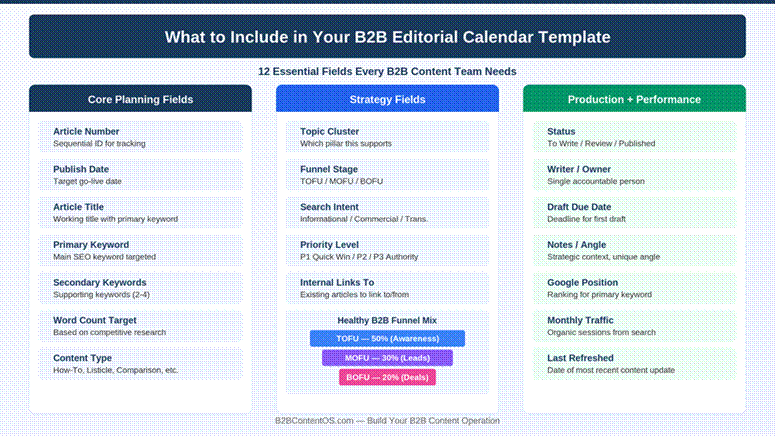
The essential columns for a professional B2B editorial calendar template.
What to Include in Your B2B Editorial Calendar Template
A B2B editorial calendar template needs more columns than most people expect. Here is every field that belongs in a professional setup, organized by category.
Core Planning Fields
| Field | What to Track | Example |
| Article Number | Sequential ID for tracking | 8 |
| Publish Date | Target go-live date | April 7, 2026 |
| Article Title | Working title, including primary keyword | How to Build a B2B Editorial Calendar |
| Primary Keyword | The main SEO keyword you are targeting | b2b editorial calendar template |
| Secondary Keywords | Supporting keywords (2-4) | content calendar b2b, editorial calendar example |
| Word Count Target | Based on competitive research | 2,500 |
| Content Type | Format of the piece | Template + How-To |
Strategy Fields
| Field | What to Track | Example |
| Topic Cluster | Which pillar this supports | Content Operations |
| Funnel Stage | TOFU, MOFU, or BOFU | MOFU |
| Search Intent | Informational, Commercial, Transactional | Informational |
| Priority | P1 Quick Win / P2 High Impact / P3 Authority | P1 Quick Win |
| Internal Links To | Which existing articles to link from this piece | Content Engine, Strategy Pillar |
Production Fields
| Field | What to Track | Example |
| Status | To Write / In Review / Scheduled / Published | To Write |
| Writer | Who owns this piece | Sarah |
| Due Date | Deadline for first draft | March 31 |
| Editor | Who reviews before publishing | Head of Marketing |
| Notes | Strategic context, angle, key points | Include downloadable Google Sheets template |
Performance Fields (Add Once Content Is Live)
| Field | What to Track |
| Google Position (30 days) | Where the article ranks for its primary keyword |
| Monthly Organic Traffic | Sessions from organic search |
| Leads Generated | Conversions tied to this piece |
| Last Refreshed | Date of most recent content update |
| You do not need to fill in every field on day one. Start with the core planning fields and strategy fields. Add production and performance fields as your process matures. |
How to Build Your B2B Editorial Calendar: Step-by-Step
The weekly operating rhythm that keeps your editorial calendar running on autopilot.
Step 1: Anchor Your Calendar to Your Content Strategy
Before you open a spreadsheet, you need answers to three questions. What topics will you cover? Who are you writing for? And what does “success” look like for each piece of content?
If you do not have a documented B2B content marketing strategy, build that first. Your editorial calendar is the execution layer of your strategy. Without a strategy underneath it, a calendar is just a list of things to write.
Your strategy should tell you: your topic clusters, your target audience personas, your funnel coverage goals, and your publishing cadence. Feed those answers into your calendar structure before you add a single article.
| Action step: List your 3-5 core topic clusters. Every article you add to your calendar should map to one of these clusters. If it doesn’t, question whether it belongs in the calendar at all. |
Step 2: Build Your Keyword Universe
For each topic cluster, identify 10-20 target keywords using a tool like Ahrefs, Semrush, or even free tools like Google Search Console and AnswerThePublic. Sort them by search volume, keyword difficulty, and search intent.
Assign each keyword a priority level. P1 keywords are high-volume, lower-difficulty terms where you can rank quickly. P2 keywords are competitive but high-value for authority-building. P3 keywords are long-tail, high-intent terms that convert well even at low volume.
Once you have your keyword list, you have the raw material for 3-6 months of content. One keyword = one article. Do not try to rank for multiple primary keywords in the same piece.
Step 3: Map Articles to Your Funnel
A common mistake is loading your editorial calendar with TOFU awareness content and neglecting MOFU and BOFU pieces. In B2B, the content that converts deals happens in the middle and bottom of the funnel.
A healthy ratio for most B2B teams is roughly 50% TOFU, 30% MOFU, and 20% BOFU. TOFU brings in traffic. MOFU converts visitors to leads. BOFU closes deals or supports sales conversations.
Map each article in your keyword universe to a funnel stage before you put it in the calendar. If you see a gap, that is your first priority to fill.
Step 4: Set Your Publishing Cadence
Be honest about what your team can actually produce. One well-researched, 2,500-word article per week beats three thin, rushed pieces every time. If you have a team of one or two writers, start with two articles per week and build from there.
For most B2B teams using a repeatable content engine, a sustainable cadence looks like: one pillar-style deep dive per month, two to three supporting cluster articles per week, and one distribution-focused piece (like a case study or comparison post) per month.
| Never leave “publish” as the only date in your calendar. Every article needs a production timeline, not just a go-live date. |
Step 5: Assign Ownership and Workflow Stages
For each article in the calendar, assign a single owner. Not a team. One person who is accountable for getting that piece from brief to published.
Define your workflow stages and track them in the status column. A simple four-stage workflow covers most teams: To Brief, In Progress, In Review, Scheduled. If you use a more complex review process, add stages as needed.
For small teams handling content production at scale, workflow clarity eliminates the bottleneck of “I thought you were handling that.” Every article has a name next to it. Every name has a deadline. End of story.
Step 6: Add Internal Link Planning
For each new article, identify three to five existing pieces it should link to and three to five existing pieces that should link back to it. Record both in your editorial calendar template.
This is often skipped, and it is a significant SEO mistake. Internal links are how Google understands the topical relationship between your pages. Without intentional internal linking, your content sits in silos, and your authority does not compound across your topic cluster.
When you do a B2B content audit, missing internal links are one of the most common structural problems you will find.
| Action step: For every new article you add to your editorial calendar, spend 10 minutes identifying five existing articles that should link to it. Add those to the notes column before the article goes into production. |
Step 7: Schedule Your First Quarterly Review
An editorial calendar is not a set-it-and-forget-it document. Every quarter, review what is working, what missed its ranking targets, and what topics have emerged that you hadn’t planned for.
Build the review into the calendar itself: a recurring entry every 90 days to reassess priorities, refresh underperforming content, and reallocate production resources. Tracking this is much easier once you have used tools like those in our best content audit tools roundup to benchmark performance.
How to Run Your Editorial Calendar Week-to-Week
Building the calendar is the easy part. Running it consistently is where most teams fall down. Here is the weekly operating rhythm that keeps an editorial calendar functional for small B2B teams.
Monday (15 minutes): Review what is due this week. Confirm that in-progress articles are on track. Flag any blockers early so they don’t become fires on Thursday.
Wednesday (30 minutes): Check the production status of all articles currently in progress. Move any completed drafts into review. Brief the next batch of articles going into production next week.
Friday (15 minutes): Confirm that this week’s articles are scheduled or published. Update the status column. Add any new keyword or topic ideas that came up during the week.
This is a 60-minute total weekly time investment. If your editorial calendar is requiring more time than that to maintain, it is either too complex or not set up correctly.
In practice, what most B2B marketing teams find is that the first two weeks of running the calendar feel manual and clunky. By week four, it becomes automatic. By week eight, your team cannot imagine operating without it.
The goal of a weekly editorial rhythm is to make publishing feel boring, in the best possible way. No fires, no last-minute scrambles, no weeks where nothing ships. Just consistent, on-strategy content.
Common Editorial Calendar Mistakes (And How to Fix Them)
Five mistakes that derail B2B editorial calendars, and how to fix each one.
Mistake 1: No Keyword for Every Article
Every article in your editorial calendar must target a specific primary keyword. If an article has no keyword, it has no organic traffic potential. It exists only for social media shares, which are temporary. Organic traffic compounds.
Fix: Before any article goes into the calendar, assign a primary keyword. If you cannot find a keyword worth targeting, reconsider whether the article belongs in the calendar.
Mistake 2: Too Many TOFU Articles
It feels good to publish awareness content because it gets shares and views. But if your calendar is 80% TOFU blog posts, your content is not supporting pipeline. Buyers need MOFU content to move from interested to convinced.
Fix: Run a funnel-stage audit of your entire editorial calendar every quarter. Identify the ratio and rebalance by adding MOFU and BOFU articles to the next quarter’s plan.
Mistake 3: No Distribution Plan in the Calendar
Publishing is step one, not step done. An article that goes live with no distribution plan will get seen by no one except whatever organic search traffic it earns over the next few months.
Fix: Add a distribution column to your editorial calendar. For each article, document where you will share it: LinkedIn post, email newsletter, relevant Slack communities, a podcast episode, a social media carousel. Plan the distribution at the same time you plan the content. The strategy behind each channel is covered in detail in our guide to B2B content marketing strategy.
Mistake 4: Treating the Calendar as a Writing Schedule Only
Your editorial calendar is not a list of articles. It is a strategic asset that documents your content operation. If it only shows publish dates and article titles, it is not doing its job.
Fix: Ensure every row in your calendar has: a primary keyword, a funnel stage, an owner, a status, and notes on the strategic angle. Use marketing automation for B2B content to trigger alerts and reminders when deadlines are approaching.
Mistake 5: Never Updating Old Entries
An editorial calendar becomes useless the moment it drifts out of sync with reality. If articles that were published six weeks ago still show “In Progress,” nobody trusts the calendar.
Fix: Make status updates non-negotiable. Every time an article moves stages, the calendar gets updated that day. Assign this responsibility to the article owner, not a separate ops person.
Free B2B Editorial Calendar Template
We built a free B2B editorial calendar template at B2BContentOS that you can copy and use today. It includes all the columns described in this article, a pre-built status tracking system, a quarterly review tab, and color-coded priority labels.
The template is designed for teams of 1 to 5 people managing 50 to 100 articles per year. It works in Google Sheets and can be exported to Excel if needed.
What to Do Next
The teams that consistently outperform their competitors on content are not necessarily writing better articles. They are writing the right articles, at the right time, for the right audience. Your editorial calendar is how you make that happen.
FAQs
What is a B2B editorial calendar template?
A B2B editorial calendar template is a structured planning document, usually in spreadsheet form, that tracks every piece of content your team plans to produce. It includes columns for publish date, article title, primary keyword, author, funnel stage, status, and internal link planning. The “B2B” version adds business-specific fields like topic cluster, buyer persona, and pipeline impact.
How is an editorial calendar different from a content calendar?
A content calendar schedules what to publish and when. An editorial calendar adds the strategic layer: why you are publishing each piece, who it is for, what keyword it targets, where it sits in the funnel, and how success will be measured. For B2B teams with long buying cycles, the strategic layer makes a significant difference in how content performs.
How far in advance should I plan my editorial calendar?
Plan 90 days in detail and 12 months at a high level. Detailed planning means every article has an assigned keyword, owner, funnel stage, and due date. High-level planning means you have your topic clusters mapped and your publication cadence set for the full year. Revisit and update the detailed 90-day view monthly.
What tools can I use to manage a B2B editorial calendar?
Google Sheets and Airtable are the most common tools for small B2B teams. More advanced teams use project management tools like Notion, ClickUp, or Asana with a content calendar view. The tool matters less than the discipline of keeping it updated. Start with a Google Sheet and upgrade only if the tool becomes a genuine bottleneck.
How many articles should I include in my B2B editorial calendar?
For a team of one to three people, plan for 8 to 12 articles per month. For a team of four to five people, 16 to 20 articles per month is sustainable. Do not plan more than your team can produce at a high quality standard. A smaller number of well-researched, high-quality articles consistently outperforms a higher volume of thin content.
How do I maintain my editorial calendar once it’s built?
Assign a single owner for calendar maintenance. Run a 15-minute editorial calendar check-in every Monday to review the week’s production pipeline and update statuses. Schedule a 60-minute quarterly review to reassess priorities, add new keywords, and archive completed content. The weekly check-in keeps the calendar accurate. The quarterly review keeps it strategically aligned.