

Quick Answer: Is Mangools KWFinder worth it?
Yes, Mangools KWFinder is worth it for solo founders and small B2B teams doing keyword research. At $29/mo (Mangools Basic), it provides accurate keyword difficulty scores, SERP analysis, and competitor research for 200 keyword lookups per day. It is significantly cheaper than Ahrefs or Semrush while covering the core keyword research use case. If your primary need is finding low-competition keywords for B2B blog content, Mangools delivers strong value at its price point.
Disclosure: Some links in this post are affiliate links. If you sign up through them, I may earn a commission at no extra cost to you. I only recommend tools I believe are genuinely useful.
Finding the right SEO tool in 2026 can feel like navigating a minefield. With the SEO landscape shifting dramatically due to Google’s Search Generative Experience (SGE) and constant algorithm updates, it is no longer enough to just look at raw “Search Volume” and guess your chances of ranking.
You need precise data. But you also don’t necessarily want to pay $200+ a month for complex enterprise software if you run a small business, a niche blog, or a mid-sized agency. And we have Mangools KWFinder.
Often called the “Designer’s Choice” of SEO suites or the “Apple” of SEO tools, Mangools has built a reputation for providing gorgeous, intuitive data without the overwhelming complexity of industry giants like Ahrefs or Semrush. But does it actually have the raw data power to help you rank on the first page of Google and navigate AI overviews?
After extensive testing and analyzing its latest 2026 features, from its unique Link Profile Strength (LPS) algorithm to its new SGE metrics, this detailed review breaks down everything you need to know.
What is Mangools KWFinder?
Launched in 2014, Mangools is an all-in-one SEO suite designed primarily for beginners, bloggers, freelancers, and small-to-medium businesses. While KWFinder is its flagship keyword research tool, purchasing a subscription actually gives you access to a fully integrated ecosystem of five core SEO tools:
- KWFinder: Keyword research and discovery.
- SERPWatcher: Daily rank tracking.
- SERPChecker: In-depth SERP and competitor analysis.
- LinkMiner: Backlink analysis.
- SiteProfiler: Overall website authority and SEO metrics.
Unlike bulky enterprise software that requires weeks of training to master, Mangools focuses on the 20% of SEO tasks that produce 80% of your results: finding achievable keywords, tracking your rankings, and analyzing your competitors.
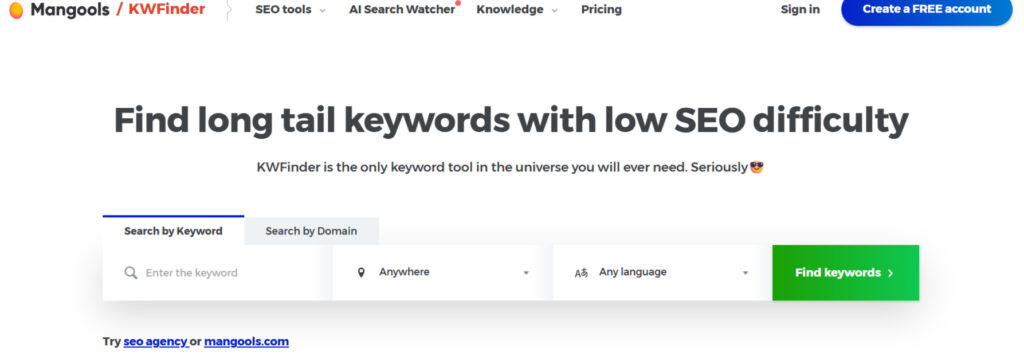
KWFinder Features & Accuracy
KWFinder is the beating heart of the Mangools suite. When evaluating a keyword research tool, the three pillars that matter most are Data Accuracy, Actionability, and Affordability. Here is how KWFinder performs in 2026.
1. The Keyword Database & Suggestion Power
Mangools boasts a massive database of over 2.5 billion keywords, which actually outnumbers Ahrefs’ database of roughly 500 million. When you type in a seed keyword, KWFinder generates hundreds of suggestions instantly.
You aren’t just limited to standard “Related Keywords.” The tool features dedicated tabs for:
- Autocomplete: Pulls in exact variations of what people are actively typing into Google.
- Questions: Helps you find specific “How to…” or “What is…” queries. These are historically easier to rank for and are the exact types of queries that trigger Google’s Featured Snippets and AI Overviews.
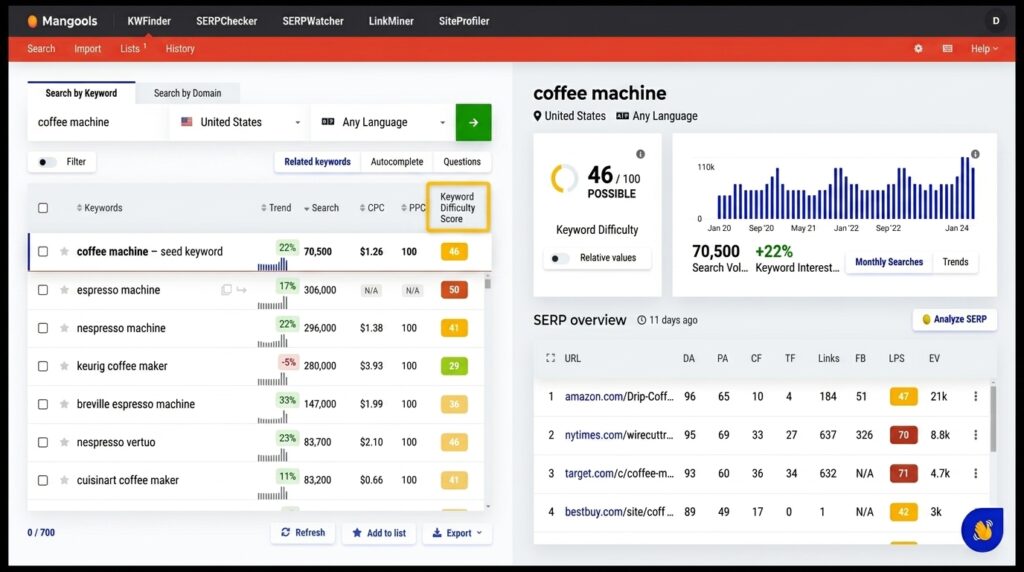
2. The Keyword Difficulty (KD) Algorithm Explained
Most SEO tools calculate “Keyword Difficulty” by looking at the overall Domain Authority of the websites ranking on page one. This is a flawed metric. A massive site like Forbes might have a high domain authority, but the specific article ranking for your keyword might have zero backlinks of its own, making it highly vulnerable to being outranked.
KWFinder does things differently. Its KD score (ranging from 0 to 100) is built around Link Profile Strength (LPS). KWFinder fetches the actual first-page results in real-time and calculates the LPS for each individual ranking URL, not just the parent domain.
Furthermore, KWFinder features Relative Keyword Difficulty (RKD). By entering your own URL into the tool, KWFinder recalculates the difficulty score based on your site’s specific link strength against the current SERP. A keyword that looks like a “Hard 42” to the general public might show up as an “Easy 26” for your specific domain.
Because of this page-level LPS logic, independent correlation studies have frequently rated KWFinder’s difficulty score as the most accurate in the industry for predicting real-world ranking difficulty.
3. SGE & AI Overview Compatibility
In 2026, ranking in Google requires optimizing for AI Overviews and the Search Generative Experience (SGE). High search volume is useless if an AI snippet answers the user’s question perfectly and results in zero clicks.
Mangools has adapted to this era by integrating semantic triples and topic clustering into its suggestions. The tool now features a “Generative Visibility Index” and SGE-specific filters. This allows you to identify which keywords are likely to be “swallowed” by AI answers, and which ones will still drive traditional blue-link organic traffic to your website.
4. Hyper-Local SEO Mastery
If you run a local business or a service-area company, national search volumes are largely irrelevant. You need city-level data. KWFinder absolutely shines here, allowing you to filter data across more than 52,000 specific locations globally.
If you are a plumber in Chicago, you can see the exact search volume and competition for “emergency plumber near me” restricted entirely to users in Chicago, rather than the whole United States.
Ready to find low-competition keywords in your niche? Start your KWFinder trial here.
Exploring the Rest of the Mangools Suite
Affiliate link — we earn a small commission at no extra cost to you.
While KWFinder gets all the spotlight, your subscription grants you access to four other powerful tools. They integrate seamlessly to create a closed-loop SEO ecosystem.
SERPWatcher (Rank Tracking)
Tracking your keyword rankings is essential to measure your ROI. SERPWatcher is a phenomenal, beginner-friendly rank tracker that updates your keyword positions daily.
Instead of just telling you that you moved from “Position 8 to Position 5,” SERPWatcher uses a Dominance Index (also referred to as the Performance Index). This metric calculates your ranking position multiplied by the actual search volume of the keyword, giving you a “Share of Voice” percentage. You can track unlimited domains (up to your plan’s keyword limits) across both desktop and mobile devices, and even track your Google My Business listing visibility.
In a massive update for 2026, Mangools also added AI Visibility Tracking for free across all plans. You can track which prompts your brand appears for across LLMs like ChatGPT, Gemini, Claude, and Google AI Overviews.
SERPChecker (Competitor Analysis)
Before you write a 2,500-word blog post, you need to know who you are up against. SERPChecker simulates the Google Search results for any keyword (from any localized IP address) and pulls in over 40 critical metrics.
You can view the Domain Authority (DA) and Page Authority (PA) pulled directly from Moz, Trust Flow (TF) from Majestic, Facebook shares, and the Website Popularity Rank (WPR). By entering your own targeting URL, the tool will compare your SEO score against the top 10 results so you know exactly how many backlinks you need to build to claim the #1 spot.
LinkMiner (Backlink Research)
Backlinks remain a core ranking factor. LinkMiner utilizes a massive database of 9.5 trillion backlinks to help you spy on your competitors’ link-building strategies.
The tool displays Citation Flow, Trust Flow, anchor texts, and whether links are Follow or NoFollow. The standout feature of LinkMiner is the one-click website preview. Instead of opening dozens of tabs to find where a link is placed, LinkMiner loads a preview of the referring website directly inside the dashboard and highlights the exact anchor text.
SiteProfiler (Domain Overview)
SiteProfiler is your bird’s-eye view tool. Enter any domain, and it spits out a beautifully visualized report of the site’s overall health, backlink profile, top content, and audience demographics. It also features a great “Competitors” section that instantly identifies sites sharing similar keyword overlaps with your target domain.
What is Mangools Missing? (The Honest Truth)
To comply with EEAT guidelines, a review must be transparent about a product’s limitations. Mangools is incredible for the price, but it is not a $999/month enterprise suite. Here is what you will miss if you choose Mangools over an advanced tool like Ahrefs or Semrush:
- No Technical Site Audit Tool: Mangools cannot crawl your website to find broken links, missing meta tags, slow page speeds, or technical Javascript rendering issues. If technical SEO is a priority, you will need a separate tool.
- No Content Editor: Unlike tools like SurferSEO or Semrush’s Content Assistant, Mangools does not offer an AI-driven text editor to grade your content’s NLP optimization in real-time as you write.
- Limited Backlink Depth: While LinkMiner is great, it lacks a dedicated “Backlink Gap” tool, and it does not feature a backlink toxicity score for performing spam link audits.
- LSI Keywords & Search Intent Metrics: Currently, KWFinder lacks a dedicated column that explicitly labels the “Search Intent” (Informational, Transactional, Navigational) of a keyword, and it does not have a dedicated LSI keyword generation feature.
Mangools Pricing 2026: Unbeatable Value for Money?
One of the biggest selling points of Mangools is its affordability. While enterprise competitors have shifted to strict usage-based pricing models that start at $129/month, Mangools remains incredibly budget-friendly.
(Note: Pricing below reflects approximate monthly costs when billed annually, which saves you around 35-40%).
| Plan Name | Approx. Monthly Cost | Daily Keyword Lookups | Tracked Keywords | Best For |
|---|---|---|---|---|
| Free | $0 | 5 | 10 (SERPWatcher) | Testing the waters. |
| Entry | ~$24.50 – $29.00 | 25 | 50 | Hobbyists & Solopreneurs. |
| Basic | ~$49.00 | 100 | 200 | Bloggers & Small Local Businesses. |
| Premium | ~$69.00 | 500 | 700 | Freelancers & Growing Sites (Includes 3 user seats). |
| Agency | ~$89.90 – $129.00 | 1,200 | 1,500 | Small Agencies (Includes 5 user seats). |
Is it worth it? Absolutely. At the Basic tier (~$49/mo), the tool breaks down to a little over a dollar a day. If you find just one low-competition keyword per month that brings in converting traffic, the software pays for itself immediately. Plus, Mangools offers a 48-hour money-back guarantee on their paid plans, removing the risk of trying it out.
Lock in your Mangools subscription at the best current rate here!
Ahrefs & Semrush vs. KWFinder: Which Should You Choose?
The inevitable question is whether Mangools can replace industry titans like Ahrefs or Semrush.
Choose Ahrefs or Semrush if:
- You are an SEO agency managing dozens of enterprise-level clients.
- You require deep, forensic backlink audits and toxicity reports.
- Technical site auditing is a daily requirement for your workflow.
- You have a software budget exceeding 150−200+ per month.
Choose Mangools KWFinder if:
- You are a blogger, freelance writer, or niche site builder.
- You run a local business and need highly accurate, city-specific keyword data.
- You find traditional SEO dashboards cluttered, overwhelming, and difficult to learn.
- You want 90% of the keyword research power at roughly 20% of the cost.
As one reviewer aptly noted: “A $1,000 tool sitting unused helps no one. A $49 tool used daily drives real organic traffic growth.”
How to Find Low-Competition Keywords Fast with KWFinder (Workflow)
If you decide to invest in Mangools, here is a proven, 5-step workflow to find keywords you can actually rank for on the first page of Google:
- Enter a Seed Keyword & Set Location: Type your broad topic (e.g., “Pour over coffee”) and select your specific location. If you are a local business, drill down to your exact city.
- Sort by Keyword Difficulty (KD): Click the KD column to sort results in ascending order. Look for keywords scoring in the “Green” zone (0-29), which Mangools classifies as easy to rank for.
- Use the “Questions” Tab: Switch to the questions tab to find queries like “what is the best pour over coffee maker for travel.” These have lower volume but incredibly high purchase intent.
- Calculate Relative Difficulty (RKD): Click on a promising keyword and enter your own domain URL into the SERPChecker panel. Watch the difficulty score adjust to your specific site’s authority.
- Verify the Search Intent: Before writing, look at the SERP Overview panel. Are the top 10 results all e-commerce product pages? If so, writing a purely informational blog post won’t rank. Ensure your content format matches what Google is actively rewarding.
Pros and Cons Summary
Pros:
- Best-in-class User Interface: Clean, beautiful, and zero learning curve.
- Highly Accurate KD Score: Relies on page-level Link Profile Strength (LPS) rather than broad domain authority.
- Hyper-Local SEO: Access search data for over 52,000 specific cities and regions.
- Incredible Value: 5 premium tools starting at roughly 25−49/month.
- Browser Extension: Powerful free Chrome/Firefox extension for instant on-page SEO metrics.
- AI Visibility Tracking: Track brand mentions across AI LLMs like ChatGPT and Gemini.
Cons:
- No Site Audit Tool: You cannot crawl your site for technical SEO errors.
- Smaller Keyword Database: 2.5 billion keywords is massive, but still smaller than Semrush’s 25 billion, meaning obscure international niches might lack data.
- Limited Backlink Features: No spam toxicity scores or dedicated backlink gap tool.
- No Content Editor: Lacks an AI writing assistant to grade content formatting.
Final Verdict: Is Mangools KWFinder Worth It?
If you are an enterprise SEO professional who spends their days doing Javascript rendering analysis and forensic link audits, Mangools is not for you. You will outgrow it quickly.
However, if you are a blogger, a niche site builder, a freelance writer, or a small business owner, Mangools KWFinder is arguably the best value-for-money SEO suite on the market in 2026. It completely removes the “analysis paralysis” caused by overly complex software, giving you exactly what you need to move the needle: actionable keyword data, accurate difficulty scores, and reliable daily rank tracking.
By focusing entirely on the core tasks that actually drive organic traffic, Mangools has created a tool that is not just affordable, but a joy to use on a daily basis.
Ready to dominate your niche and reach the first page of Google?
👉 Click Here to Start Your Mangools KWFinder Journey Today!
Affiliate link — we earn a small commission at no extra cost to you.
Frequently Asked Questions (FAQ)
Is KWFinder’s keyword difficulty score actually accurate? Yes. Independent correlation studies routinely rank KWFinder’s KD score as highly accurate for predicting real Google ranking positions. Because it uses Link Profile Strength (LPS) at the page level rather than just looking at overall Domain Authority, it provides a much more realistic picture of your competition.
Can Mangools replace Ahrefs or Semrush? For advanced technical SEOs and massive agencies, no. It cannot match their technical site auditing or forensic backlink analysis depth. However, for bloggers, small businesses, and content-focused SEOs, Mangools easily handles 80-90% of your daily needs at a fraction of the cost.
Does KWFinder work for Local SEO? Absolutely. KWFinder is one of the best tools on the market for local SEO because it allows you to filter search volume and difficulty data across more than 52,000 specific cities, states, and regions.
Is there a free trial available? Yes. Mangools offers a 10-day free trial that requires no credit card. During the trial, you can test out KWFinder, SERPWatcher, LinkMiner, and the rest of the suite to see if it fits your workflow before committing.
Looking for budget-friendly hosting to pair with your SEO stack? See my honest Hostinger review after two years of use.
