A content SEO audit tells you which pages on your site deserve more investment, which need fixing, and which are quietly dragging down your rankings. Done right, it takes a messy blog archive and turns it into a prioritized action list you can actually work through.
This checklist is built for B2B marketers. That means it goes beyond raw traffic numbers and looks at whether your content is earning rankings, building authority, and moving buyers through your funnel.
A content SEO audit is the systematic process of evaluating every indexed page on your website to determine what deserves more investment, what needs updating, and what is dragging down your overall rankings. It scores each page across four to five dimensions — search visibility, on-page SEO quality, content quality, AI search readiness, and business alignment — and produces a prioritized action list rather than just an inventory. For B2B teams, a content SEO audit differs from a generic audit because it weights pipeline value alongside traffic, treating a page that converts three buyers as more important than a page that attracts three hundred browsers. Most teams run a full audit twice a year and a lighter version quarterly.
The B2B Content SEO Scorecard: Score Every Page Before You Decide What to Do With It
To prioritize your content without second-guessing every decision, rate each page across five dimensions before you decide what to do with it.
The B2B Content SEO Scorecard rates each page on a 1-3 scale across:
- Search Visibility: Is the page ranking and earning clicks for a relevant keyword?
- On-Page SEO Quality: Are the basics (title tag, meta description, headers, schema) done correctly?
- Content Quality and E-E-A-T: Is the content original, expert-level, and clearly structured?
- AI Search Readiness: Does the page contain directly extractable, quotable answers?
- Business Alignment: Does this page serve your ICP and connect to your funnel?
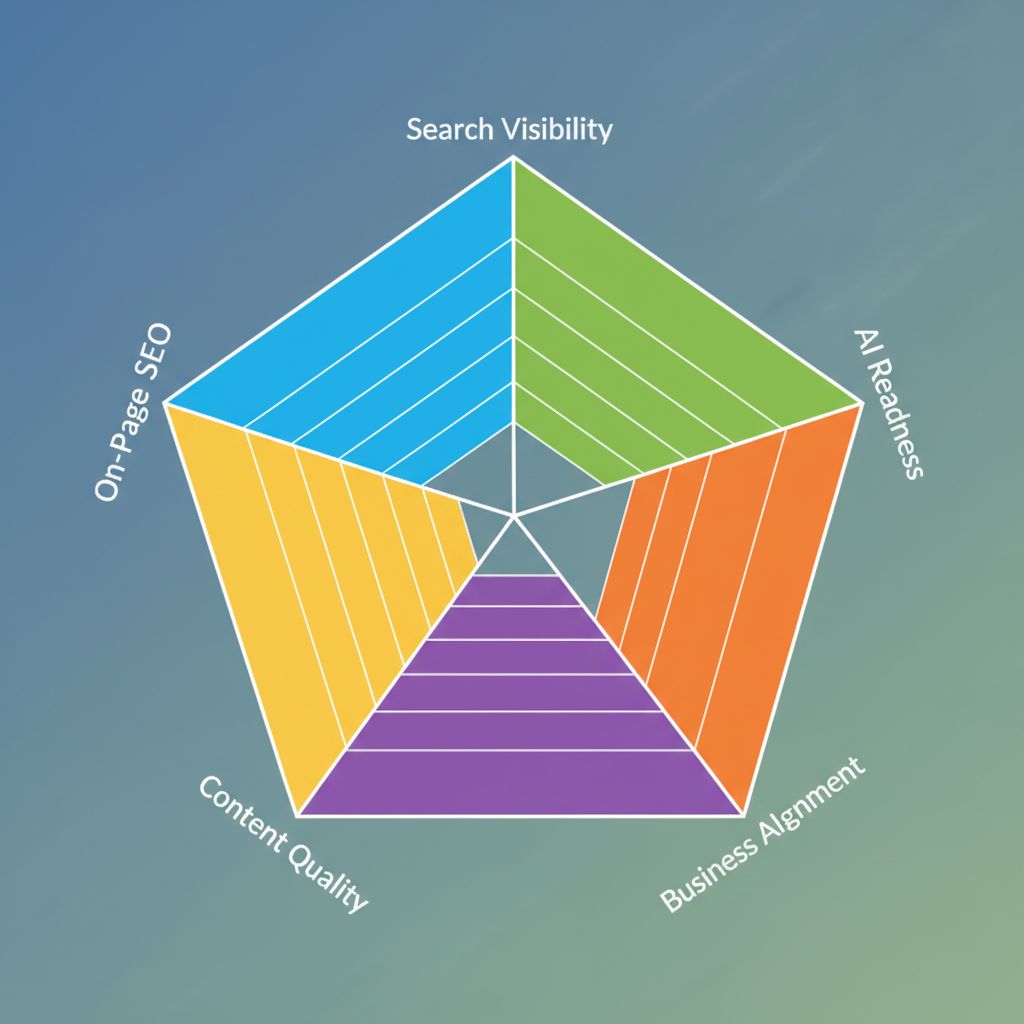
Each dimension scores 1-3. Total scores translate into action:
- 12-15: High-performer. Protect it, build internal links to it, and expand where content gaps exist.
- 9-11: Has potential. Targeted updates will move it significantly.
- 5-8: Underperformer. Rewrite, merge with a stronger piece, or delete and redirect.
- Under 5: Dead weight. Unless there is a strong backlink reason to keep it, redirect and move on.
This framework separates B2B content audits from generic ones in two ways. It weights AI search readiness as its own dimension, because a page can rank well on Google and still be invisible to ChatGPT or Perplexity. And it requires you to ask whether a page actually serves your business, not just whether it gets traffic.
A content SEO audit is the systematic process of evaluating every indexed page on your website to determine what deserves more investment, what needs updating, and what is dragging down your overall rankings. It scores each page across four to five dimensions — search visibility, on-page SEO quality, content quality, AI search readiness, and business alignment — and produces a prioritized action list rather than just an inventory. For B2B teams, a content SEO audit differs from a generic audit because it weights pipeline value alongside traffic, treating a page that converts three buyers as more important than a page that attracts three hundred browsers. Most teams run a full audit twice a year and a lighter version quarterly.
What a Content SEO Audit Actually Covers
A content SEO audit covers blog posts, pillar pages, and any other indexed content you want search engines and AI tools to find. It does not cover crawl errors, Core Web Vitals, or site architecture, though those problems live adjacent to this work.
Before you start, pull together:
- A full URL list from Google Search Console, Screaming Frog, or your CMS sitemap
- GSC data for the last 90 days: impressions, clicks, average position, and CTR per URL
- GA4 or equivalent: sessions, engagement rate, and goal completions per URL
- A spreadsheet with one row per URL and columns for each scorecard dimension
The 7-Step Content SEO Audit Checklist for B2B Marketers
Work through these steps for each page. Score each dimension as you go, then total the scorecard at the end.
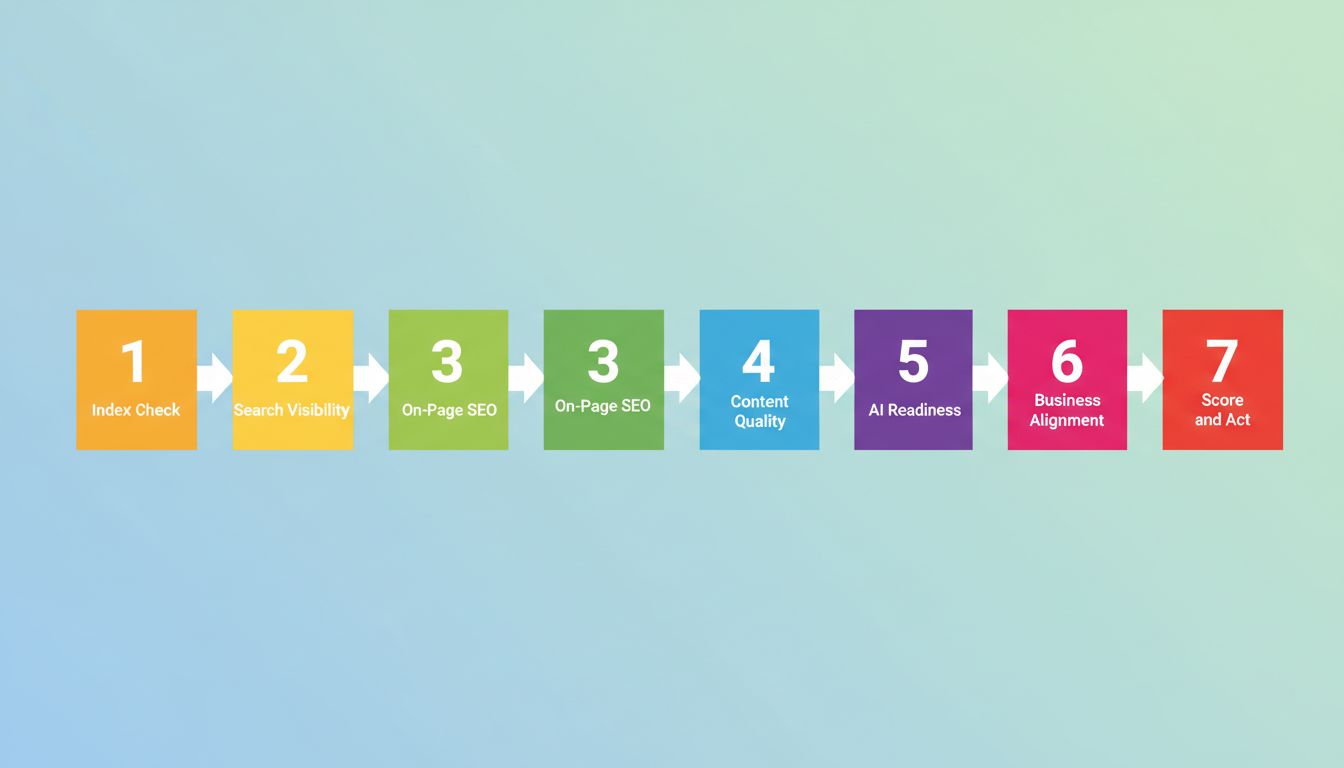
Step 1: Confirm the Page Is Indexed
Use the site:yourdomain.com/slug operator in Google or the URL Inspection tool in GSC to confirm each page is indexed. Check for a noindex tag in the source, a robots.txt block, or a redirect chain that might be fragmenting link authority.
There is no point auditing a page search engines cannot see.
Step 2: Score Search Visibility
Pull 90-day GSC data for each URL. Note impressions, average position, CTR, and the primary query driving impressions. A page with 5,000 impressions and 1% CTR has a different problem from a page with 200 impressions and 15% CTR. The first needs a stronger title and meta description. The second needs more topical authority or internal links.
Score 1-3: 1 = under 500 impressions with no clear ranking keyword. 2 = 500-5,000 impressions ranking 6-20 for a relevant keyword. 3 = ranking top 5 with consistent clicks on a high-intent keyword.
Step 3: Evaluate On-Page SEO
Check each of these elements on every page:
- Title tag contains the target keyword and stays under 60 characters
- Meta description is under 155 characters and gives a clear reason to click
- One H1 per page, matching or closely reflecting the title tag
- H2s frame logical sub-questions, not vague labels like “Overview” or “Introduction”
- Target keyword appears in the first 100 words
- Images have descriptive alt text
- Schema markup is set (Article, FAQ, or HowTo as appropriate)
Most B2B blog posts fail on the meta description (left blank or auto-generated) and schema (never set at all). Both are fast wins that compound over time.
Score 1-3: 1 = multiple basics missing. 2 = title and H1 present but meta is weak and schema is absent. 3 = all elements in place, keyword-optimized, schema configured.
Step 4: Check Content Quality and E-E-A-T
Read the first three paragraphs. If they do not directly answer what someone searching this keyword wants to know, the page has an intent problem. Then check the full piece for:
- Search intent match: Is the format right? A “checklist” query needs an actual checklist, not an essay.
- Depth: Does it cover what top competitors cover, and add something they do not?
- Originality: Any frameworks, examples, or data not found on the other ranking pages?
- E-E-A-T signals: Author bio, publication date, cited sources, specific examples from real practice
- Readability: Short paragraphs, headers that guide navigation, no walls of text
For B2B specifically: would a senior marketer at a 50-person SaaS company find this genuinely useful, or does it read like a generic explainer they could find anywhere?
Score 1-3: 1 = thin, generic, or intent mismatch. 2 = solid information but lacks original angle or depth. 3 = original framework or insight, strong E-E-A-T signals, intent matched precisely.
Step 5: Test AI Search Readiness
AI Overviews, ChatGPT, and Perplexity pull answers from content structured for direct extraction. For each page, check:
- At least one 40-60 word paragraph that directly answers the primary query
- H2s and H3s that frame clear sub-questions, not vague section titles
- Key terms defined clearly, near the top of the page
- A FAQ section with brief, direct answers
- Stats and claims linked to verifiable sources
Pages that pass this check earn AI citations and featured snippets at a far higher rate. You can also run any page through the AEO/GEO Scannability Auditor to get a structured score automatically.
Score 1-3: 1 = no extractable answers, vague headers, no FAQ. 2 = some structured content but no clearly quotable blocks. 3 = multiple quotable snippets, strong FAQ, clear definitions near the top.
Step 6: Assess Business Alignment
This is the dimension no generic SEO audit includes. For each page, ask:
- Which ICP does this content serve?
- Does it connect to a product, service, or tool you offer?
- Is there a relevant internal CTA or a link to a next step in the funnel?
- Does the funnel stage match the keyword intent?
A page driving 200 visits from buyers is worth more than a page driving 2,000 visits from people who will never buy. Pipeline alignment is what separates B2B content from traffic-farming.
Score 1-3: 1 = no clear ICP, no CTA, no funnel connection. 2 = relevant topic but weak or missing CTA. 3 = clear ICP alignment, strong internal linking, CTA matched to funnel stage.
Step 7: Total Your Scorecard and Assign an Action
Add up the five dimension scores. Then use the decision matrix below to assign each page an action. Do not skip directly to the matrix without completing all five scores. The combination of dimensions matters. A page with a perfect score on business alignment but a 1 on AI readiness needs different work than a page that is weak across all five.
A content SEO audit is the systematic process of evaluating every indexed page on your website to determine what deserves more investment, what needs updating, and what is dragging down your overall rankings. It scores each page across four to five dimensions — search visibility, on-page SEO quality, content quality, AI search readiness, and business alignment — and produces a prioritized action list rather than just an inventory. For B2B teams, a content SEO audit differs from a generic audit because it weights pipeline value alongside traffic, treating a page that converts three buyers as more important than a page that attracts three hundred browsers. Most teams run a full audit twice a year and a lighter version quarterly.
Content SEO Audit Decision Matrix
After scoring every page, apply this matrix to assign a clear action.
| Total Score | Business Importance | Action |
|---|---|---|
| 12-15 | High | Keep. Build internal links to it. Expand where content gaps exist. |
| 12-15 | Low | Keep but deprioritize. No active investment needed right now. |
| 9-11 | High | Update. Targeted rewrites, stronger CTA, improve AI readiness. |
| 9-11 | Low | Update lightly or merge into a stronger, higher-scoring piece. |
| 5-8 | High | Rewrite or rebuild from scratch with a clearer angle and intent. |
| 5-8 | Low | Merge with a higher-scoring page or delete and 301 redirect. |
| Under 5 | Any | Delete and 301 redirect. If meaningful backlinks exist, consult before cutting. |
Business Importance here means relevance to your ICP, product, or pipeline. Score it on your own judgment. A post on a tangentially related topic that drives zero leads is low importance regardless of traffic volume.
A content SEO audit is the systematic process of evaluating every indexed page on your website to determine what deserves more investment, what needs updating, and what is dragging down your overall rankings. It scores each page across four to five dimensions — search visibility, on-page SEO quality, content quality, AI search readiness, and business alignment — and produces a prioritized action list rather than just an inventory. For B2B teams, a content SEO audit differs from a generic audit because it weights pipeline value alongside traffic, treating a page that converts three buyers as more important than a page that attracts three hundred browsers. Most teams run a full audit twice a year and a lighter version quarterly.
What Most Teams Get Wrong in a Content SEO Audit
Auditing without a scoring framework. The most common mistake is treating a content audit as an inventory exercise. You collect URLs into a spreadsheet, tag each one keep/update/delete, and then nothing moves because there is no priority order. An audit without a scoring system produces a list, not a plan.
Optimizing for traffic instead of pipeline. B2B marketers often audit content the same way a media site would: keep pages with high traffic, cut pages with low traffic. That logic breaks in B2B. A thin-traffic page targeting a specific buying trigger is more valuable than a high-traffic page with no buyer intent behind it.
Skipping AI search readiness entirely. A growing share of B2B buyers now use AI tools to research solutions before visiting a vendor website. If your content does not contain direct, extractable answers, it will not be cited in AI Overviews or by ChatGPT. This is a distinct dimension from traditional SEO and it needs its own check in the audit.
Treating every underperformer the same. A page with 3,000 impressions, a position of 11, and solid content is a completely different case from a page with 50 impressions and thin paragraphs. The first needs targeted updates. The second might need a full rewrite or deletion. A checklist that does not distinguish between them leads to wasted effort on the wrong pages.
Not using high-scoring pages to lift weaker ones. Once you identify your top-performing content, use it. Add internal links from those pages to the pages you are trying to build up. Pages with authority can pass it to newer or weaker pages through strategic internal linking. Most teams skip this because it requires editing published posts. It is one of the highest-return moves in a content audit.
A content SEO audit is the systematic process of evaluating every indexed page on your website to determine what deserves more investment, what needs updating, and what is dragging down your overall rankings. It scores each page across four to five dimensions — search visibility, on-page SEO quality, content quality, AI search readiness, and business alignment — and produces a prioritized action list rather than just an inventory. For B2B teams, a content SEO audit differs from a generic audit because it weights pipeline value alongside traffic, treating a page that converts three buyers as more important than a page that attracts three hundred browsers. Most teams run a full audit twice a year and a lighter version quarterly.
How to Run the Audit Without Getting Stuck
The biggest reason content audits stall is scope. You decide to audit 300 URLs, build a spreadsheet, and then stop because the task is too large to hold in your head.
Here is a workflow that prevents that:
Week 1: Pull your URL list and GSC data. Tag each URL with the primary keyword driving impressions. This single step surfaces your highest-impression pages and your completely invisible ones.
Week 2: Run the five-dimension scorecard on your top 30 pages by impressions. These are the pages search engines are already surfacing. Small improvements to title tags, meta descriptions, and content structure often produce fast ranking gains on this group.
Week 3: Score the bottom 20% by impressions. These are your deletion candidates. A page with under 100 impressions in 90 days that earns no clicks and serves no ICP is taking up crawl budget and diluting topical authority.
Week 4: Build your action plan across three tiers. Quick wins are on-page fixes for high-impression, low-CTR pages. Rewrites are pages scoring 5-8 on the scorecard with high business importance. Cuts are pages scoring under 5 that can be deleted and redirected to more relevant destinations.
You do not need to fix everything at once. Fixing the right pages first is what actually moves rankings. If you need a fuller prioritization framework, the Content Refresh Checklist for B2B Blogs walks through the update sequencing in detail.
A content SEO audit is the systematic process of evaluating every indexed page on your website to determine what deserves more investment, what needs updating, and what is dragging down your overall rankings. It scores each page across four to five dimensions — search visibility, on-page SEO quality, content quality, AI search readiness, and business alignment — and produces a prioritized action list rather than just an inventory. For B2B teams, a content SEO audit differs from a generic audit because it weights pipeline value alongside traffic, treating a page that converts three buyers as more important than a page that attracts three hundred browsers. Most teams run a full audit twice a year and a lighter version quarterly.
Frequently Asked Questions
What is the difference between a content SEO audit and a technical SEO audit?
A content SEO audit looks at what is on the page: quality, search intent match, on-page optimization, and business alignment. A technical SEO audit looks at how the site is built: crawlability, site speed, schema implementation, and indexation. Both matter but solve different problems. Start with content if rankings and click-through rates are the issue. Start with technical if search engines cannot properly crawl or index the site.
How long does a content SEO audit take for a 100-page B2B blog?
Using the scorecard framework, expect 3-5 minutes per URL for the scoring steps. For 100 pages, that is 5-8 hours of audit work spread across two weeks. The action planning phase takes another 2-3 hours. Budget one full week for setup and scoring, a second week for prioritization.
How often should B2B teams run a content SEO audit?
Twice a year for most teams. Once a year if you publish slowly and your archive is under 50 posts. Some teams run a lighter version of Steps 1-3 quarterly to catch pages slipping in rankings, then save the full five-dimension scorecard for semi-annual reviews.
Which pages should I audit first?
Start with your pages that already have significant impressions but low CTR. These are pages search engines are showing but users are not clicking. Small improvements to the title tag and meta description on this group often produce ranking gains within 4-6 weeks, faster than any other category of audit work.
Should I delete pages that get zero traffic?
Not automatically. First check whether the page has meaningful backlinks or serves a specific ICP use case that might not drive direct traffic. If both answers are no, deleting and redirecting to the most relevant page is usually the right call. If the page has backlinks, redirect carefully to a topically relevant destination so you preserve that link equity.
What tools do I actually need to run this checklist?
Google Search Console (free) handles most search visibility data. Screaming Frog’s free version crawls up to 500 URLs and surfaces on-page issues. A spreadsheet handles the scoring. You do not need an expensive SEO platform to run this audit. For a detailed breakdown of paid tools worth considering for larger sites, see the Best Content Audit Tools comparison.
A content SEO audit is the systematic process of evaluating every indexed page on your website to determine what deserves more investment, what needs updating, and what is dragging down your overall rankings. It scores each page across four to five dimensions — search visibility, on-page SEO quality, content quality, AI search readiness, and business alignment — and produces a prioritized action list rather than just an inventory. For B2B teams, a content SEO audit differs from a generic audit because it weights pipeline value alongside traffic, treating a page that converts three buyers as more important than a page that attracts three hundred browsers. Most teams run a full audit twice a year and a lighter version quarterly.
Get the Full Checklist
Use this 40-point audit on your own blog posts. The checklist covers every category in this guide: search visibility, on-page SEO, content quality, AI search readiness, and business alignment. Open the Google Sheet, make a copy, and work through one post at a time.
What To Do Next
Run the B2B Content SEO Scorecard on your top 30 pages by impressions this week. That single pass surfaces your most pressing issues: pages with poor CTR that need title and meta rewrites, pages with weak AI readiness that need FAQ sections added, and pages with no business alignment that should be cut.
Do not try to audit everything at once. Start with the 30 highest-impression URLs, identify the bottom 20%, and plan one quarter of improvements before expanding the scope.
If you find pages with significant thin content problems, the Thin Content Audit guide covers how to diagnose and fix those specifically. For gaps in your topic coverage found during the audit, the Content Gap Analysis for B2B Blogs gives you a process to find what competitors rank for that you do not.
The audit itself does not improve your rankings. Executing the action plan does.