

Most B2B content programs die not at the writing stage but at the review stage. The draft is strong, the research is done, and then it sits in a document for eleven days waiting on a product manager, a security lead, or a compliance officer who never quite gets to it. The fix is not a better review tool. It is a review system designed around how busy subject matter experts actually behave. This guide gives you that system: a risk-based framework, role boundaries, and an approval matrix that cut review cycles without lowering technical standards.
SME reviews cost more than you think
The numbers behind stalled reviews are not subtle. Grammarly’s 2023 State of Business Communication study, cited by ZipBoard, puts the average cost of poor communication and miscommunication to a US business at $12,506 per employee per year in lost productivity. Your content review process is a form of communication, and it leaks the same way. A draft that bounces between five reviewers, each correcting the other’s edits, is pure waste.
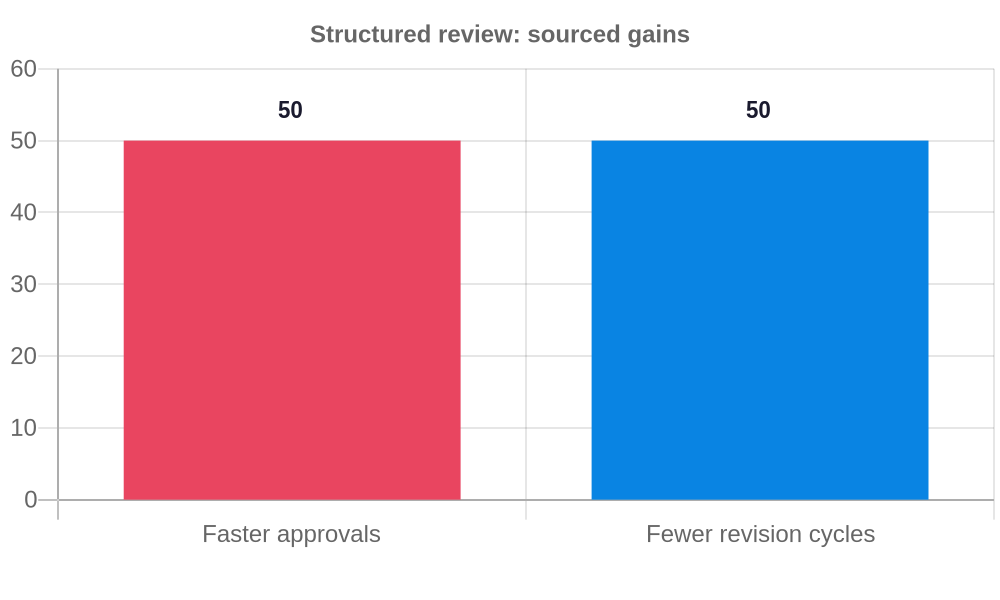
There is also a measurable upside to fixing it. ZipBoard reports that organizations with a structured review process see approvals run about 50% faster and go through roughly 50% fewer revision cycles. A Box and IDC report cited in the same source found teams save 3 to 5 hours per person each week when approval workflows are automated. ELM Learning, a learning agency that moved its review and quality assurance into ZipBoard, reported roughly 5,000 staff hours saved a year, about 2 hours per person per day, and a 50% cut in review cycle times.
The opportunity is clear. A well-run review workflow is not a minor efficiency gain. It is the difference between publishing weekly and publishing when the stars align.
Why experts stall: the five real causes
Before you change the process, understand why it stalls. Most guides blame the expert. The evidence points the other way. The causes below are structural, and each has a known fix.
They are not measured on your output. This is the root cause, and almost no page-one article addresses it. Your subject matter expert is evaluated on product delivery, engineering velocity, or compliance outcomes, not on marketing. Reviewing your draft reads as a peripheral distraction. Parse.ly and MacMillan Search make this point directly: B2B SMEs live on engineering, product, or compliance KPIs, and marketing review is not one of them. Failing to write review duties into their scope guarantees the review sits at the bottom of the pile.
The end-stage dump. Componize observed teams dropping as much as 750 pages of content on an expert in a single review at the end of a draft cycle. No one reviews 750 pages well. Your expert opens it, feels overwhelmed, and closes it. The fix is incremental, topic-based review where the expert sees small authoritative chunks across the sprint, not one giant file at the gate.
They get dragged into copyediting. Asked to “review the draft,” a technical expert peaks at commas, passive voice, and heading capitalization. That is what reviewers do by default. MadCap Software’s guidance is explicit: without structured instructions, experts spend most of their review correcting typos and layout instead of validating technical truth. That misuses their slot and burns their patience.
Tool friction. Componize also found experts may use specialist authoring or XML tools only about 5 days out of the entire year. Forcing a busy engineer to learn a new review interface for a 10-minute check is a non-starter. They will ask for a PDF and an email, and you will be back to version chaos.
The wrong approval structure. Some tools push “default approval” rules, where silence after 3 days means approved. That works for a low-risk social post. For a regulated claim, default approval is a compliance accident waiting to happen. The rule structure has to match the content risk, not treat every piece the same.
The SME Validation Loop: a risk-based review framework
Here is the framework this guide is built around. I call it the SME Validation Loop. It has three tiers, and each tier decides how deep the expert review goes and what the approval rules are. The loop replaces the “send it to everyone and hope” model with a deliberate, risk-matched process.
The core move is to shift the expert from creator to validator. Your content team does the research, drafting, and testing. The expert validates direction early and accuracy at the end. That is the validator model both TechSmith and MadCap describe, and it is the fastest way to respect an expert’s time.
A decision matrix: who reviews what, and when
Most stalled reviews are too many people reviewing everything. The tighter the role boundary, the fewer the collisions. Cloud Campaign recommends capping core approvers at 3 to 5 stakeholders to prevent bottlenecks. Here is a decision matrix that assigns a single owner per review dimension, with the mobile-stacking pattern built in.
The Content Approval Matrix: speed up the stat-sensitive review
A specific, high-value tactic comes from Bella Donna B2B Content Works. When content leans on statistics, benchmarks, or custom calculations, the review stalls at legal or data owners because nobody can tell whether a number is correct. Their fix is the Content Approval Matrix, a small spreadsheet that travels with the draft.
This single document removes the hardest kind of review delay. Legal can verify a sourced stat in seconds instead of asking questions that bounce back and forth. It also protects you: a verified, sourced number is a defensible number under compliance scrutiny.
Build the matrix as columns: Statistic, Location, Source, Calculation, Notes. Fill it while you write, not after. Hand it to the reviewer with the draft, and the data question is settled before it becomes a thread.
A worked example: the fintech security expert who never replied
Here is how this plays out in practice, with a realistic scenario. A B2B fintech company is writing a blog post about its new encryption approach. The security lead, Priya, is the only person who can vouch for the technical claims. In the old process, the team wrote the post, sent it to Priya on a Thursday with a note to “look it over,” and heard nothing for two weeks. The post went live stale, and a competitor published first.
Under the SME Validation Loop, the same post runs differently. The writer books a 30-minute outline validation with Priya, where she confirms the framing, the feature names, and the three claims that matter most. The writer captures her words, transcribes the call, and drafts the technical section directly from what she said rather than from guesswork. Before the final validation, the writer hands Priya the Content Approval Matrix listing every standard or statistic in the post with its source. The review request tells her explicitly: ignore typos, the editor handles those, and focus only on accuracy and edge cases. When she approves, the compliance team sees a sourced number against a claim and signs off in one pass.
That is the whole point. The same expert, the same review, but 11 days of friction compressed into about 90 minutes of her time, spread across two focused checkpoints.
Step-by-step: the review workflow that works
Put the framework into practice with this six-step sequence. It is the workflow this post is named for.
- Classify the risk. Run every piece through the three-tier loop before writing. Low-risk awareness content gets a light-touch outline check. Regulated or compliance-adjacent content triggers the full multi-touch path.
- Name the validator early. Book the expert’s outline validation and the final validation before the draft exists. A calendar slot is far harder to ignore than an email. MadCap suggests 30-minute biweekly syncs as a cadence that keeps experts engaged without burning them out.
- Interview, do not brief. For technical topics, run a tight interview instead of sending a brief. Capture the expert’s language, transcribe it, and draft from their words. Busy experts ignore briefs; they rarely ignore a 30-minute call about their own work.
- Prevent the copyedit trap. Send every review request with explicit role instructions. Tell the expert exactly what to check and exactly what to ignore. Reassure them that an editor owns formatting.
- Attach the evidence. For any stat-driven piece, send the Content Approval Matrix with the draft. Verify, source, and show your calculations before you ask for a signature.
- Match the approval rule to the risk. Use default approval only for low-risk content. Require explicit sign-off for anything Tier 2 or higher, and route the compliance gate only when the content actually needs it.
What Most Teams Get Wrong
Two mistakes show up over and over, and fixing them changes everything.
They treat it as a software problem. Most content on this topic is written by vendors selling review tools, and the message is “buy our platform.” But the expert who does not want to review will not review your platform either. The behavioral layer, the role boundaries, the risk tiering, and the interview-first workflow move the needle. Software helps only after those are in place. Buy the tool to enforce a good process, not to replace one.
They chase the expert with the whole draft. The most common fix people propose is “bug them more.” Reminders and escalation do not fix a process that dumps a monolithic document on a busy person. Componize’s 750-page example is extreme, but the pattern holds at any scale. When in doubt, split the review into smaller, topic-based chunks across the sprint so the expert only ever sees the whole thing once, at the end, looking polished and already checked.
Three review models: which fits your team
The same loop runs in one of three rhythms. Pick the model that matches your team and your expert’s time, and change it as your program grows.
Synchronous, live review. The expert joins a shared session and walks the draft with the writer in real time. This is the fastest for a single complex piece because questions get answered in the moment. It is also the hardest to schedule and the most likely to get cancelled. Reserve it for Tier 3 regulated work or for a first-ever collaboration with an expert you have not worked with before.
Asynchronous, email-based review. The expert reviews on their own time and replies when they can. This is the most common model and the most dangerous without structure. Without role instructions, the expert drifts into copyediting. Without a deadline, the review sits. Use it only with the anti-copyedit protocol and a hard 3-day window.
Hybrid loop. A 30-minute outline call up front, then asynchronous validation, then a short final confirm. This is the model this guide recommends for most B2B teams. It respects the expert’s calendar, keeps the review bite-sized, and front-loads the alignment that prevents late surprises. MadCap’s suggestion of 30-minute biweekly syncs works well as the cadence that keeps the relationship warm between pieces.
Here is how the choice plays out for a real team. A mid-market SaaS company runs a hybrid loop for its monthly product blog: a 30-minute call with the product manager to validate the outline, async technical validation over three days, and a final check-in. In the same month, a patch about a new API payment flow triggers Tier 3, so the same product manager joins a synchronous review where the writer asks the security and billing questions in one sitting. Both posts clear review in under a week. The model flexed with the risk.
Adapt for remote and async-first teams
Remote teams add one more constraint: the expert is in a different time zone and a different tool stack. The fixes are simple but non-negotiable.
Record the interview. When your expert is in another time zone, run the 30-minute call on camera and transcribe it. You capture their language exactly, which is what makes technical content credible, and you avoid a second scheduling round trip when you realize you missed an answer.
Send one review at a time. In async-first teams the biggest failure is a session with five open comments, none of them resolved, and no owner. Route each review dimension to one person on a clear schedule, as the matrix above shows. When the editor finishes, the expert sees a cleaner draft and a cleaner ask.
Publish the review calendar. If your company runs sprint planning, put the content review windows on the same calendar the experts already read. A review slot that lives next to the product sprint is far more likely to be honored than an email with “ASAP” in the subject line.
Measuring the review loop
You cannot improve what you do not measure. Track three numbers from the first quarter you run the loop. Time to approval, measured from draft submission to sign-off. Revision cycles, the number of round trips a piece takes before it clears. And reviewer satisfaction, a quick question to the expert about whether the process respects their time. ELM Learning’s 50% cut in review cycle times came after centralizing and structuring the loop. Your baseline is your only comparison, so record it before you change anything.
Look at the obvious wins you can expect from a structured review process, based on the sources above. A chart of the sourced benchmarks keeps the business case front of mind.
Frequently asked questions
How long should an SME review take?
Set a standard reviewer window of about 3 days, which CELUM recommends to keep momentum. For low-risk content, a silent default can approve it after that window. For high-risk content, escalate to a named approver rather than letting it lapse.
How many reviewers should be on a piece?
Keep core approvers to 3 to 5 people at most, per Cloud Campaign. More reviewers do not add safety. They add conflicting edits and slower cycles. Assign one owner per review dimension and resolve disagreements with a single named decision maker.
What if the expert keeps requesting edits at the last second?
Move the expert review earlier in the cycle so there is nothing left to discover at the end. If they still flag major changes late, it is usually because the outline validation was skipped. A 30-minute outline call catches wrong assumptions before you write 2,000 words around them.
Do we need approval software?
No. Start with the framework, role boundaries, and the Content Approval Matrix in a shared spreadsheet. If the process still stalls on tracking and versioning, then add a lightweight tool. Choose the tool for the process, not the other way around.
How do I get executive buy-in for expert review time?
Quantify the review as part of the expert’s scope. Ask the responsible manager to include a line item for content validation in the expert’s sprint. The $12,506 per employee cost of miscommunication is a concrete number you can bring to that conversation.
Is default approval safe?
Only for low-risk content. For anything regulated, compliance-sensitive, or safety-critical, default approval is dangerous. Use a risk-based rule: silence means approve only on Tier 1, and explicit sign-off is mandatory on Tiers 2 and 3.
What To Do Next
Start this week with one piece of content. Classify it into a risk tier, book one outline validation with the relevant expert, and draft the technical section from an interview rather than a brief. Measure the review cycle on that single post. Then run the same loop on your next piece, and the one after that. Within a month you will have a repeatable review workflow, experts who no longer dread your requests, and a publishing cadence that survives contact with product and compliance teams.
To make this concrete, download the SME Content Review Template. It bundles the review role matrix, the Content Approval Matrix for stat-heavy drafts, and a reviewer tracker with a time-to-approval formula, ready to paste into your next content sprint.
For the supporting process, pair this loop with a broader content workflow template and the governance framework that keeps the whole operation consistent.
