

AI agents for B2B lead generation research prospects, enrich records, score leads, write personalized outreach, and book meetings with minimal human input. In 2026 the tools that try to replace your SDR team entirely are failing, and the ones that amplify a human rep are producing most of the pipeline. The evidence is consistent across every head-to-head test: hybrid human-in-the-loop agents generate 2.8x more sales pipeline than fully autonomous replacements (Amplemarket, 2026), while autonomous agents report 75-90% customer churn within three months (11x.ai customer data, 2026). This guide gives small B2B teams a practical framework to evaluate, deploy, and QA these agents without burning your domain reputation or your budget. It builds on our earlier work on AI agents for B2B content marketing and AI marketing agents for B2B, and goes one layer deeper into the sales side of the funnel.
What are AI agents for B2B lead generation?
AI agents for B2B lead generation are software systems that combine large language models, prospect databases, and workflow automation to perform sales development tasks that used to require a human SDR. A lead-generation agent can build targeted lists, research accounts, write personalized emails, send follow-ups, and book meetings on your behalf. Most modern agents sit somewhere between a point tool and a full sales platform, and the category splits into four distinct types.
Four types of lead-gen agents you will encounter
- Prospecting and data agents. These research accounts and contacts, clean and enrich records, and build prioritized lists. Clay is the best-known example; it orchestrates 100+ data providers through spreadsheet-style workflows, and it is a research engine, not an outreach tool.
- AI SDRs (outbound). These own the full outbound loop: find prospects, write messages, send campaigns, handle replies, and book meetings. AiSDR, 11x.ai Alice, Artisan Ava, and Amplemarket Duo compete here. They differ sharply on autonomy versus human approval.
- Conversational site agents (inbound). These qualify and book meetings with people already on your website. Qualified’s Piper is the clearest example, capturing peak traffic at 3 AM that no human SDR can cover.
- CRM-native agents. HubSpot Breeze, Salesforce Agentforce, and similar tools embed prospecting, enrichment, and follow-up directly inside your CRM. They lose capability breadth but win on zero data plumbing.
Adoption is broad but shallow. McKinsey data (cited by monday.com, 2026) shows 62% of organizations are experimenting with AI agents, yet only 23% are actively scaling agentic systems across operations. That gap is exactly where most small teams live: they have tested a tool, but they have not built the workflow around it that makes agents profitable. Our guide on B2B content marketing KPIs covers the measurement side of that gap; this post covers the deployment side.
How well do AI agents for B2B lead generation actually work?
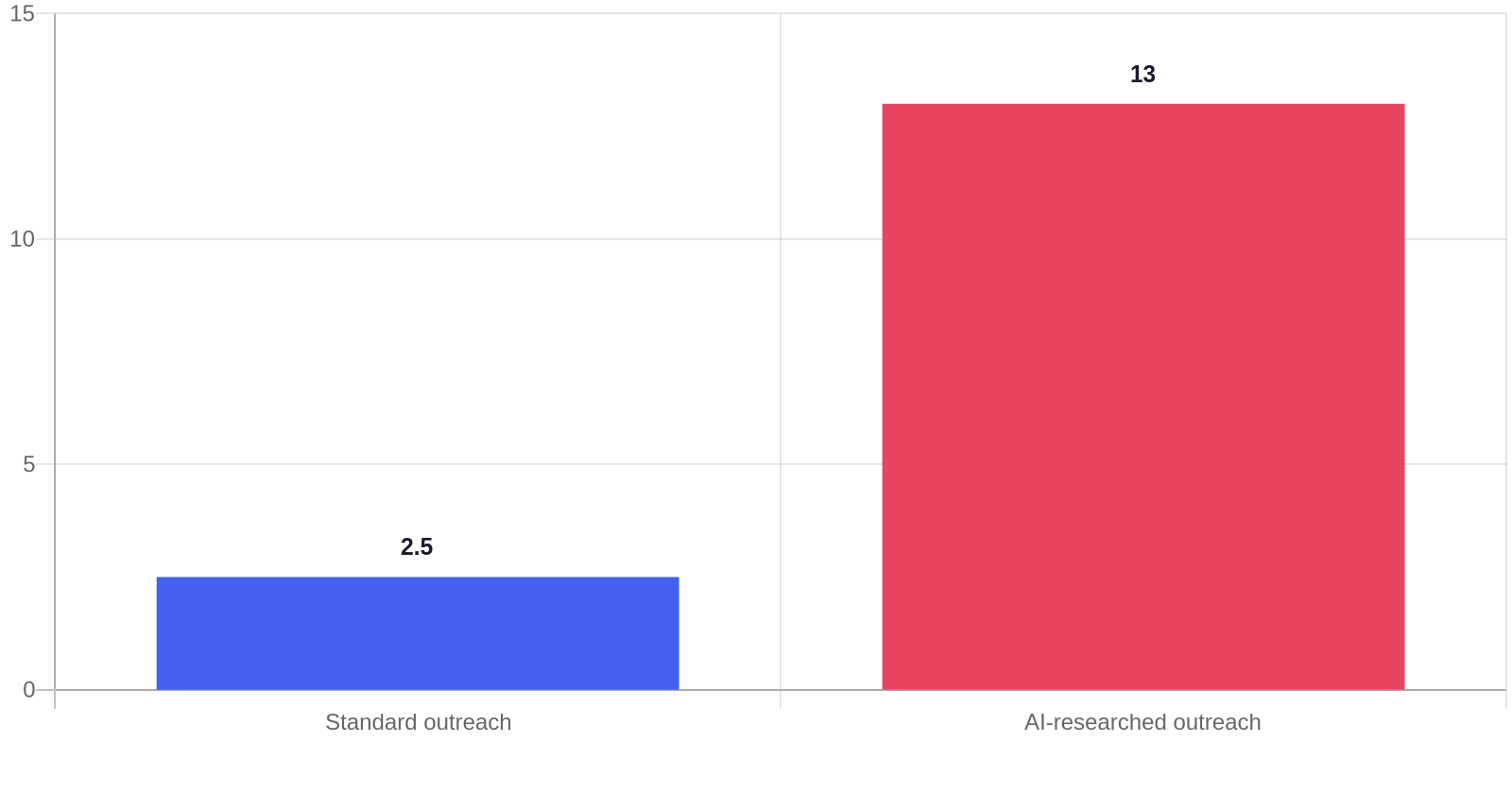
AI agents for B2B lead generation work well enough to move the metric that matters, reply rate, by a wide margin, but only when a human approves the final send. The cleanest evidence is a controlled A/B test published by Clay’s GTM team in 2026. The control campaign, 473 emails without AI personalization, opened at 80% and produced 12 replies, a 2.5% reply rate. The AI-researched variant, 162 emails, opened at 85% and produced 21 replies, a 13% reply rate. That is a 5x lift on a fraction of the sends.
Coldreach reports a similar pattern from its own outbound practice: a 3.8% cold reply rate, roughly 10x the B2B industry average (Coldreach blog, 2026). The common thread is research depth, not volume. Agents that research the account before writing the message outperform agents that spray templated copy at scale.
The failure mode is equally consistent. Amplemarket’s 231-point audit of AI sales agents (2026) found fully autonomous tools score poorly on deliverability: Artisan Ava scored 0/21 on deliverability and 35/231 overall while charging roughly $60,000 per year, and 11x.ai Alice scored 0/21 on deliverability with reported 75-90% customer churn at three months driven by “zero results.” By contrast, Amplemarket’s own human-in-the-loop Duo scored 219/231 and reports 5-6x productivity per rep and the 2.8x pipeline multiple. The pattern is not vendor cheerleading, it repeats across independent tests: autonomy destroys quality, and quality drives reply rates. As Amplemarket’s Arjun Krisna put it in the 2026 audit, “It is the difference between AI that assists the SDR and AI that tries to replace them, and in 2026 the assistive model is the one delivering results.”
How to evaluate AI agents for B2B lead generation
Score every candidate on five slots before you run a trial: data quality, deliverability, message quality, orchestration, and guardrails. Most buyer’s guides rank tools on feature counts, which is why teams pick a beautiful dashboard and then discover the agent cannot send mail without blacklisting the domain. A structured five-slot score catches those failures before you commit.
The Agent Fit Score (AFS)
The Agent Fit Score is a 5-slot evaluation framework for lead-gen agents, scored 1-10 per slot with a weighted total out of 100. A candidate needs 75+ to justify a paid pilot, and it must not score below 6 on deliverability or guardrails, the two slots that cause irreversible damage.
Worked example. A fictional 12-person analytics SaaS, call it Northwind Insights, scored three candidates in one afternoon. The fully autonomous tool (Artisan-style) earned Data 8, Deliverability 2, Message 4, Orchestration 6, Guardrails 3: 47/100, fail on the two slots that matter. The CRM-native agent (Breeze-style) earned 7, 9, 6, 8, 7: 72/100, close but weak on customization. A composed stack (Clay for research, Instantly for sending, CRM for routing) earned 9, 9, 8, 7, 8: 84/100 and a pilot. The scores took 90 minutes and saved a six-figure mistake.
Build, buy, or hybrid: the decision matrix
Buy a turnkey agent when you need speed, build an API-based agent when you need control, and run a hybrid composed stack when you want both on a small budget. The matrix below compares the three realistic paths for teams under 25 people, using 2026 pricing from the sources above.
Time to value: days, but often zero results.
Deliverability: often 0/21, buy separate tools.
Control: black box, weak guardrails.
Best for: testing the category, never for your main domain.
Time to value: 1-2 weeks, minimal plumbing.
Deliverability: native, tied to your CRM.
Control: middle, limited customization.
Best for: teams already standardized on one CRM.
Time to value: 2-4 weeks, requires setup.
Deliverability: full control, warmup native.
Control: highest, human approval by design.
Best for: small teams that want pipeline without six-figure software.
The hidden cost of the build path is engineering time. A custom agent on raw LLM APIs costs fractions of a cent per token, but you pay for a GTM engineer to maintain data connections, prompt versions, and deliverability infrastructure. Clay’s own analysis pegs the “no-brainer” price point for lead-gen software at roughly $800/month, the point where software beats manual labor (GTM with Clay, 2026). For most small teams the composed hybrid wins: it matches turnkey results, costs less than a CRM seat stack, and keeps a human in the approval loop. Pair the workflow with the second buying audience if you also want your outbound targets to find you through AI search engines; the two efforts compound.
The 30-day pilot plan for AI lead-gen agents
Run a 30-day pilot in four phases, and start your domain warmup on day one because deliverability setup takes longer than the trial. This is the trap most guides miss: a new sending domain needs four weeks of warmup before cold outreach, and an established domain needs two (Instantly, 2026). A 30-day trial that spends itself on warmup tests nothing. The fix is to run warmup in parallel on a dedicated subdomain while you pilot, then review results at day 30 against a baseline.
The four-phase pilot
Score and shortlist
Sandbox test
Small-batch live
Measure and decide
Worked example, continued. Northwind Insights ran the composed stack pilot on a warm subdomain. Days 15-24 they sent 12,900 emails at the 30-per-inbox cap across 43 inboxes. Results: 3.9% reply rate, 34 meetings booked, $0.27 cost per meeting in software, zero spam complaints, and zero domain damage. Their previous human-only outbound booked 11 meetings a month. The agent did not replace the SDR; it gave the SDR 3x the meetings from the same working hours.
How to QA AI outreach so it does not burn your domain
Put automated pre-review filters between the AI draft and the human approver, then add circuit breakers that freeze the agent on anomalies. Human-in-the-loop approval looks safe on paper, but it fails in practice through review fatigue: when reps must read 200 AI drafts a day, they click approve on autopilot. The fix is to make the machine check the machine first.
Three layers of QA that protect your reputation
- Automated content filters. Before a draft reaches a human, run it through a semantic checker that rejects known AI hallmarks (“I hope this email finds you well,” “delve,” “testament”), unsourced numbers, and personally-identifiable hallucinations. Amplemarket and the B2B content teams that publish QA audits agree this step is neglected: the sources tell you to keep a human in the loop, but none of them tell you how to stop the human from rubber-stamping. Our AI personalization for ABM content guide shows the same filter-first pattern on the content side.
- Deliverability baselines. Enforce hard caps: 30 cold emails per inbox per day, spam complaint rate under 0.1% with severe damage above 0.3%, and bounce rates under 2% (Instantly, 2026). A single aggressive campaign can burn a domain that took months to warm.
- Circuit breakers. Configure triggers that instantly freeze agent sending: more than N identical messages detected, a reply from an existing customer, a pricing hallucination, or spam complaint spikes. Without a breaker, an agent in a context-window loop can email the same prospect ten times at machine speed.
Measure the reputation deficit, not just the wins. Track angry opt-outs, “stop emailing me” replies, and spam reports as a primary counter-metric alongside meetings booked. A campaign that books five meetings but generates 200 spam reports has a negative ROI that no dashboard will show you, because the damage lands on next month’s deliverability, not this month’s pipeline report.
What most teams get wrong
The most expensive mistake is buying autonomous “replace your SDR” tools for a main sending domain, based on demo data that hides deliverability scores of zero. The second mistake is skipping automated QA and trusting human approval at volume, which degrades to rubber-stamping within two weeks. The third is measuring the wrong things: teams track meetings booked and ignore reply classification accuracy, spam complaints, and domain reputation, then wonder why results collapse in month two. The fourth is comparing tools on feature lists instead of the Agent Fit Score, so they pick the pretty dashboard over the tool that can actually send mail. And the fifth is ignoring the warmup timeline, running a 30-day trial on an unwarmed domain, and concluding that AI outreach does not work when the real failure was deliverability, not the agent.
There is a sixth failure worth naming, because it is the quietest: teams deploy an agent and never give it the material it needs to sound credible. An AI SDR that drafts from a stale one-page prompt will quote outdated pricing, reference a case study your company no longer publishes, or invent a customer name. The data behind your outreach is a content problem, not a sales problem. The teams that see the 2.8x pipeline lift are the ones who feed their agents current case studies, fresh pricing pages, and a written positioning doc, then verify the agent cites them correctly in a test batch before going live. Sales enablement and content marketing turn out to be the same job once an agent sits between them.
What to do next
Score your shortlist with the Agent Fit Score this week, and start domain warmup on day one, because it takes four weeks and most trials are thirty days. Run the four-phase pilot on a dedicated subdomain with a 30-per-inbox cap and human approval on every send. Put automated pre-review filters and a circuit breaker in place before you scale past 1,000 emails a week. If you already buy content that these agents will use in outreach, make sure your internal links to case studies and pricing are current, because outdated PDFs are the most common hallucination source in AI-drafted messages. The tools that work in 2026 amplify your SDR; the tools that fail replace them. Choose the amplifier.
Frequently asked questions
Can AI agents replace human SDRs in B2B?
Not in 2026. Fully autonomous agents report 75-90% customer churn within three months (11x.ai customer data, 2026), while hybrid human-in-the-loop systems generate 2.8x more pipeline (Amplemarket, 2026). The winning pattern is AI for research, drafting, and follow-up, with a human approving sends and handling objections.
How much do AI agents for B2B lead generation cost?
Turnkey autonomous agents run $900-$5,000+ per month, CRM-native agents run $100-$150 per seat per month, and composed hybrid stacks (Clay plus Instantly plus your CRM) run $47-$358 per month total (Instantly pricing, 2026). A custom API-built agent costs pennies per token but requires engineering maintenance that most small teams underestimate.
What reply rate should I expect from AI outreach?
A realistic cold reply rate is 2.5-4%: Clay’s 2026 A/B test hit 13% with AI research on 162 emails, Coldreach reports 3.8% at scale, and the B2B baseline without personalization sits around 2.5%. Treat anything above 5% as exceptional, and distrust vendors who promise 10%+ as a baseline.
Do AI agents hurt email deliverability?
They can, and the data is blunt: Artisan Ava and 11x.ai Alice both scored 0/21 on deliverability in Amplemarket’s 2026 audit. Protect yourself with native warmup, a 30-email-per-inbox-per-day cap, spam complaint rates under 0.1%, and a circuit breaker that freezes sending on anomaly.
What is the best AI agent setup for a small team?
For teams under 25 people, the composed hybrid wins on cost, control, and results: a research agent for list building, a sending platform with native warmup, and your CRM for routing, with human approval on every send. CRM-native agents are the better choice only when you already run one CRM everywhere and accept its customization limits.
How do I know an AI agent is actually working?
Track five numbers in the pilot: reply rate (2.5-4% target), cost per meeting, reply classification accuracy on 50+ threads, bounce rate under 2%, and spam complaint rate under 0.1%. If the agent cannot hit these with human approval on a warmed domain, the tool is the problem, not the workflow.
