

A one-person B2B content team works when you stop imitating a five-person department and start running an operating system built for one. That means a fixed weekly hour budget, a small set of formats you repeat, and a 90-day plan split into three phases: build the foundation, run the engine, then make it compound. This playbook gives you that plan, week by week, plus the templates to run it.
Most advice for solo content marketers stays at the level of “prioritize ruthlessly” and “repurpose more.” True, and useless on a Monday morning when you have four requests from sales, a blog backlog, and no editor. What follows is the actual operating plan: what to do in days 1 to 30, 31 to 60, and 61 to 90, how many hours each piece gets, and what to refuse.
Why Solo Content Teams Fail (It’s Not Effort)
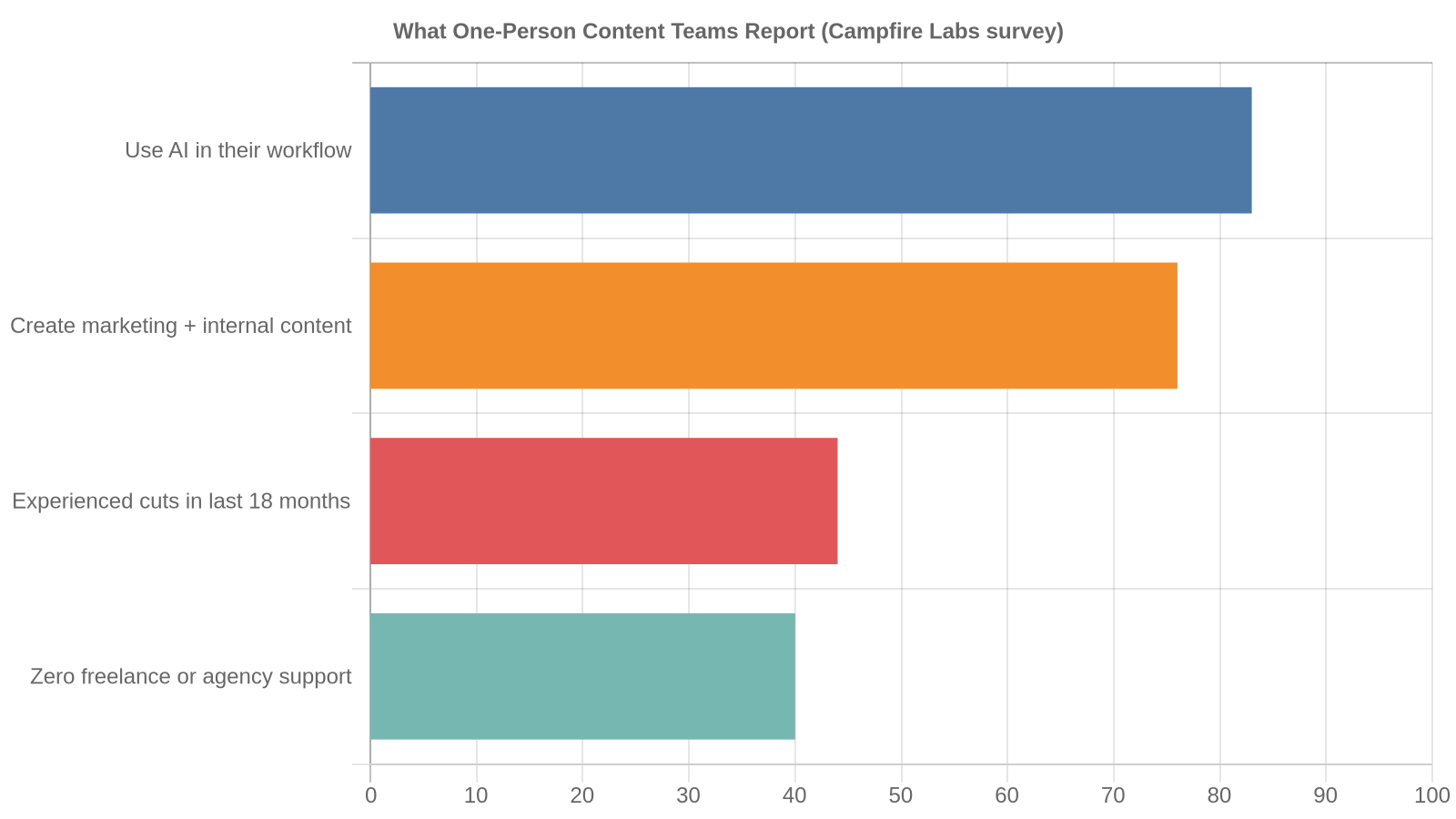
Solo content teams fail because they operate as a service desk instead of a system. Every department sends requests, the marketer says yes, and strategy dies by a thousand favors. In Campfire Labs’ survey of one-person content teams, 76% said they create content for both marketing and internal needs like sales collateral and product copy, and 40% had zero freelance or agency support. You are not just the writer. You are the intake queue, the editor, the analyst, and the distribution channel.
The failure pattern is predictable. Month one, you publish ambitiously. Month two, internal requests eat your calendar. Month three, the blog goes quiet and leadership asks what content actually does. The fix is not working harder. The fix is an operating system that caps reactive work and protects the compounding work, which is exactly what the next 90 days build.
The Solo Content OS: One Framework, Three Phases
The Solo Content OS is a 90-day operating plan with three 30-day phases: Foundation (days 1 to 30), Engine (days 31 to 60), and Compounding (days 61 to 90). Each phase has one job. Foundation decides what you will and will not do. Engine turns that decision into a repeatable weekly rhythm. Compounding shifts hours from net-new writing into refreshing, repurposing, and distribution, where solo teams get their real edge.
Phase 1, Days 1 to 30: Foundation
The Foundation phase produces three artifacts: a one-page strategy, a content inventory, and an intake rule. Nothing else. Resist the urge to publish heavily this month; two solid posts are enough while you build.
Week 1: write the one-page strategy. One target audience, one primary goal (pipeline, signups, or qualified traffic, pick one), three topic clusters you will own, and the two formats you will repeat. A solo team that tries to run blog, video, podcast, and social simultaneously runs none of them well.
Week 2: inventory what already exists. Pull every published URL into a sheet with traffic, target keyword, and a keep, update, merge, or cut call. If the site has history, this inventory usually reveals that your fastest wins are updates, not new posts. Our guide on how to prioritize blog posts for content refresh covers the scoring.
Week 3: set the intake rule and get it approved by your manager. Every content request goes through one form asking what it is, who it serves, and the deadline. You commit to a fixed reactive budget (see the hour split below) and everything beyond it gets scheduled into future weeks, not squeezed into this one. Getting this approved in writing is the single highest-return meeting of your quarter.
Week 4: build the minimum toolkit. An editorial calendar, a reusable content brief, and one AI-assisted drafting workflow with human review. Steal ours: the B2B editorial calendar template and the human-in-the-loop AI content workflow were both built for teams your size.
Phase 2, Days 31 to 60: Engine
The Engine phase installs the weekly rhythm and holds it for four straight weeks. The target output is one substantial piece per week plus its derivatives, not because one is a magic number but because it is sustainable alongside reactive work, and a piece you ship every week beats three pieces you ship in a burst then nothing.
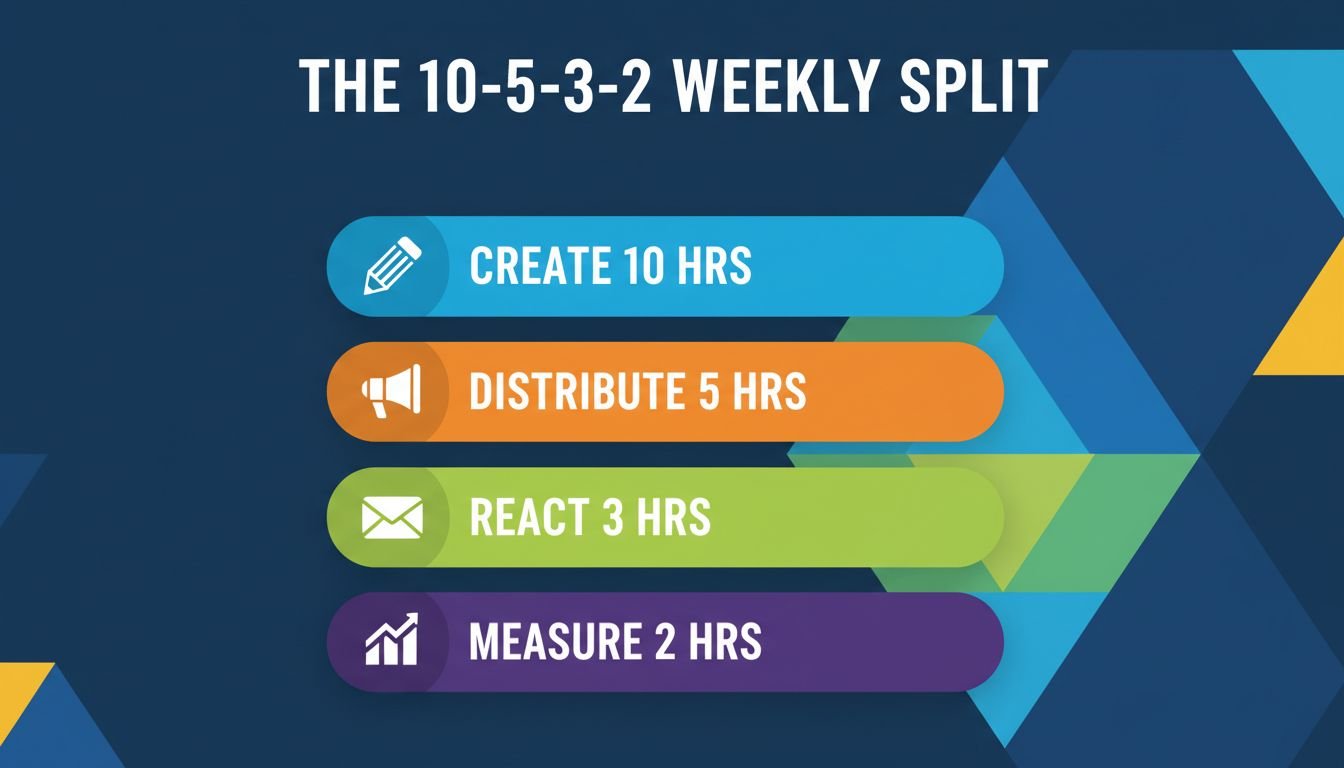
The weekly hour budget is the core of the phase. On a 40-hour week, split content time 10-5-3-2: ten hours creating the week’s main piece, five hours on distribution and repurposing, three hours on reactive internal requests, two hours on measurement and admin. If you only get 20 content hours because you also own other marketing channels, halve every number but keep the ratio. The ratio is the point. Most solo marketers invert it, spending the most time reacting and the least distributing, which is exactly backwards.
During this phase, run every piece through the same pipeline: brief on Monday, draft by Wednesday, subject-matter-expert review Thursday, publish and distribute Friday. The SME review slot matters more than it looks. As a team of one you have no editor, so a 20-minute async review from a founder, engineer, or salesperson is your quality bar and your expertise signal in one step.
Phase 3, Days 61 to 90: Compounding
The Compounding phase reallocates roughly a third of creation time into work that multiplies what already exists: refreshing decayed posts, repurposing winners, and building internal links between cluster pages. New publishing drops to two or three pieces per month and total output impact goes up, because updates to established URLs typically recover rankings faster than new URLs earn them.
In week 9 or 10, run your first mini-audit: which of the pieces from Phase 2 got traction, which internal requests actually produced sales usage, and which channel drove real visits. Kill what did not work. A solo team’s advantage is that this decision takes one meeting with yourself, not a quarterly committee. By week 12, write the next quarter’s one-pager in an afternoon, because now you have real data instead of guesses.
This phase is also where automation pays off. Repurposing and distribution are the most automatable parts of the job; our marketing automation workflows for B2B content teams walks through seven you can set up without an ops hire. That matches how solo teams already behave: in the same Campfire Labs survey, 83% reported using AI in their workflows, mostly to buy back hours rather than to replace judgment.
The Do-Automate-Outsource-Refuse Matrix
To decide where each task belongs, score it on two questions: does it need your context (audience, product, internal knowledge), and does it repeat weekly? Tasks needing your context that repeat are yours to do. Repeating tasks that do not need your context get automated. Non-repeating tasks that need craft but not context get outsourced. Everything else gets refused or scheduled far out.
| Task type | Needs your context? | Repeats weekly? | Verdict | Examples |
|---|---|---|---|---|
| Strategy, briefs, final edit | Yes | Yes | Do | Topic selection, content briefs, SME interviews, final voice pass |
| Mechanical production | No | Yes | Automate | Social scheduling, first-draft repurposing, reporting dashboards |
| Craft-heavy one-offs | No | No | Outsource | Design assets, video editing, technical long-forms outside your depth |
| Off-strategy requests | Varies | No | Refuse or defer | One-off decks with no reuse, content for channels you dropped |
The matrix earns its keep on the Refuse row. Animalz’s advice for a content team of one makes the same point: evaluate every request against your KPIs, because unfiltered requests will fill your entire bandwidth. The matrix gives you a polite, defensible way to say it: “This doesn’t repeat and doesn’t ladder to the quarter’s goal, so it’s scheduled for next month’s reactive budget.”
What Most Solo Marketers Get Wrong
The biggest mistake we see is benchmarking against funded content teams. Comparing your output to a company with three writers and an editor produces either burnout or despair, and both kill consistency. Your benchmark is your own last quarter.
The second mistake is treating distribution as the leftover. A solo team that publishes four pieces and distributes them well will beat one that publishes eight and shares each once on LinkedIn. The 10-5-3-2 split hard-codes distribution time so it cannot be cannibalized.
The third mistake is skipping the intake rule because it feels confrontational. Without a written, manager-approved reactive budget, every “quick request” is a negotiation you lose by default. With one, the system says no so you don’t have to.
The fourth mistake is producing net-new content long after the archive is the better investment. If you have 30 or more published posts, decay is quietly eating your traffic while you write. Run the content refresh checklist before committing to another quarter of pure net-new.
Your Weekly Operating Rhythm, Step by Step
Here is the full weekly workflow once the Engine phase starts. It assumes the 10-5-3-2 split on whatever total you have.
- Monday (2h): write or finalize this week’s brief from the editorial calendar. Check the intake form; slot new requests into the reactive budget, this week or later.
- Tuesday to Wednesday (6h): draft the main piece. Use your AI-assisted workflow for structure and first-pass prose, then rewrite in your voice.
- Thursday (2h): send the draft to one SME for async review with a 24-hour window and two specific questions. Handle this week’s reactive requests in the 3-hour block.
- Friday (5h): incorporate review, publish, then spend the full distribution block: cut the piece into 3 to 5 derivative posts, queue them across two weeks, send the newsletter mention, add internal links from two older posts.
- Friday last 30 min: log the week in your tracker: published, distributed, requests handled, hours actual vs. planned. This 30 minutes is what makes week 12’s review take an afternoon instead of a lost weekend.
The Metrics That Matter for a Team of One
Track four numbers and ignore the rest: pieces shipped on rhythm (consistency), organic sessions to your three clusters (growth), content-assisted pipeline or signups (business impact), and percentage of hours spent reactive (system health). If reactive hours creep past 25% of your content time for two consecutive weeks, the intake rule has failed and needs re-approval, not more effort.
Resist reporting everything your analytics tool can export. A solo team’s monthly report is five lines and one recommendation. Anything longer costs hours you budgeted for distribution, and nobody reads it anyway.
FAQs
How much content can one person realistically produce?
One substantial piece per week plus derivatives, sustained indefinitely, is the realistic ceiling for a solo marketer who also handles distribution and internal requests. Bursts of more are possible but always collapse. Consistency at one per week compounds; sprints do not.
Should a one-person team use freelancers?
Yes, for craft-heavy one-offs like design, video editing, or deep technical pieces outside your expertise. Keep strategy, briefs, and final editing in-house because they need your context. Even a small monthly freelance budget applied to the Outsource row of the matrix buys back your highest-value hours.
What tools does a solo B2B content team actually need?
Five: an editorial calendar, a reusable brief template, one AI writing assistant with a human review step, a social scheduler, and Google Search Console. Add nothing else until a specific weekly task demands it. Tool sprawl is a time tax solo teams cannot afford.
How do I say no to internal content requests without political damage?
Get a reactive-hours budget approved by your manager in writing, then route every request through one intake form. Requests beyond the budget get scheduled, not rejected, so the answer is always “yes, in week X” rather than “no.” The system absorbs the conflict for you.
When should a one-person content team become a two-person team?
When the four metrics are healthy and the constraint is provably hours, not strategy: you are shipping on rhythm, clusters are growing, content touches pipeline, and reactive work is capped, yet high-scoring Do-quadrant work goes undone every week. Hire against the matrix: the first hire takes the quadrant consuming most of your hours, usually production.
What To Do Next
Start Phase 1 this week, not next quarter. Write the one-page strategy first; it takes two hours and every other decision in the system depends on it. Then book the intake-rule conversation with your manager before you build anything else, because the plan only holds if the reactive budget is real.
Download the 90-Day Solo Content OS planning sheet to get the phase-by-phase checklist, the weekly hour budget, and the tracker in one spreadsheet. Prioritize the Foundation artifacts over publishing volume in month one. Avoid the trap of announcing a big content push before the system exists.
If your site already has an archive, pair this plan with a refresh pass: the repeatable content engine guide covers the production system in more depth, and the refresh checklist above tells you which old posts to fix first. Ninety days from now you will have data, rhythm, and a defensible calendar. That is more than most five-person teams can say.
