

Content marketing for tech startups is the practice of creating technically credible, audience-specific content that attracts developers, executives, and enterprise buyers — converting sustained organic attention into pipeline and revenue across long B2B sales cycles. Unlike paid acquisition, content compounds: every high-ranking article keeps generating leads without additional spend.
This guide covers the exact strategies that produce results in 2026 — from keyword architecture and developer content to AI search optimization and multi-touch attribution.
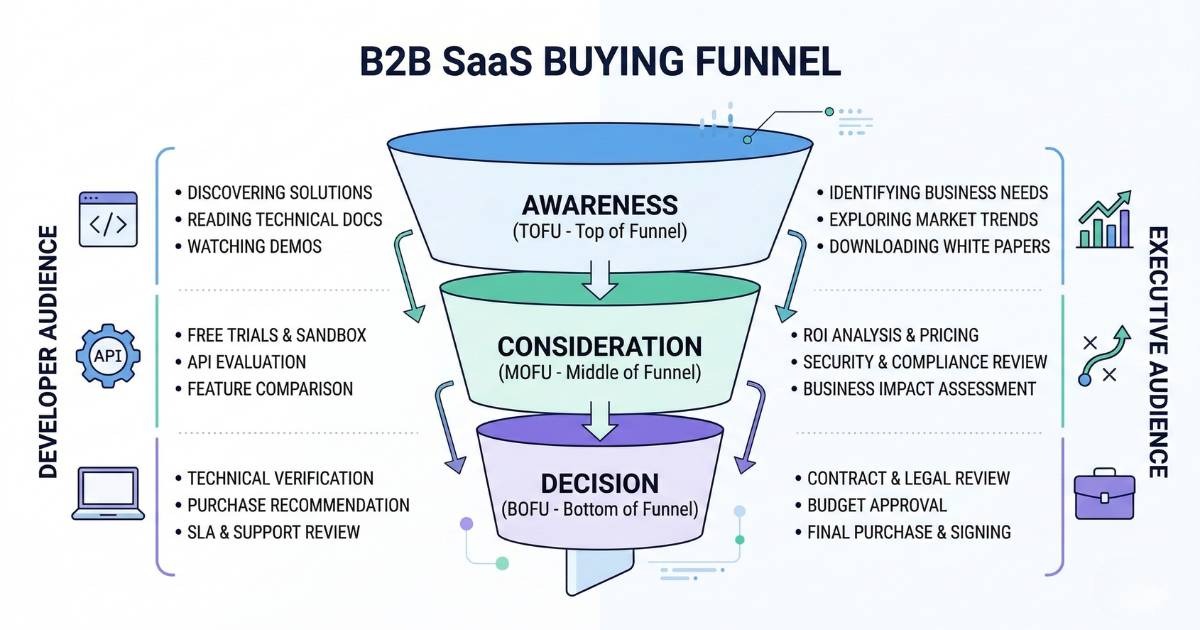
What Are the Highest-ROI Content Strategies for Tech Startups?
The three highest-ROI content strategies for early-stage tech startups are: (1) SEO-driven comparison and alternative pages targeting competitor brand keywords, (2) technical tutorials that attract developer audiences and fuel product-led growth, and (3) founder-led thought leadership that builds pipeline trust at the executive level. Early-stage startups achieve better ranking results by concentrating on 2–3 high-intent keyword clusters rather than spreading content production across broad topics. Depth in a narrow niche beats shallow coverage of a wide category. A startup publishing 10 deep guides on one problem will outrank one publishing 100 thin posts on many.
Why this order matters: Comparison pages capture demand that already exists. Tutorials generate demand from developers discovering a solution while solving a problem. Thought leadership converts that demand into closed deals by establishing brand credibility with economic buyers.
Why Does Content Marketing Work Differently for Tech Startups?
Tech startup content marketing operates under three constraints that don’t apply to most businesses: complex multi-stakeholder buying, developer audiences who reject marketing-speak, and long sales cycles that require content at every stage. According to Gartner, the average B2B buying group includes 6 to 10 decision-makers. Google and CEB research shows buyers complete over 60% of their research before contacting a sales team. That means your content must do most of the selling before your sales team ever gets involved.
The compounding effect of content is particularly valuable for startups with limited marketing budgets. A well-optimized article can drive qualified leads for three to five years without additional investment — something no paid ad campaign delivers at the same economics.
Five primary benefits of content marketing for tech startups:
- Compounding organic traffic that reduces paid acquisition costs over time
- Thought leadership that builds credibility with executive buyers
- Developer documentation that creates trust before the sales conversation starts
- AI search visibility — appearing in ChatGPT, Perplexity, and Google AI Overviews answers
- Measurable pipeline contribution tied to revenue, not vanity metrics like pageviews
How Do You Build a Keyword Strategy for a Tech Startup?
A tech startup keyword strategy maps content to the three stages of the B2B buying funnel: awareness (TOFU), evaluation (MOFU), and decision (BOFU) — with the highest commercial intent reserved for the bottom. This structure ensures content reaches buyers at every point in their research process, from first awareness of a problem through to final vendor selection.
| Funnel Stage | Intent Type | Example Keyword | Content Format |
|---|---|---|---|
| TOFU | Informational | “how to reduce customer churn” | Long-form guide, tutorial |
| MOFU | Commercial | “best project management tool for remote teams” | Comparison, listicle |
| BOFU | Transactional | “[Competitor] alternative” / “[Tool] pricing” | Alternative page, pricing guide |
BOFU content punches above its weight. Competitor alternative pages capture buyers who have already decided to switch — they need permission and a clear path, not education. A single well-optimized “[Competitor] vs [Your Product]” page can drive more qualified pipeline than 20 informational articles.
How to find the right clusters: Start with three to five pain points your best customers shared before buying. Map each pain point to a search query. Group related queries into clusters. Build one pillar page per cluster and support it with five to ten spoke articles.
What Content Do Developers Actually Engage With?
Developers engage with content that respects their intelligence and saves their time. The formats that consistently perform with developer audiences are: working code examples, accurate API documentation, architecture diagrams that explain trade-offs, honest error-handling guides, and transparent product limitation docs. Developer trust is built through radical specificity and honesty. A tutorial that acknowledges edge cases and failure modes will earn more respect — and more shares on Hacker News and Stack Overflow — than a polished walkthrough that hides complexity.
High-performing developer content types:
- Technical tutorials with copy-paste code blocks and environment setup steps
- API documentation that covers authentication, rate limits, and error responses
- Architecture decision records (ADRs) explaining why engineering choices were made
- Postmortems that detail outages with root cause analysis and remediation steps
- Benchmark comparisons with reproducible methodology
Distribution channels for developer audiences: GitHub (README content, gists), Stack Overflow (genuine answers, not promotional), Hacker News (Show HN posts for product launches), and developer-focused subreddits.
What Content Do Executive Buyers Need to See?
Executive buyers — CTOs, VP Engineering, and CISOs — evaluate vendors on risk reduction, ROI proof, and strategic fit with company direction. They scan for credibility signals, not features. The content formats that convert executive audiences are ROI case studies, cloud migration success stories, cybersecurity and compliance reports, industry benchmark reports, and analyst-style thought leadership addressing strategic decisions they’re actively weighing.
Key principle: According to Forrester, executive buyers expect quantified business value early in the evaluation process. “Better security” fails. “Reduced incident response time by 67% across 200 enterprise customers” converts.
How Do You Optimize Content for AI Search and Generative Answers?
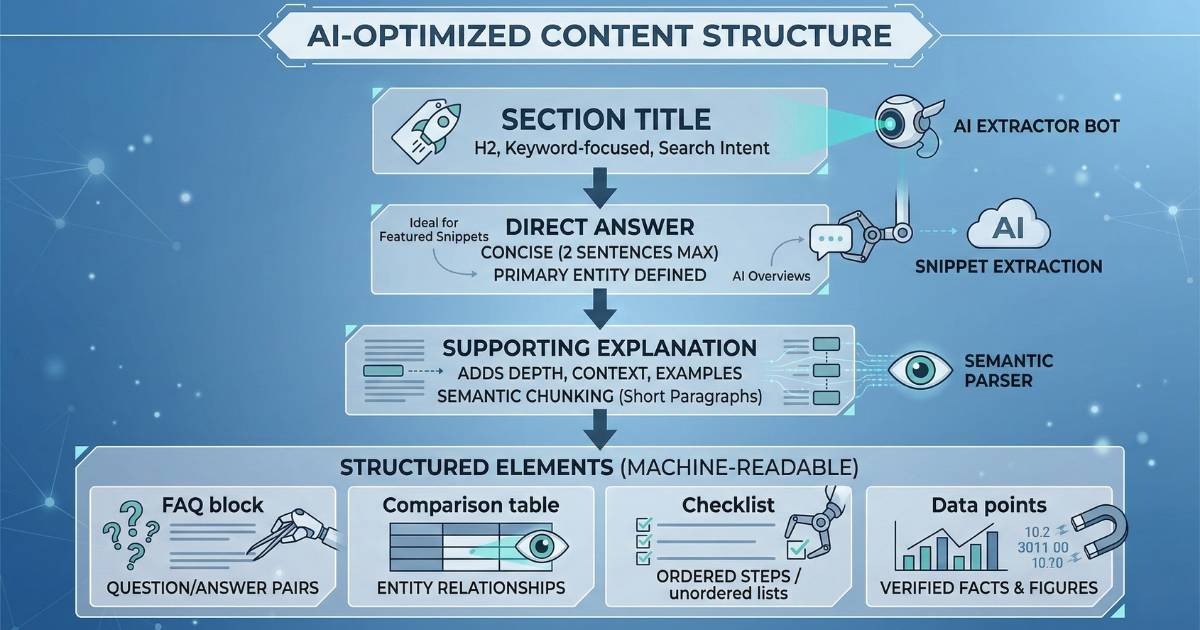
Content optimized for AI search (Google AI Overviews, ChatGPT, Perplexity) must be structured for passage-level extraction, not just keyword matching. AI systems pull self-contained answer blocks from pages — not the page as a whole. SE Ranking research shows approximately 44% of AI citations come from the first 30% of a page, which means front-loading your most citable answer is one of the highest-leverage optimizations available.
The five structural changes with the highest AI visibility impact:
- Front-load definitions. Place the key answer or definition within the first 50–70 words of each section.
- Write 134–167 word answer blocks. This is the optimal length for AI citation based on current SERP data. Each major section should open with one self-contained block at this length.
- Use question-based H2 and H3 headings. Match the exact phrasing of how users ask AI tools (e.g., “How do you…” “What is…” “Why does…”).
- Include comparison tables. Tables carry high AI extractability for MOFU and BOFU queries.
- Cite statistics with source names inline. “According to Gartner…” signals authoritative attribution that AI systems weight heavily.
AI extractability by content format:
| Content Format | AI Extractability | Best For |
|---|---|---|
| FAQ blocks | High | BOFU / product pages |
| Comparison tables | High | MOFU / alternatives |
| Numbered step lists | High | Tutorials / how-tos |
| Long-form narrative | Medium | Thought leadership |
| Video transcripts (with schema) | Medium | Explainers |
| Interactive tools | Low | Calculators, configurators |
Important: AI Overviews citations are strongly correlated with pages that already rank in the top 10. Ranking well in traditional search remains the primary lever for Google AI citation. AI Mode (Gemini 3.5 Flash) draws from a broader pool where freshness and entity authority matter more than raw position.
Should Tech Startups Use Interactive Content?
Yes. Interactive content generates roughly 52% more engagement than static content, according to Demand Metric and Ion Interactive research — and it creates a compounding data advantage: every interaction teaches you more about buyer intent and qualification signals. The four formats that consistently perform for tech startups are ROI calculators, product-fit quizzes, interactive product tours, and technical configuration tools.
Four interactive formats that perform for tech startups:
- ROI calculators — Allow prospects to input their own numbers and see projected savings. Removes the CFO objection before it’s raised. Gate the detailed report behind email capture.
- Product-fit quizzes — “Which plan is right for you?” Qualifies leads before sales engagement.
- Interactive product tours — Reduce time-to-value for PLG products by letting users explore features without committing to a trial.
- Technical configuration tools — Let developers calculate API usage costs, estimate performance at scale, or configure integrations before signing up.
Progressive disclosure principle: Deliver genuine value before requesting contact information. A calculator that shows partial results and gates the full breakdown converts significantly better than one that requires email before showing anything.
How Do You Build Content From SME Expertise Without Slowing Down?
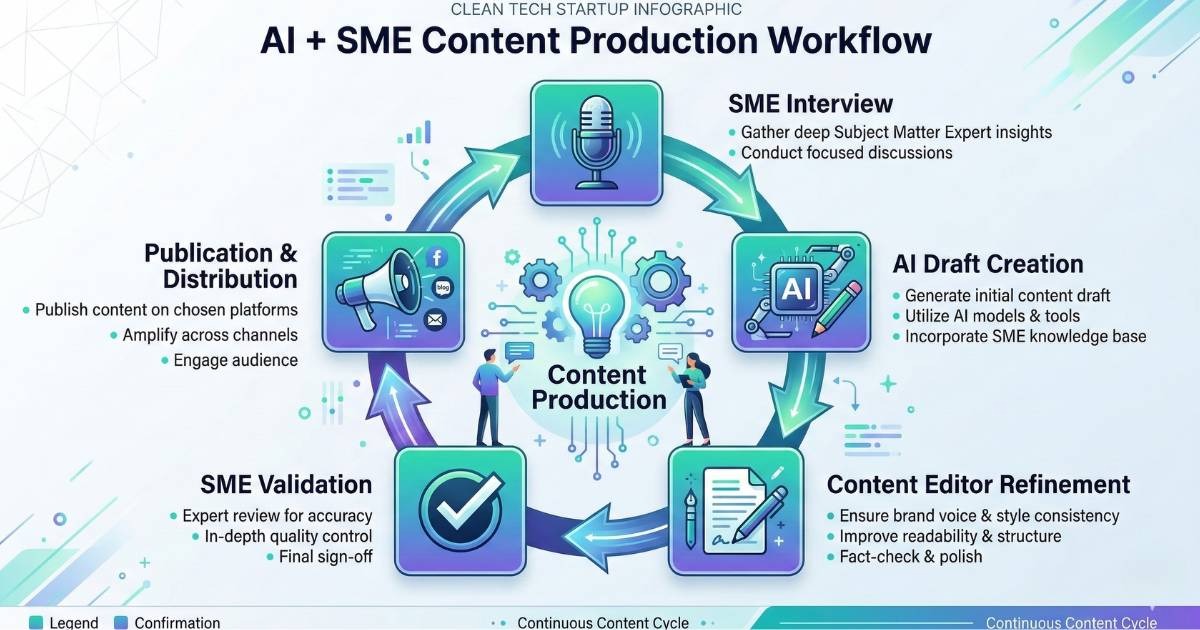
The SME-as-validator model makes expert-driven content scalable without requiring executives to write full drafts. The process runs in three steps: record a structured 20–30 minute expert interview, draft from the transcript using AI assistance, and return the draft for expert validation. This preserves authentic voice and domain-specific insight while keeping the time commitment for busy executives to under 30 minutes per piece.
Three-step SME-as-validator process:
- Record a structured 20–30 minute expert interview. Use a standard question template covering: the core problem, how they think about solutions, mistakes they see buyers make, and outcome data they’ve seen. AI transcription tools (Otter.ai, Fireflies) eliminate manual transcription.
- Draft from the transcript using AI assistance. Use the transcript as the primary source, not general AI knowledge. This preserves authentic voice and domain-specific insight that readers — and AI search systems — recognize as genuinely expert.
- Return the draft for expert validation. 15-minute review, not a full rewrite. The expert flags inaccuracies, adds specifics, and approves quotes.
Why this matters for GEO: Authentic thought leadership from named practitioners — with verifiable credentials, company affiliations, and consistent cross-platform presence — is weighted more heavily by AI systems than generic content. Your author entity should exist on LinkedIn, in your company’s Crunchbase profile, and in any industry publications you’ve contributed to.
What Does a Content Distribution Plan Look Like?
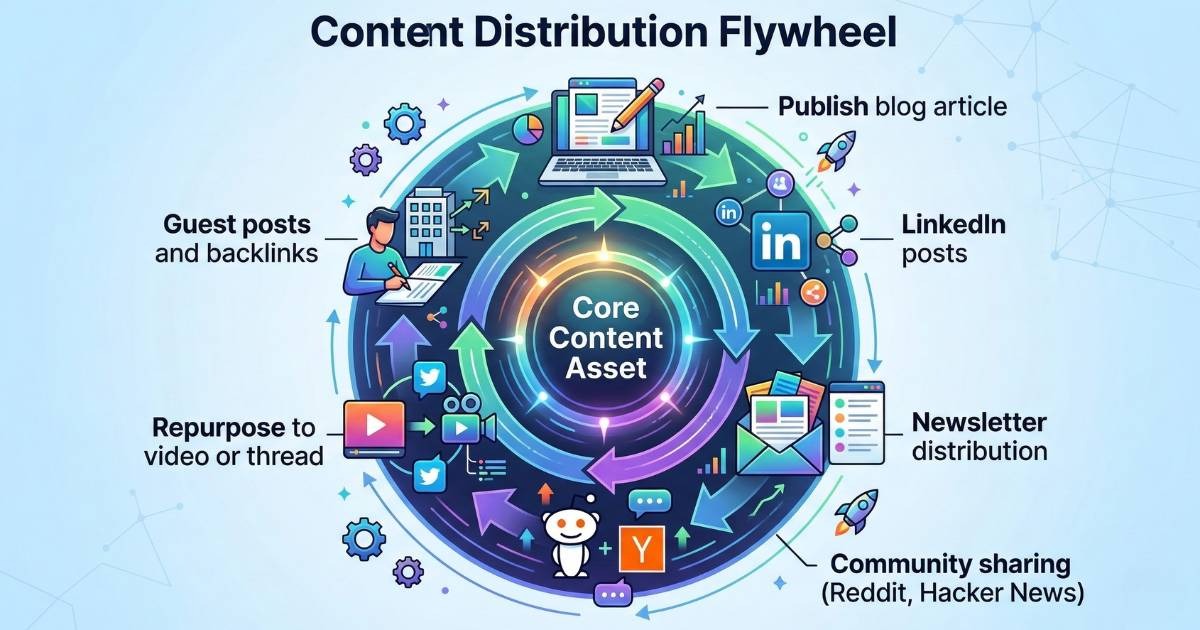
Distribution is where most tech startup content programs fail. Publishing without distribution produces no results regardless of content quality. A six-week launch framework ensures every major piece reaches its full potential audience. The framework has three phases: pre-launch awareness building, coordinated launch day execution, and systematic repurposing into derivative assets.
Phase 1 — Pre-launch (Weeks 1–4)
- Build awareness on LinkedIn by sharing excerpts, questions, and teaser data points
- Identify 10–15 influencers, newsletter editors, and community moderators who cover the topic
- Participate genuinely in developer/buyer communities (Reddit, Slack groups, LinkedIn) without promotional intent
Phase 2 — Launch (Week 5)
- Coordinated publish across all company channels: LinkedIn, X/Twitter, internal Slack, email newsletter
- Submit to technical communities: Hacker News (Show HN), Product Hunt, relevant subreddits
- Outreach to influencer list with specific, non-generic ask
Phase 3 — Repurposing (Week 6)
- Transform the core piece into 5–7 derivative assets: LinkedIn threads, carousel posts, short-form video scripts, newsletter segments, and guest post pitches
- Email outreach to relevant publications for republication or link opportunities
Platform-audience matrix:
| Platform | Primary Audience | Content Format |
|---|---|---|
| GitHub | Developers | READMEs, gists, open-source code |
| Stack Overflow | Developers | Answers with genuine value |
| Hacker News | Developers + founders | Show HN, interesting technical articles |
| Executives, buyers | Thought leadership, case studies, data | |
| Industry newsletters | Executives | Guest contributions, data studies |
| G2 / Capterra | Buyers researching tools | Profiles, review responses |
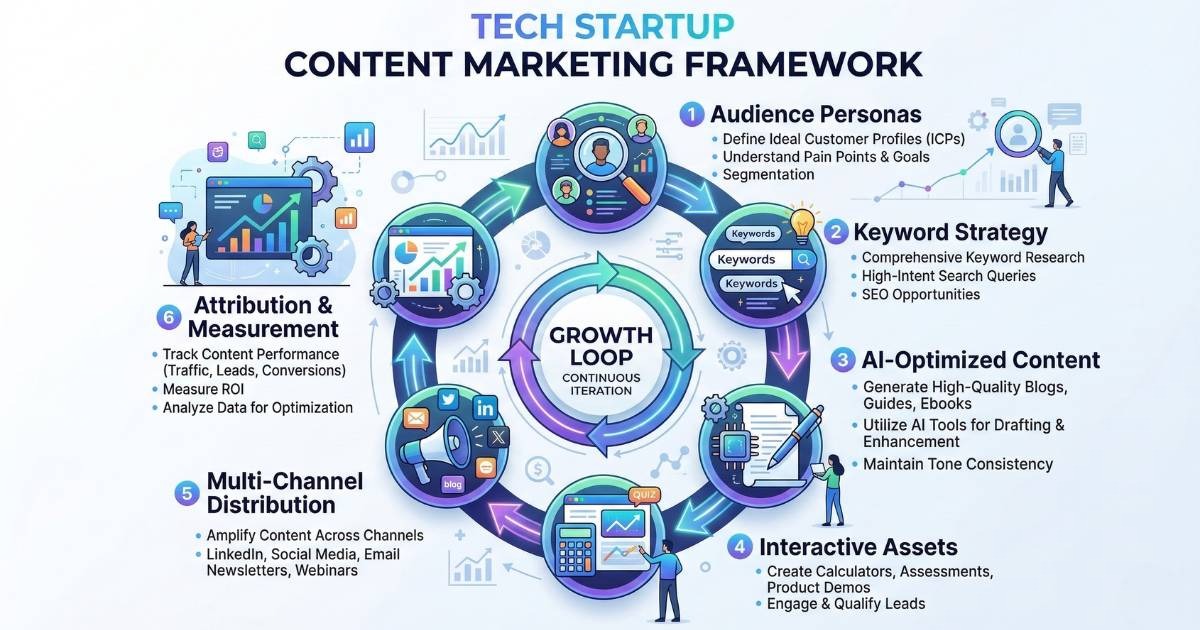
How Do You Measure Content Marketing ROI for B2B?
B2B content attribution is complex because enterprise buying involves 20–30 marketing touchpoints before a purchase decision, according to Demand Gen Report data. Single-touch attribution (first click or last click) systematically undercounts content’s contribution to revenue. The solution is multi-touch attribution combined with three revenue-connected metrics: LTV:CAC ratio, pipeline contribution percentage, and deal velocity improvement.
The four attribution models you should understand:
| Model | How It Works | When to Use |
|---|---|---|
| Linear | Equal credit across all touchpoints | Early stage — no bias yet |
| Time-decay | More credit to final interactions | Short-cycle, transactional |
| U-shaped | 40% first touch, 40% conversion, 20% middle | Demand gen programs |
| W-shaped | Weights three milestones equally | Complex enterprise sales |
Three metrics that connect content to revenue:
- LTV:CAC Ratio — Healthy SaaS benchmarks 3:1 to 5:1 (OpenView Partners). Content-sourced customers typically have lower CAC and higher LTV than paid-sourced customers. Track separately.
- Pipeline Contribution — Mature B2B content programs report 30–60% of pipeline influenced by content (Forrester). Start by tagging every inbound lead to the first content piece they consumed.
- Deal Velocity — Track whether content-touched deals close faster than non-content-touched deals. Quantify the time difference and multiply by average deal value — that’s content’s sales acceleration ROI.
AI visibility as an emerging metric: Track brand mentions appearing in ChatGPT, Perplexity, and Google AI Overviews responses for your target queries. This is a leading indicator of category authority, 6–12 months before it shows up in traditional organic rankings.
Frequently Asked Questions
What is content marketing for tech startups?
Content marketing for tech startups is creating and distributing technically credible content — tutorials, guides, case studies, and comparison pages — that attracts developers, executives, and enterprise buyers through search and AI-generated answers, reducing reliance on paid acquisition.
How much should a tech startup spend on content marketing?
Early-stage startups typically allocate 10–20% of their marketing budget to content. A lean team of one content lead plus one technical writer, supported by SME interviews, can produce a competitive content program at $5,000–$15,000/month all-in. The compounding return means earlier investment pays off more.
How long does it take for content marketing to work?
Organic content typically takes 3–6 months to rank and generate meaningful traffic. Programs that invest in high-intent BOFU content (competitor alternatives, pricing pages) see faster pipeline impact. AI search citations can appear within weeks of publication if the content is technically optimized.
What content marketing tools do tech startups need?
The essential stack: Ahrefs or SEMrush for keyword research, Google Search Console for tracking organic performance, a CMS with SEO controls (WordPress + RankMath), Clearscope or Surfer for content optimization, and HubSpot or equivalent for connecting content to pipeline. For email list building, AWeber offers a free tier up to 500 subscribers.
How do you create content if you have no marketing team?
Use the SME-as-validator model: founders or engineers do 20–30 minute structured interviews, AI tools draft from the transcript, and the SME validates in 15 minutes. This produces authentic expert content without requiring executives to write full drafts.
Summary: Content Marketing for Tech Startups in 2026
The tech startup content programs that compound year over year share five traits: they target high-intent keywords at every funnel stage, they create genuinely technical content that developers share, they systematically optimize for AI search extraction, they distribute every piece through a structured six-week playbook, and they measure success through pipeline contribution and LTV:CAC — not pageviews.
Start narrow. Pick two to three keyword clusters closest to your buyer’s final decision. Publish depth, not volume. Distribute every piece aggressively. Measure what moves deals, not what looks good in dashboards.
