

A content SEO audit checks whether your blog posts are optimized for search visibility, reader intent, and AI citation potential. It is different from a technical SEO audit, which focuses on crawlability, site speed, and server configuration. Most checklists online blend the two together, which means content marketers end up wading through robots.txt checks and canonical tag validation when they really need to know: is this post ranking as well as it should?
This checklist covers only the content layer. Every check maps to something you can fix in the post itself, not in your hosting panel or CMS settings. If you need the full technical audit, start with a B2B content marketing audit guide instead.
The Content SEO Fit Score: A Framework for Prioritizing What to Fix First
Before you touch a single post, you need a way to decide which posts deserve your time. The Content SEO Fit Score rates each blog post on five dimensions, each scored 1 to 5. Add the scores together for a total out of 25. Posts scoring below 15 need immediate work. Posts between 15 and 20 are candidates for a targeted refresh. Posts above 20 are performing well and should be left alone.
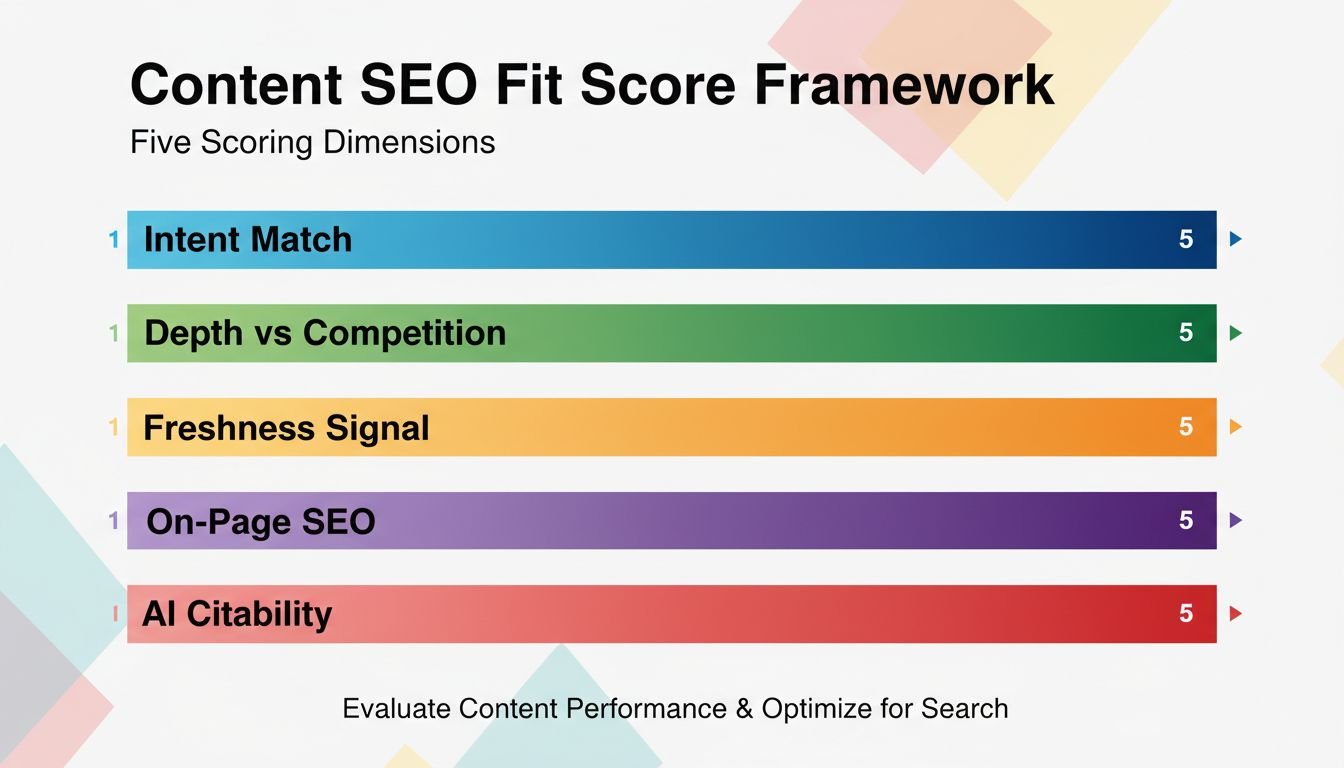
| Dimension | What It Measures | Score 1 (Weak) | Score 5 (Strong) |
|---|---|---|---|
| Intent Match | Does the post answer what the searcher actually wants? | Post answers a different question than the keyword implies | Post directly addresses the primary search intent within the first 100 words |
| Depth vs. Competition | Does the post cover the topic as thoroughly as the top 3 ranking pages? | Missing 3+ subtopics that competitors cover | Covers all competitor subtopics plus at least one unique angle |
| Freshness Signal | Is the content current and accurate? | References outdated tools, stats, or dates older than 18 months | All references are current, data is recent, screenshots are up to date |
| On-Page SEO | Are title, meta, headers, and internal links optimized? | Missing meta description, keyword not in H1, no internal links | Keyword in H1 and first paragraph, meta under 155 chars, 3+ internal links |
| AI Citability | Can AI search engines extract and cite clear answers from this post? | No directly quotable statements, no structured data | Contains 3+ extractable answer paragraphs (40 to 60 words each), FAQ schema present |
Score every post you plan to audit before doing any optimization. This keeps you from spending three hours rewriting a post that only needed a meta description update.
The 15-Point Content SEO Audit Checklist
Work through these checks in order. Each one builds on the previous, so skipping ahead wastes time.
Search Intent Alignment (Checks 1 to 3)
1. Does the post match the dominant SERP format? Search your primary keyword. If the top 5 results are all listicles and your post is a narrative essay, you have a format mismatch. Fix the format before anything else, because no amount of on-page optimization will overcome a structural misalignment with what Google is rewarding.
2. Does the first paragraph directly answer the query? Readers and AI systems both scan the opening. If your post starts with background context or a story, the answer is buried. Move your direct answer to sentence one or two.
3. Does the post serve one intent or try to serve three? A common problem in B2B blogs is a single post that tries to be a how-to guide, a tool comparison, and a thought leadership piece simultaneously. Pick one intent. Split the rest into separate posts and link between them.
Content Depth and Originality (Checks 4 to 7)
4. Are you missing subtopics the top 3 competitors cover? Open the top 3 ranking pages side by side. List every H2 and H3 heading. If they all cover a subtopic and you do not, that is a gap. Add it, but only if it genuinely serves the reader. Do not add padding sections just to match a word count.
5. Do you have at least one angle competitors lack? If every section of your post also appears in the top 3 results, you are a commodity. Find one thing you can add: a proprietary framework, a real-world example from your own work, a contrarian take backed by evidence, or a practical template none of them offer.
6. Is the post long enough to satisfy the intent, and short enough to respect the reader? Word count is not a ranking factor, but comprehensiveness matters. Check the average word count of the top 3 results for your keyword. If they are all 3,000 words and your post is 800, you are probably too thin. If they are all 1,200 words and your post is 4,000, you are probably padding.
7. Are statistics, claims, and data points sourced and current? Every stat in your post should link to its original source. If you cannot find the source, remove the stat. Unsourced claims erode E-E-A-T and give AI systems nothing to verify. Check dates on every source. Anything older than two years deserves a fresh search for updated data.
On-Page SEO Fundamentals (Checks 8 to 11)
8. Is the primary keyword in the H1, the first 100 words, and at least one H2? This is basic, but a surprising number of B2B posts miss it. The H1 should contain the exact primary keyword or a close variant. The first paragraph should use it naturally. At least one H2 should include it or a semantic variation.
9. Is the meta title under 60 characters and the meta description under 155? Truncated titles and descriptions lose clicks. Write the meta title as if it were a headline, not a keyword dump. The meta description should preview the value of the post, not repeat the title.
10. Does the post have at least 3 internal links to relevant published pages? Internal links are how search engines understand your site’s topic architecture. Every post should link to at least 3 other relevant, published pages on your site. Check that every link target actually exists. Linking to a page that returns a 404 is worse than no link at all. Run an internal linking audit if you have not done one recently.
11. Do all images have descriptive alt text that includes the keyword where natural? Alt text serves accessibility and SEO. Write it as a description of what the image shows, not as a keyword-stuffed label. If the image genuinely relates to the primary keyword, include it. If it does not, describe the image honestly.
AI Search Readiness (Checks 12 to 15)
12. Does the post contain at least 3 directly quotable answer paragraphs? AI search engines pull concise, self-contained answers from pages. Each answer paragraph should be 40 to 60 words, start with a clear statement, and make sense without reading the rest of the post. Place these immediately after the H2 they relate to.
13. Is FAQ schema implemented with real questions people search for? FAQ schema helps your content appear in rich results and gives AI systems structured question-answer pairs to cite. Use 4 to 6 questions based on actual search queries (check “People also ask” boxes and autocomplete suggestions). Answer each in 2 to 4 sentences.
14. Are comparison tables and definition boxes present where the topic warrants them? Structured content like tables, comparison matrices, and definition callouts are easier for AI systems to parse and cite than prose buried in long paragraphs. If your post compares options, has a process with distinct steps, or defines terms, format those sections as structured elements.
15. Does the post pass a scannability check for both human readers and AI crawlers? Use short paragraphs (3 to 5 sentences max). Use descriptive H2s and H3s that preview the answer, not vague labels. Avoid walls of text longer than 150 words without a subheading, list, or visual break. The B2B AI search visibility guide covers the full set of AI-readiness checks if you want to go deeper.
Step-by-Step Workflow: Running This Audit on Your Blog
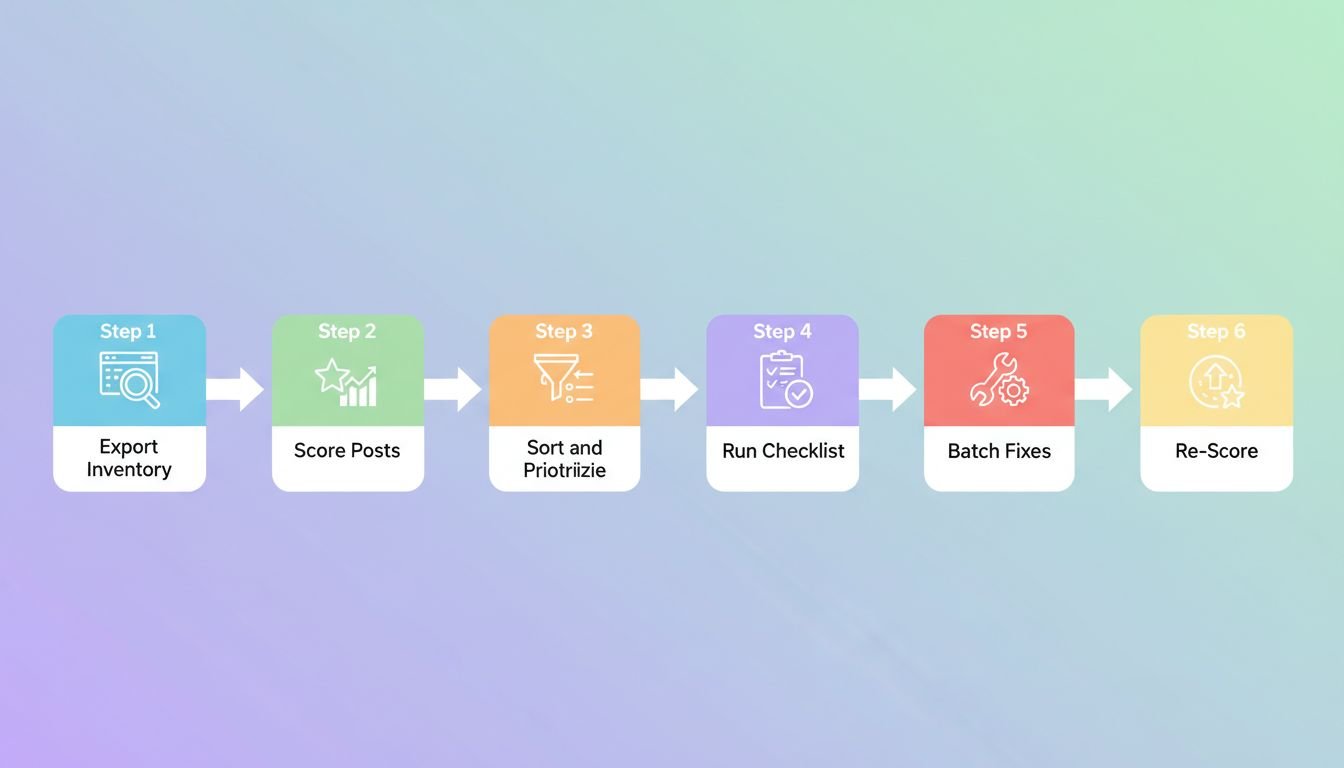
This workflow assumes one person running the audit on a B2B blog with 30 to 100 published posts. Adjust the time estimates if your catalog is larger.
Step 1: Export your post inventory (30 minutes). Pull a list of every published post with its URL, title, publish date, word count, and primary keyword. Google Search Console gives you click and impression data per page. Export the last 12 months.
Step 2: Score every post with the Content SEO Fit Score (2 to 4 hours). Open each post alongside its GSC data. Score it 1 to 5 on each of the five dimensions. Record scores in a spreadsheet. This is the slowest step, but it saves time later by preventing you from auditing posts that do not need it.
Step 3: Sort by score and pick your first 10 posts (15 minutes). Sort ascending by total score. The bottom 10 are your priority. If two posts score the same, prioritize the one with higher impressions but low clicks, because that post already has search visibility and just needs content improvements to convert.
Step 4: Run the 15-point checklist on each priority post (30 to 45 minutes per post). Work through all 15 checks. Note every issue. Do not fix anything yet. Just document.
Step 5: Batch fixes by type (varies). Group your issues: all meta updates in one batch, all intent-mismatch rewrites in another, all internal link additions in a third. Batching by type is faster than fixing one post end-to-end before moving to the next, because you stay in the same mental mode and can use the same tools.
Step 6: Re-score after fixes (1 hour). Go back to your spreadsheet. Re-score each post you fixed. If any post still scores below 15, it needs a deeper rewrite or should be merged into another post. Use the content refresh checklist for the full rewrite process.
Content SEO Audit vs. Technical SEO Audit vs. Full Site Audit
| Audit Type | What It Covers | Who Should Run It | How Often | Time Required |
|---|---|---|---|---|
| Content SEO Audit | Intent match, depth, on-page optimization, AI citability per post | Content marketers, SEO writers | Quarterly | 1 to 2 days for 50 posts |
| Technical SEO Audit | Crawlability, indexation, site speed, Core Web Vitals, redirects | SEO specialists, developers | Monthly (light) / Quarterly (deep) | Half day to 2 days |
| Full Site Audit | Content + Technical + Backlinks + UX + Competitor analysis | Agency or senior SEO lead | Biannually | 1 to 2 weeks |
If you are a content marketer on a small B2B team, the content SEO audit is the one you should own. Leave the technical audit to your developer or SEO specialist. Do not try to do everything at once.
What Most Teams Get Wrong with Content SEO Audits
They audit everything at once. Auditing 100 posts in a single sprint leads to shallow analysis and zero follow-through. Start with the 10 lowest-scoring posts. Fix those. Then move to the next 10. Momentum matters more than coverage.
They optimize for keywords without checking intent. A post can have perfect keyword density, a great meta description, and strong internal links. But if it answers a different question than the searcher is asking, none of that matters. Intent alignment is the first check, not an afterthought.
They ignore AI search readiness entirely. In our audits, we repeatedly see B2B blogs that rank well in traditional search but never appear in AI Overviews or Perplexity results. The reason is almost always the same: no directly quotable answer paragraphs, no FAQ schema, and no structured comparison content. Adding these elements takes 30 minutes per post and can open an entirely new traffic channel.
They treat the audit as a one-time project. A content SEO audit is not a spring cleaning event. Content decays. Competitors publish new posts. Search intent shifts. Build the audit into your quarterly content operations. Set a calendar reminder. The teams that audit consistently outperform the teams that audit once and forget.
They skip the re-scoring step. If you do not measure the impact of your fixes, you cannot tell whether the audit worked. Re-score every post you touched 30 days after publishing the updates. Compare to the original scores. This is how you build evidence that content SEO work produces results, which matters when you are justifying your time to leadership.
Frequently Asked Questions
How often should I run a content SEO audit?
Run a full content SEO audit quarterly. Between audits, monitor your top 20 posts monthly using Google Search Console click and impression trends. If any post drops more than 20% in clicks month over month, pull it into an ad-hoc audit immediately rather than waiting for the next quarterly cycle.
What tools do I need for a content SEO audit?
At minimum, you need Google Search Console (free) for performance data and a spreadsheet for scoring. Rank Math or Yoast handle on-page checks inside WordPress. For competitive analysis, Frase or Surfer SEO show you what top-ranking pages cover. For a full list of options, see our best content audit tools comparison.
How is a content SEO audit different from a content refresh?
An audit diagnoses problems. A refresh fixes them. The audit tells you which posts need work and what kind of work they need. The refresh is the actual rewriting, restructuring, and re-optimization. Always audit first, then refresh. Refreshing without an audit means you are guessing at what to fix.
Should I delete posts that score very low on the Content SEO Fit Score?
Not automatically. A post scoring 5 out of 25 might still serve a purpose if it targets a keyword with no other coverage on your site. Before deleting, check whether merging it with a stronger post would create a more comprehensive resource. Deletion is the right call only when the post has zero traffic, zero backlinks, and overlaps entirely with another published post. See the thin content audit guide for the full decision framework.
Can I automate parts of the content SEO audit?
You can automate data collection (GSC exports, word counts, meta tag checks) and some scoring dimensions (freshness signals, internal link counts). You cannot reliably automate intent match analysis or depth comparison, because those require reading the post and comparing it to competitors. Plan to automate about 40% of the work and do the rest manually.
What should I do if my entire blog scores below 15?
Prioritize by business impact. Sort posts by the revenue potential of their target keywords, not by SEO score. Fix the 5 posts that target your highest-value keywords first, even if other posts scored lower. A mediocre post on a high-intent keyword is worth more than a strong post on a keyword nobody searches for.
What To Do Next
Start with the Content SEO Fit Score. Open a spreadsheet, list your 20 most important blog posts (by traffic or by business relevance), and score each one across the five dimensions. This takes about an hour and gives you a prioritized list of what to fix.
Then run the 15-point checklist on your 5 lowest-scoring posts. Fix the issues you find. Re-score after 30 days.
Do not try to audit your entire blog in one sitting. Do not blend this with a technical SEO audit. Do not skip the re-scoring step. The value of an audit is not in running it. The value is in measuring whether your fixes actually moved the needle.
If you have not run an internal linking audit recently, do that alongside this content audit. Broken internal links and orphan pages undermine every other optimization you make. The internal linking audit process takes about half a day for a 50-post blog and pairs well with this checklist.
