

Disclosure: Some links in this post are affiliate links. If you sign up through them, I may earn a commission at no extra cost to you. I only recommend tools I believe are genuinely useful.
Quick Answer: Frase vs Surfer SEO for B2B in 2026
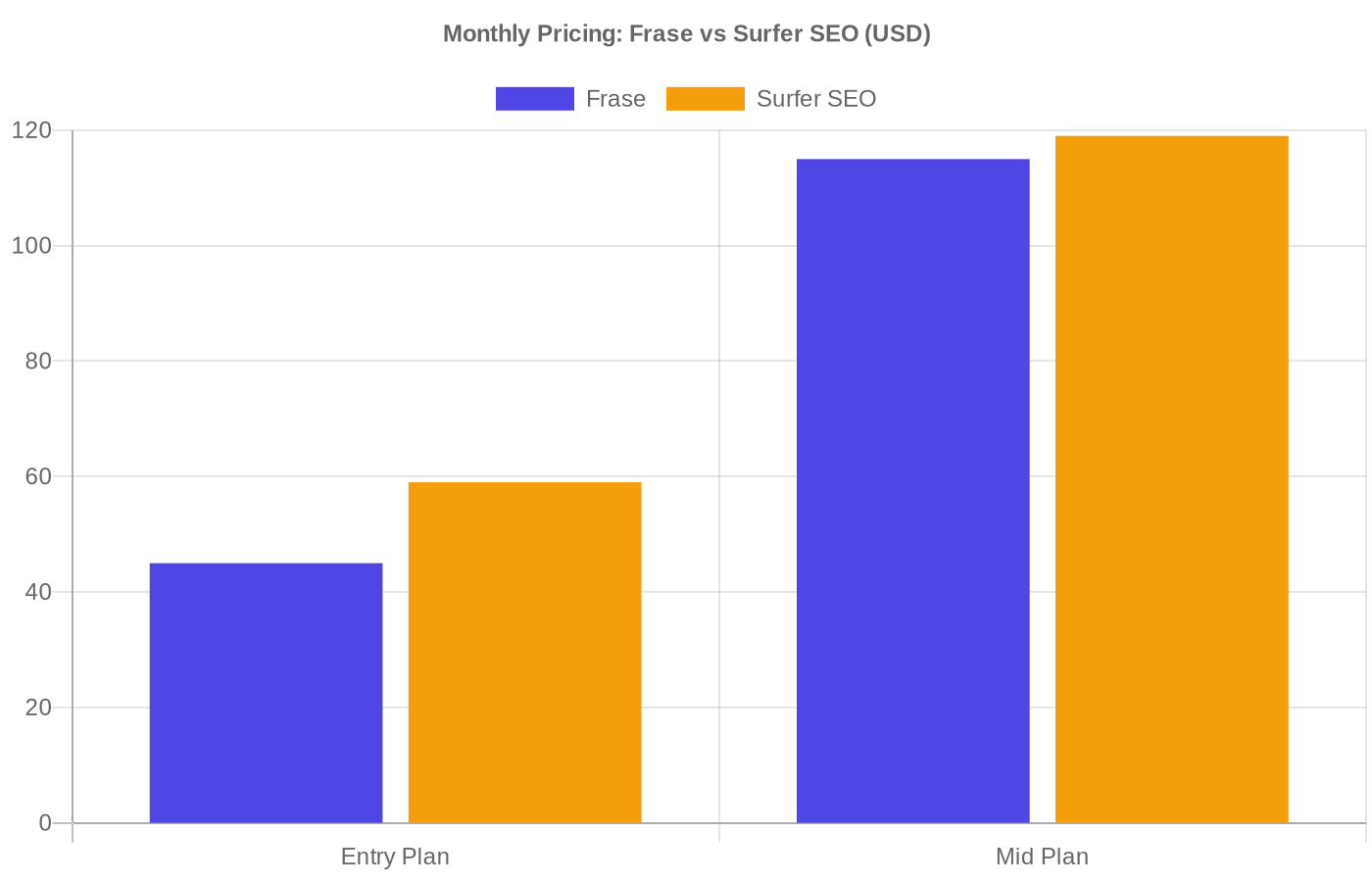
Frase is the better fit for lean B2B teams whose bottleneck is producing research-backed briefs and drafts fast (Starter from $39/mo billed yearly, $49 month-to-month). Surfer SEO is the better fit for teams that already have a writing process and need data-driven on-page optimization plus AI visibility tracking to actually rank (Discovery from $49/mo billed yearly, $59 month-to-month). The 2026 decision has an added layer: both tools now sell AI search readiness, and the real question is which stage of your content loop is broken.
Frase and Surfer solve two different problems, not the same problem twice, and the gap between them widened through 2026. Frase is built for the stage before you write a word: SERP research, briefs, outlines, and now an autonomous drafting-to-publishing loop. Surfer is built for the stage after a draft exists: scoring it against five hundred on-page factors and, since Surfer 3.0, tracking whether your page gets cited by ChatGPT, Gemini, and Perplexity. If you are a lean B2B team deciding between the two, the real question is not “which tool is better.” It is “which stage of my content process is actually broken.” This refresh updates the pricing, adds the AI-search dimension every 2025 comparison missed, and gives you a scoring model you can run in under a minute.
What Frase Actually Does Well
Frase pulls the top-ranking pages for a keyword, extracts their headings and subtopics, and builds you a working outline in minutes. For a solo founder or a two-person content team, that is the part of content production that eats the most time: staring at a blank doc trying to figure out what a 2,000-word post should cover. Frase also ships an AI writer grounded in that SERP data, so you can go from outline to first draft without leaving the tool. If you are briefing writers by hand today, our Best SEO Tools for Small Business roundup covers the free and low-cost alternatives before you decide whether Frase is worth the upgrade.
The thing most reviews understate is that Frase is no longer just a brief generator. Its 2026 product adds a GEO score you can run inside the editor, checking whether your draft answers questions in the first 40 to 60 words (the window AI engines extract), backs claims with structured facts, and organizes data into lists and tables an LLM can parse. It also ships Content Guard, which watches your published pages for ranking or traffic decay and drafts fixes for you. What Frase does not do particularly well is tell you, after the fact, whether a finished draft is actually optimized enough to rank. Its SEO score is a secondary add-on, not the core engine. If your bottleneck is “we do not know what to write,” Frase closes that gap fast. If your bottleneck is “we write plenty but nothing ranks,” Frase alone will not fix it.
What Surfer SEO Actually Does Well
Surfer’s Content Score is the product. You paste in a draft, and it compares your word count, heading structure, keyword density, and semantic terms against the pages currently on page one. The suggestions are specific: add this term four more times, this heading is missing, your content runs 400 words short of the median ranking page. Independent testing matters here. An Originality.ai study put Surfer’s Content Score correlation with actual Google rankings at 26% to 28%, while an Ahrefs analysis pegged Frase’s Topic Score correlation near 10%. Neither score predicts rankings perfectly, but if optimization accuracy is your priority, Surfer’s number is meaningfully closer to what Google actually rewards.
Surfer 3.0, released in 2026, is built for the agentic web. Its AI Tracker scrapes real user-facing answers from ChatGPT, Gemini, Perplexity, Google AI Overviews, and Google AI Mode, then tells you your visibility score, your mention rate, and which competitor sites are winning citations. It also ships a Facts and Coverage Booster that inserts missing factual citations into your draft. The caveat is the front end of the process: Surfer’s outline and brief tools exist, but they are not as fast or as detailed as Frase’s for turning a bare keyword into a structured plan. Surfer assumes you already know roughly what you are writing about and just need help making it competitive.
Why 2026 Changed the Decision (the AI Visibility Layer)
The comparison most guides still write ignores the new layer: both tools now sell AI search readiness, and you have to decide which one matters for your traffic. Search behavior has shifted hard. Industry tracking from the deep-research sources shows about 48% of tracked queries now trigger a Google AI Overview, user-reported AI visibility tools note a forecast of roughly 25% decline in traditional search volume, and organic click-through tends to drop around 61% when an AI Overview appears. B2B buying has followed: 94% of B2B buyers use generative AI somewhere in their product evaluation, and 69% of software buyers report choosing a different vendor than planned based on an AI chatbot recommendation. This is why the “AI agent as a second buying audience” is no longer a fringe idea.
What most guides miss is that ranking on Google and getting cited by an LLM are now different goals. An analysis of 57,253 URLs found that only about 12% of URLs cited by conversational engines also rank in Google’s top ten for the same query. That is the whole strategic point: pages you would never see on a Google SERP can still become the answer ChatGPT gives a buyer. Frase and Surfer attack this from opposite ends. Frase’s GEO score checks your draft’s structure for extractability (direct answers, definitions, tables). Surfer’s AI Tracker measures your real-world visibility in the engines themselves. For a B2B team, that means Frase makes your text machine-readable before you publish, while Surfer tells you whether the machines actually picked you up afterward. You can start with one, but if AI citations matter to your pipeline, you will likely want the other’s strengths too.
The Content Tool Fit Score: A Framework for Choosing in 2026
Most comparison articles list features side by side and leave you to do the math yourself. The Content Tool Fit Score does the math for you. Score your team on three inputs: team size, monthly content velocity, and your primary bottleneck. In 2026 I add a fourth that did not exist a year ago: whether AI visibility is a measurable part of your pipeline, not just a buzzword. A team of one publishing four posts a month with a research and briefing bottleneck and no dedicated AI-citation-tracking budget scores toward Frase. A team of three or more publishing ten or more posts a month with an optimization bottleneck and a need to track ChatGPT citations scores toward Surfer.
The scoring logic stays simple on purpose: weight your bottleneck twice as heavily as team size or budget, because tool fit follows the actual constraint in your process, not your headcount. A five-person team that still cannot produce a usable brief in under an hour has a Frase problem, not a Surfer problem, regardless of how big the team is. And the costing layer has changed enough that you should run the real numbers before you commit (see the pricing section below).
Try the Content Tool Fit Score
Content Tool Fit Score: Frase or Surfer for Your Team?
Frase vs Surfer: Feature and Pricing Comparison (Updated 2026)
The pricing below was verified against the official Frase and Surfer pricing pages in August 2026 and reflects the plans you will actually be offered. Note the shift: Surfer rebranded its tiers in 2026 to Discovery, Standard, Pro, and Peace of Mind, and both tools have moved to credit-based limits that behave differently under annual and monthly billing.
| Category | Frase | Surfer SEO |
|---|---|---|
| Core strength | Keyword-to-outline research, drafting, and autonomous publishing loop | Draft-to-ranking optimization scoring plus AI citation tracking |
| Content score accuracy | Topic Score, ~10% correlation with rankings (Ahrefs) | Content Score, ~26-28% correlation (Originality.ai / Surfer) |
| AI/GEO feature | GEO score in-editor + Content Guard auto-updates | AI Tracker (ChatGPT, Gemini, Perplexity, AI Overviews) + Facts Booster |
| Entry pricing (mtm / annual) | Starter $49 / $39 | Discovery $59 / $49 |
| Mid-tier pricing (mtm / annual) | Professional $129 / $103 | Standard $119 / $99 |
| High-tier pricing (mtm / annual) | Scale $299 / $239 | Pro $219 / $182 |
| Top plan | Enterprise (custom) | Peace of Mind $359 / $299; Enterprise from $999 |
| Credit behavior | Starter has no overages; Pro/Scale charge overages | Monthly credits reset monthly; annual credits pool for the year |
| Best fit | Solo or small teams whose bottleneck is briefing, drafting, and upkeep | Teams with an existing writing process whose bottleneck is ranking and AI visibility |
The Hidden Cost of Credits: What the Sticker Price Does Not Show
This is the gap most comparison articles skip, and it matters for B2B teams on a budget. Both tools price by monthly credit limits, and the difference in behavior is big.
Frase’s Starter plan holds hard at its limits: 10 articles a month and 50 audit pages, with no overage charges, so a surprise bill is off the table. An independent 2026 head-to-head reached the same conclusion on the cost difference. On Professional and Scale, Frase charges overages when you exceed (roughly $5 per extra article on Professional and $4 on Scale). Surfer goes a different direction. On Surfer’s monthly plans, unused credits reset and disappear at the end of each cycle. On Surfer’s annual plans, you get your entire credit pool up front for the year, which is a material advantage if your publishing is seasonal rather than steady.
The real trap is add-ons. A small team on Surfer’s Standard plan can quickly add the SERP Analyzer at $29 a month and the standalone AI Tracker at $95 a month, pushing the actual operating cost toward $220 a month before rank tracking ($8.50 per 100 keywords) shows up. Budget against the total, not the headline “from $59” price. For a lean B2B team that mostly needs briefs and drafts, Frase’s flat Starter price with no overages is easier to predict. For a team that needs daily citation tracking plus optimization, Surfer’s headline number is the start, not the end.
How to Test Both Tools Before You Commit
Do not decide off a comparison article alone, including this one. Run both tools against the same target keyword and compare the actual output.
- Pick one real target keyword you are planning to write about this month, ideally one with commercial or transactional intent.
- Run it through Frase’s SERP analysis and generate an outline. Time how long it takes you to go from keyword to a brief you would actually hand to a writer.
- Take an existing published post on a related topic and run it through Surfer’s Content Score. Note how many specific, actionable changes it surfaces.
- If AI citations matter to you, run the same draft through Surfer’s AI Tracker and Frase’s GEO score. Compare which one actually changes what you write.
- Compare the two experiences against your actual bottleneck: did the missing piece turn out to be the outline, the optimization, or the visibility measurement?
- Use your trial period on the tool your test pointed to, not the one with better marketing copy.
What Most Teams Get Wrong
The most common mistake is buying Surfer before the team has a repeatable briefing process. Surfer will faithfully tell you your content is missing terms and structure, but if your writers start from a blank page every time, the content score improves while the actual usefulness of the post does not. Optimization tools amplify whatever process feeds them; they do not replace a broken one. The second common mistake runs the other way: teams stick with Frase’s AI-generated drafts as final copy because the outline step felt so efficient, then wonder why nothing ranks. A strong outline is not a finished, optimized post.
The mistake new to 2026 is treating AI visibility as a checkbox instead of a measurement. Teams pay for GEO features, publish, and then cannot tell whether ChatGPT is citing them. If you are going to spend on AI search readiness, you need the feedback loop: either Surfer’s AI Tracker or a lightweight manual check of your own answers in ChatGPT and Perplexity, run monthly against your priority keywords. And a smaller mistake worth naming: teams buy the more expensive plan of either tool “to be safe” before they have used the entry tier long enough to know whether they will actually hit its limits.
Does It Matter? The Case Study Signal
It is fair to ask whether switching or keeping one of these tools moves the needle. The 2026 case studies from Surfer’s published research show the ceiling when optimization plus AI visibility is done deliberately. Planable used Surfer’s Topical Map to plan content clusters without cannibalization and reported a 176% increase in organic traffic and roughly 10x growth in high-ranking content assets within six months. BugHerd reported a 127% year-over-year lift in organic lead conversions after data-driven content refreshes. On the Frase side, Webflow’s multi-channel push reported AI-driven signups growing from 2% to 8% of total organic acquisition and a 4x increase in AI-influenced signups.
None of these prove one tool beats the other; they prove the process works when the tool matches the bottleneck. That is the honest takeaway: the tool is the amplifier, and the process fits determine the result.
Frequently Asked Questions
Is Frase or Surfer better for a solo B2B content team?
For a solo team, Frase is usually the better starting point. The biggest constraint for a one-person operation is time spent on research and outlining, and Frase’s lower entry price and faster brief-to-draft workflow address that directly. Add Surfer later once you have enough published content that ranking, not writing speed, becomes the bottleneck.
Can you use Frase and Surfer together?
Yes, and plenty of teams do: Frase for the research, briefing, and upkeep stage, then Surfer to optimize the draft and track AI citations before publishing. The combined cost is higher than either tool alone, so this setup makes the most sense once your content volume justifies paying for both stages separately.
Does Frase have real SEO scoring like Surfer?
Frase offers an SEO and GEO scoring add-on, but independent testing puts its Topic Score correlation with rankings near 10%, versus Surfer’s 26% to 28%. If on-page optimization scoring accuracy is your primary need, Surfer’s version is more detailed and more central to daily use.
Which tool is cheaper for a small B2B team?
Frase’s entry plan starts a little lower than Surfer’s: $39 a month billed yearly versus Surfer Discovery at $49 a month billed yearly. At the mid and high tiers the picture shifts, and Surfer’s add-ons (SERP Analyzer, AI Tracker, rank tracking) can push its real cost well above the headline number. Price the total you actually need.
Do these tools work for technical B2B or SaaS content?
Both tools work on any topic with an existing SERP to analyze, technical B2B and SaaS included. Neither tool understands your product’s technical nuance the way a subject matter expert does, so treat both as research and optimization aids that still need a knowledgeable writer or reviewer in the loop.
Is Frase or Surfer better for AI search / getting cited by ChatGPT?
They attack different parts of the problem. Frase’s GEO score helps make your draft machine-readable and extractable before you publish. Surfer’s AI Tracker measures your actual visibility in ChatGPT, Gemini, and Perplexity and tells you what to fix. For a team serious about AI citations, the practical answer is often Frase for production plus Surfer (or a manual check) for measurement.
What To Do Next
Run the Content Tool Fit Score above with your team’s real numbers before you sign up for anything. If your bottleneck is figuring out what to write, start a Frase trial and time how fast you can turn a keyword into a brief you would actually use. If you already have a writing process and your published posts just are not ranking, start a Surfer trial and run three of your worst-performing live posts through its Content Score to see how big the optimization gap actually is. If AI citations are a real channel for you, spend an hour checking your own answers in ChatGPT and Perplexity for your top ten keywords before you buy any visibility add-on. Whichever you pick first, commit to using it on your next five posts before deciding whether you need the other tool too. Do not buy both on day one. For the broader system these tools plug into, see our B2B Content Marketing Strategy guide, the content workflow template, and our roundup of AI marketing agents for B2B.
