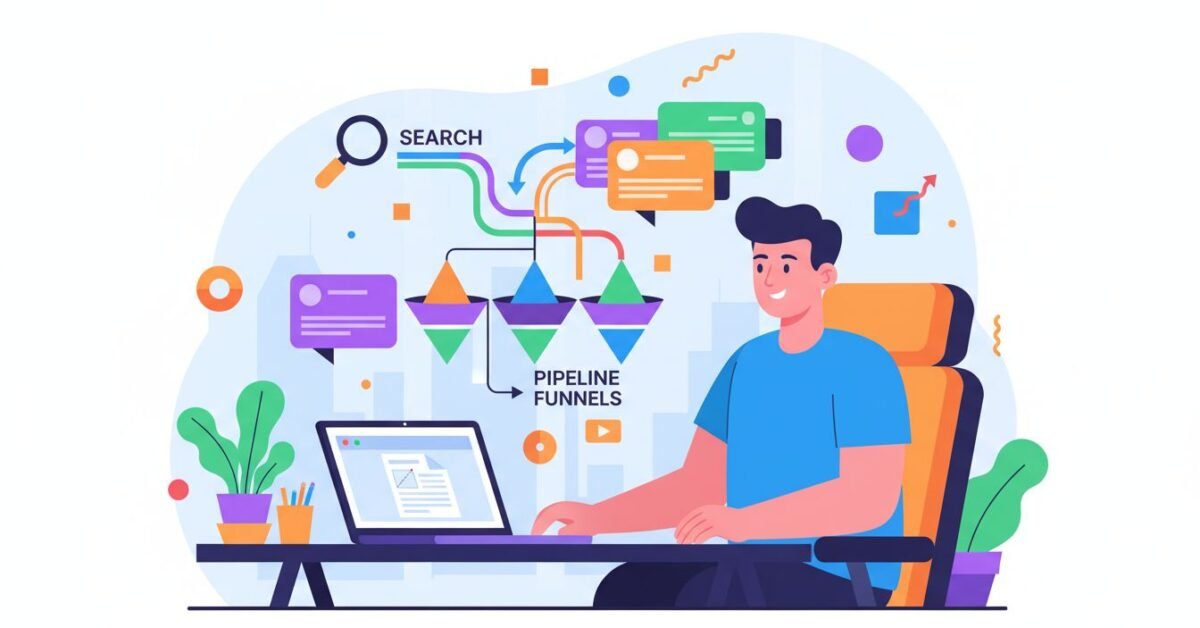

A demand gen content brief serves two readers at the same time: Google’s ranking algorithm and a prospective buyer who is actively comparing solutions.
Most B2B content briefs only serve one of them.
Standard SEO briefs tell your writer what keyword to target, what word count to hit, and which competitor URLs to beat. That is the right foundation. For SaaS and demand gen teams, it is not enough on its own. You also need the brief to specify which buyer stage this piece is meant to move, what outcome you want the reader to take after they finish, and how the content connects to your follow-up sequences. Without those fields, writers optimize for rankings and demand gen managers wonder why the traffic does not convert.
The format in this post is what I call the Dual-Intent Brief. It adds the demand gen layer without making the brief longer or harder to fill in. You get one document that both SEO and pipeline goals can point to.
Download the Dual-Intent Brief Template (Google Sheet) to get all 10 fields pre-filled with guidance and examples you can adapt immediately.
SEO Brief vs. Demand Gen Brief: What’s Missing
Why Standard Content Briefs Fall Short for Demand Gen
A standard content brief solves a well-defined problem: how does a writer produce a page that ranks for a specific keyword, covers the right topics, and matches search intent? Most SEO brief templates solve that reasonably well.
Demand gen adds a harder problem. The reader who finds your content through search is often at the top of the funnel: aware of a problem, not yet aware of your solution. The content needs to do two things in sequence. It needs to answer their search query well enough to rank and earn the click. Then it needs to move them toward a product-adjacent decision. Those two jobs require different brief fields.
Here is where the mismatch typically happens.
Search intent vs. buyer intent. A keyword like “content brief template” has clear search intent: someone wants a template. The buyer intent underneath is less obvious. Are they a solo marketer trying to get organized? A demand gen manager trying to scale a team of freelancers? A content director who wants to reduce revision cycles? Each of those needs a different angle, a different tone, and a different CTA. Standard SEO briefs do not ask this question.
The missing downstream field. SEO briefs specify what to include in the content. They rarely specify what should happen after someone reads it. If your funnel has a demo request, a trial, or a nurture sequence, the brief needs to name the destination. Otherwise writers default to generic CTAs that move readers nowhere useful.
No ICP stage field. SaaS companies sell to buyers at different awareness stages. A piece targeting someone who does not know they need a content brief is different from a piece targeting someone comparing brief templates across three vendors. The brief needs to specify which stage this piece is for. That changes the tone, the examples, the assumed knowledge level, and the CTA.
If you are thinking about how content and demand gen should work together more broadly, Content Marketing vs Demand Generation: What B2B Teams Get Wrong covers that separation in more depth.
The Dual-Intent Brief: 10 Fields Your Template Needs
The Dual-Intent Brief keeps the SEO foundation and adds the demand gen layer. Here are the ten fields, in the order a writer needs them.
1. Primary keyword and search intent. One keyword. One intent signal: Informational, Commercial, or Transactional. If you need to serve two different intents, write two pieces.
2. Answer intent. This is different from search intent. Search intent describes what type of content Google expects. Answer intent describes the specific claim or answer this piece proves at the passage level: the thing a reader should be able to extract and quote. Not “how to write a content brief” (search intent) but “a demand gen content brief needs buyer stage and pipeline outcome fields, not just keyword and word count” (answer intent). Answer intent guides writers toward quotable, extractable sentences that perform in AI Overviews and citation chains.
3. ICP and buyer stage. Name the persona and the funnel stage. “B2B content manager, problem-aware but not solution-aware” is useful. “B2B marketers” is not. This field changes everything downstream: the tone, the examples, the level of assumed knowledge, and the CTA.
4. Pipeline outcome. What do you want this reader to do after reading? Be specific: sign up for a trial, request a demo, download a template, click to a product page. This is the field most SEO briefs omit and most demand gen teams wish their writers had.
5. Competitor URLs to beat. Three URLs, not ten. Pull them from the actual SERP for the target keyword, not from a gut list of product competitors. A SERP competitor is whoever ranks above you for this specific keyword. That is often a different list from your product competitors.
6. Heading skeleton (H2s only). Specify the major sections based on SERP gap analysis: what competitors cover and what they miss. Leave H3s to the writer. Over-prescribing structure produces rigid, robotic content.
7. Entities and supporting keywords. The semantic terms, related concepts, and named entities this piece needs to mention for topical completeness. These are not secondary keywords to stuff in. They are the conceptual neighborhood the content needs to inhabit.
8. E-E-A-T source. Who carries the claimed experience behind this piece? A first-person practitioner account, a named subject-matter expert, or an attributed research-backed framework? Specify it in the brief so the writer knows the voice register from the start.
9. Sequence connection. Which nurture sequence, retargeting audience, or follow-up email does this piece feed? If a reader downloads the template in this post, what should happen next? Brief this out so your content and demand gen workflows are actually connected, not running in parallel.
10. Quality gate. What needs to be true before this piece is approved? Minimum word count based on SERP benchmarks, required internal links, specific schema type, a downloadable asset. Write it in the brief so writers know what “done” looks like before they start.
You can find all ten fields in a ready-to-use format in the Dual-Intent Brief Template.
The broader B2B Content Brief Template guide covers brief fundamentals for any content type. This post focuses specifically on the fields that matter when pipeline, not just rankings, is the goal.
The SERP-to-Sequence Bridge
The value of fields 9 and 10 above is that they force an alignment conversation before writing begins, not after.
Most SaaS content teams run SEO and demand gen as adjacent functions that share a content calendar but rarely share a brief. SEO focuses on ranking. Demand gen focuses on MQLs. Content sits in the middle, trying to serve both, briefed only for one.
The SERP-to-Sequence Bridge is a simple mapping that lives in the brief. For each piece of content, you specify one entry point (the search query) and one exit point (the next step in your funnel). That is the whole idea.
Here is what this looks like across three common SaaS content types:
| Content Type | Entry (Search Query Type) | Exit (Sequence / CTA) |
|---|---|---|
| How-to guide | Problem-aware keyword | Add to content ops nurture sequence |
| Comparison post | Solution-aware keyword | Demo request or trial signup |
| Template / checklist | Transactional keyword | Product onboarding email sequence |
The brief is the right place to fill in this table. Before writing starts, not after the piece is live and you are wondering why it is not driving pipeline.

How to Build and Use a Brief in Practice
The Dual-Intent Brief takes 20 to 30 minutes to complete well. Here is the sequence.
Step 1: Keyword validation (5 min). Confirm the keyword has real search volume and that the SERP shows content similar to what you intend to produce. If the top 10 is all product pages and yours is a how-to guide, you have an intent mismatch before you have even started.
Step 2: SERP gap analysis (10 min). Read the top 3 ranking pages for your target keyword. Note what they cover and what they miss. What questions do readers ask in related searches? What angles are absent? The heading skeleton you put in the brief should be shaped by this analysis, not by your intuition.
Step 3: ICP and buyer stage alignment (5 min). Check with your demand gen counterpart: which persona is most likely to search for this exact keyword? Is this top-of-funnel awareness, middle-funnel evaluation, or bottom-funnel decision? Align on that before you brief the writer.
Step 4: Brief completion and review (10 min). Complete all 10 fields. Have a second person review fields 3, 4, and 9: ICP stage, pipeline outcome, and sequence connection. Those are the ones most likely to be vague or missing entirely.
Step 5: Writer handoff. Send the brief. Do not explain it on a call. If the brief needs a call to explain, it is not specific enough yet.
Step 6: QA against the quality gate. Before approving the draft, check it against field 10 (the quality gate you wrote at the start). If the gate specified two internal links and the draft has none, send it back with the brief field highlighted. The brief makes the feedback specific and unarguable.
Briefing AI tools vs. human writers. When using AI to draft from the brief, fields 2 (answer intent) and 8 (E-E-A-T source) do the most work. AI tools produce generic, high-probability text unless you give them a precise claim to prove and a voice to prove it in. Human writers benefit most from field 6 (heading skeleton) and field 10 (quality gate), which set structure and define “done” without over-prescribing the prose.
For teams that use both human writers and AI tools in the same pipeline, Human-in-the-Loop AI Content Workflow for B2B Teams covers how to structure that handoff so quality does not drop at the seams.
What Most Demand Gen Content Teams Get Wrong
Writing the brief for the keyword, not the conversation. The keyword tells you how a reader arrives at the page. It says nothing about what they need to believe or do by the time they leave. Teams that brief only for the keyword produce content that ranks but contributes nothing to pipeline. Write the brief for the whole journey: entry, experience, exit.
Leaving buyer stage to inference. “This is a demand gen piece” is not a buyer stage. It is a departmental attribution. Specify the funnel stage clearly: problem-aware, solution-aware, or decision-stage. Your writer cannot accidentally write a piece that tries to sell to someone who has not yet recognized they have a problem.
Omitting the sequence connection. If you cannot name the nurture sequence or follow-up action this content feeds, you do not yet know why you are writing it. The brief should not be completable without answering this field. Make it required.
Over-specifying structure, under-specifying intent. Teams that prescribe 15 H2s and H3s but give zero guidance on what the reader should believe by the end produce content that reads like an outline with prose between the headings. Loosen the structure requirement. Tighten the answer intent field.
Briefs that get edited after handoff. A content brief that gets revised by three people after the writer has started is not a brief. It is a source of revision cycles. Lock the brief before it leaves the strategist’s hands. If something needs to change after handoff, that is a project management problem, not a brief problem.
Frequently Asked Questions
How long should a B2B content brief be?
Two to four pages covers most SaaS content pieces. A brief longer than that usually means the strategist is doing the writer’s job for them. A brief shorter than one page usually means something important is missing. The Dual-Intent Brief covers 10 fields; most are one to three sentences each.
Who should write the content brief?
The content strategist, not the writer. The brief is a strategic document: it specifies intent, ICP stage, pipeline outcome, and quality gate. Those decisions belong to whoever owns the content strategy. Asking writers to self-brief is asking them to make strategic decisions they often lack the context for.
What is the difference between a content brief and a content strategy?
A content strategy is the map. A content brief is the instruction for one specific journey on that map. Strategy specifies which topics to pursue, which personas to target, and which funnel stages to cover. A brief translates those decisions into executable guidance for one piece. You need both. They are not interchangeable.
How does a demand gen content brief differ from a standard SEO content brief?
A standard SEO brief optimizes for search ranking: keyword, search intent, word count, heading structure, internal links. A demand gen brief adds three fields a standard brief does not have: buyer stage (where the reader is in the funnel), pipeline outcome (what action you want them to take), and sequence connection (where they go in your marketing system after they read). Those three fields are what connect content to pipeline.
Should I use the same brief template for every content type?
Use the same 10-field structure but weight the fields differently by content type. For how-to guides, answer intent and heading skeleton matter most. For comparison posts, ICP stage and pipeline outcome are the critical fields. For template or checklist content, sequence connection and quality gate do the most work. Adjust the depth of each field, not the template itself.
Can this brief template work with freelancers?
Yes. Freelancers particularly benefit from fields 3 (ICP and buyer stage) and 8 (E-E-A-T source), because those are the fields in-house teams most often forget to share with external writers. Freelancers produce generic work not because they are bad writers but because they have never been told who the reader is or what voice the brand needs.
What To Do Next
Start with your next planned piece. Download the Dual-Intent Brief Template and fill in all 10 fields before you speak to the writer. Do not brief on a call. Do not brief in Slack. Complete the document first.
If you already have content briefs in use, run your last three briefs against the 10-field checklist above. Look specifically at fields 3, 4, and 9: ICP stage, pipeline outcome, and sequence connection. Those are the three fields SEO-focused teams most often skip. If any of those are blank, you have found the gap between your content ranking and your content converting.
Lock the brief before handoff. Do not schedule the writing until the brief has been reviewed by a second person. That one change separates the briefing step from the writing step and reduces revision cycles faster than any other single adjustment you can make.
If you are also building the systems around brief production, the B2B Content Engine guide covers how brief management fits into a repeatable content operating rhythm for lean teams.
