

AI adoption is high, but measured results are low. That gap is the real problem
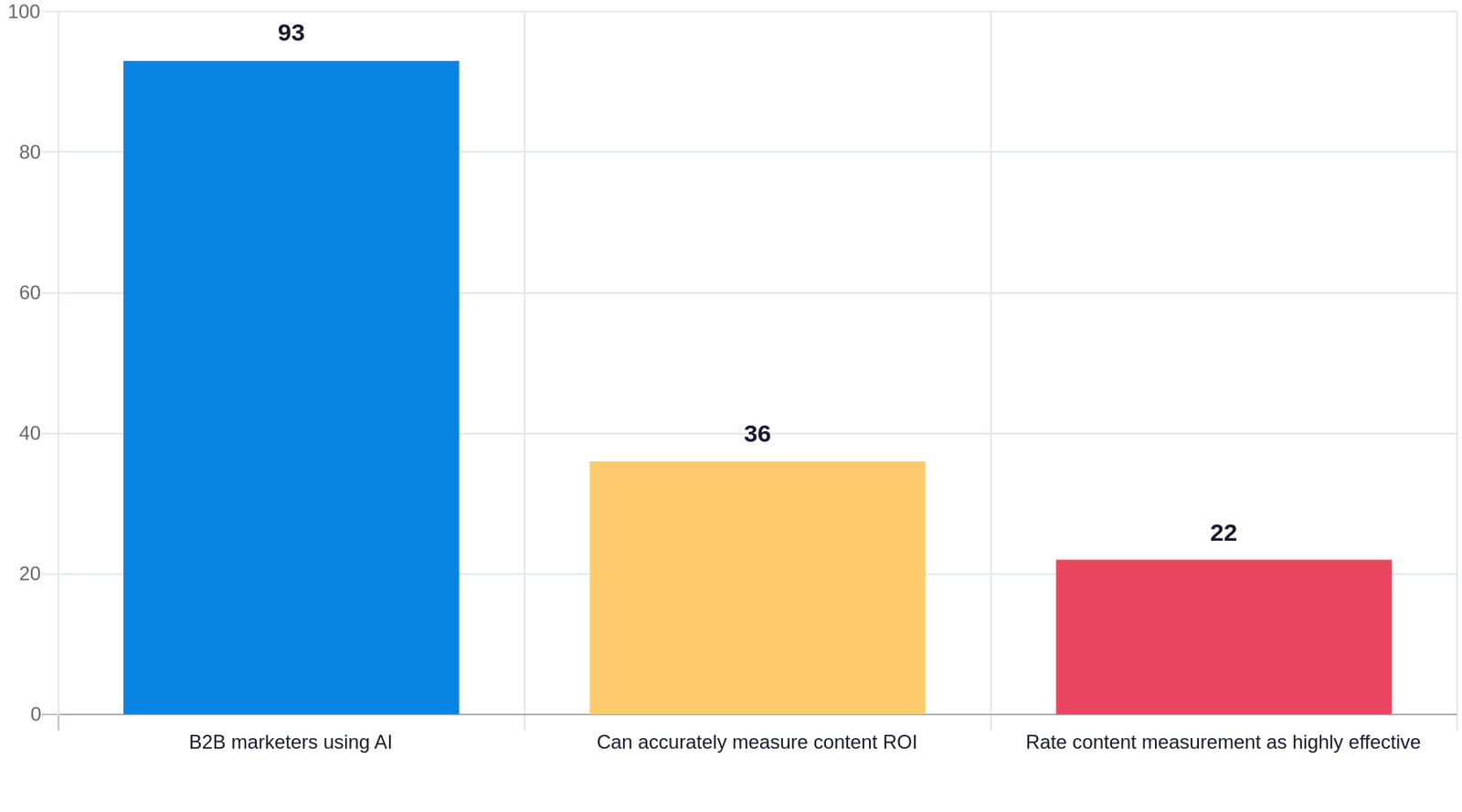
Most B2B marketers now use AI every day, yet only a fraction can prove what it returns. CMI’s 2026 research shows 93% of B2B marketers use or plan to use AI, while 95% of enterprise AI initiatives fail to deliver measurable ROI despite $30 to $40 billion in investment. That is not a technology failure. It is a measurement failure, and it is fixable.
The problem is that you are likely measuring AI by how much work it produces, not how much revenue it earns. Productivity went up, so leadership assumed results would follow. They did not. The fix starts with an honest audit of what AI actually does for your pipeline, not your output graph.
This guide walks through why the AI adoption-to-results gap forms, names the trap most teams fall into, and gives you a four-stage framework to close it. You will leave with a measurement plan your CFO can defend, not just a productivity story.
Why 95% of AI initiatives fail to show a return
Three separate forces combine to hide the real return on AI content. Each one is common, and each one is correctable once you see it.
The measurement gap. Only 36% of marketers can accurately measure content ROI, even though 83% call proving ROI a core priority, per the content marketing ROI statistics compiled by Omnibound. When you cannot measure content returns, you cannot measure AI’s marginal contribution to those returns either. You are flying on vibes in a budget cycle that demands numbers.
The abandonment spike. The percentage of companies abandoning the majority of their AI projects jumped from 17% in 2024 to 42% in 2025, citing total cost and unclear return. Teams adopt AI, see no clear financial signal after a quarter, and quietly kill it. They do not abandon AI because it failed. They abandon it because they had no yardstick to prove it was working.
The value destruction. Fully 72% of enterprise AI investments destroy value through waste caused by a lack of outcome-based accountability, according to Larridin’s 2026 AI ROI framework. Money leaks because nobody ties each tool license and each AI-authored asset to a specific, measurable business outcome.
(CMI, 2026)
(Larridin via Gartner, 2026)
(Omnibound, 2026)
Adoption is no longer a differentiator. Measured returns are the new competitive edge.
Here is a real scenario a practitioner will recognize. A B2B team of six publishes 40% more blog posts per month after adopting an AI drafting tool. Content volume climbs, per-asset cost drops, and the team feels productive. But organic pipeline from those posts is flat, and no one in finance can say whether the tool pays for itself. The output trap looks like success until the CFO asks for the number.
The AI Output Trap: why productivity never equals profit
The single biggest mistake is equating AI productivity with AI value. Nearly every vendor stat tells a productivity story. Among significant AI users, 96% report being more productive, and 75% report significant productivity increases. Yet productivity gains do not map to revenue gains unless you redirect the freed hours into work that drives pipeline.
The data makes the trap visible. AI-generated email subject lines and nurture copy show up to a 22% click-through-rate lift versus manual benchmarks, and AI-driven lead routing improves MQL-to-SQL conversion by 10%, per Martech’s ROI integration research. Those are real, measurable wins. But they only matter if you assign them a value and fold them into your attribution model. Without that step, a 22% CTR lift becomes a vanity metric that impresses no one in a budget meeting.

The trap has three signatures you should recognize.
- Volume-as-value: your report leads with words produced or assets shipped, not revenue influenced. Leadership translates that as cost, not return.
- Productivity-as-profit: you count hours saved as money earned, but the hours disappear into administrative drift instead of higher sales velocity.
- No closure loop: you generate, you do not attribute. Nothing ties an AI-authored asset back to a won deal, so finance cannot credit it.
What most guides miss is the reconciliation step between “faster” and “more revenue.” The fix is to make every hour AI saves a line item you can point at in pipeline, not a vague claim in a slide. That reconciliation is the subject of the framework below.
The AI ROI Bridge: a four-stage framework to close the gap
Here is the named framework this guide contributes. It has four stages, and you apply it in order. Call it the AI ROI Bridge. Each stage hands the next one a cleaner version of the problem, and the bridge fails if you skip a stage.
Stage 1, Audit inputs. You cannot improve what you have not itemized. Build a table of every AI subscription, plus every asset produced with AI. Most teams discover they pay for overlapping tools and produce volumes nobody can tie to a revenue stage. That first audit alone often surfaces a 15% to 25% tooling cut.
Stage 2, Incentivize outcomes. Shift every AI workstream to a single money metric. For a content engine, that metric is influenced pipeline or attributed revenue, not posts published. For an email personalization tool, it is lift in accepted leads. Give each tool a declared outcome and a target, and hold the tool, not your team, accountable to it. This maps directly to the B2B content marketing KPI practice this site already covers.
Stage 3, Attribute to revenue. This is the stage nearly everyone skips, and it is the one that makes your case defensible. Set up a 10% universal holdout group from your target accounts, keep them out of AI-influenced campaigns, and compare lifetime value and pipeline velocity against the exposed group. Distrust any single dashboard. Layer platform data, marketing mix modeling, and a geo-lift or holdout test. When all three roughly agree, you have a number you can take to the board.
Stage 4, Amplify proven work. Reinvest into what the attribution layer credits. If AI-assisted email copy drives an outsized share of influenced pipeline, fund a second experiment there. If a weekly newsletter converts better than long-form skyscraper pieces, redirect the AI effort. Amplification turns a one-quarter proof into a compounding advantage.
How to measure AI content ROI in five steps
Here is the concrete workflow. Run it the first quarter you adopt the framework, then refine it each quarter. You will produce a defensible figure by the end of the first cycle.
- Set the target metric. Adopt the Marketing Efficiency Ratio as your north star: total revenue divided by total AI spend. A healthy B2B target is around 5.0x. This gives finance one number to scrutinize rather than a spreadsheet of competing dashboards.
- Instrument a holdout. Randomly assign 10% of your target accounts to a control group. Expose them to the same content strategy minus the AI-specific treatments, and compare pipeline velocity and lifetime value at the end of the quarter.
- Triangulate three sources. Pull high-frequency platform data for the optimistic baseline, run a marketing mix model for the top-down channel view, and treat the holdout as ground truth. Discord between them points to the source you can trust.
- Convert saved hours into revenue. Take the hours AI saves each week, and force a percentage into concrete pipeline-generating work. Track that redirected effort as attributable revenue. This converts the “shadow ROI” that usually evaporates into a real line item.
- Report one board-ready number. Combine MER, holdout lift, and attributed redirected hours into a single figure with the method spelled out. A CFO who sees method and a defensible number will fund the next cycle. A CFO who sees “we wrote more posts” will not.
A fictionalized but realistic example. SaaSCo, a 40-person B2B SaaS, spends $4,000 a month on an AI content stack and publishes 18 AI-assisted posts a month. Adoption is easy. Measured value is not. In the first quarter they run the five-step workflow.
The 10% holdout shows the AI-assisted organic program drives 24% more influenced pipeline than the control at the same spend. The marketing mix model agrees within 4 points. Saved-hours reconciliation redirects eight hours a week into ABM outreach, which closes an extra two opportunities worth $86,000 in ACV.
The CFO-facing number: total attributed revenue of $64,000 against $12,000 in AI spend across the quarter, a 5.3x MER with a documented method. That is the difference between a defensible case and a vibe.
Why AI-search visibility and stack cost are part of the ROI story
Two gaps that most measurement guides ignore quietly distort your ROI number. The first is invisible pipeline from AI search engines. The second is the true total cost of your AI stack, which is higher than your license invoices suggest.
Invisible pipeline in LLM answers. When a senior B2B buyer researches inside ChatGPT, Claude, or Perplexity, the engine may summarize a vendor’s strengths without the buyer ever visiting the site. Traditional attribution collapses completely here, because there is no page view, no UTM, and often no form-fill to credit. Yet that citation can influence a deal months later. If your attribution only tracks site visits, you are under-counting the AI content that quietly builds eval-list eligibility. The fix is to track brand citations and referral mentions inside AI search environments, then fold that visibility signal into pipeline influence as a proxy, not a hard number.
The real TCO of your content stack. Most ROI formulas treat the software license as the only cost. That understates what you spend. A complete total cost includes API token usage, the labor your team devotes to prompt engineering and editing AI output back to brand quality, the data hygiene work that keeps personalization accurate, and tool integration. When you recompute ROI against true TCO, many “profitable” AI tools stop looking profitable, and the ones that survive the test become the obvious candidates for stage-four amplification. This is exactly why the audit stage matters so much.
Both corrections push in the same direction. They make your ROI estimate more honest, which is precisely what earns trust with finance. A slightly lower but defensible number beats an inflated one that collapses the moment someone asks how you got it.
Decision matrix: when to let AI write, assist, or stay away
Not every content type deserves the same AI involvement. Use this matrix to assign AI to high-volume, low-stakes work and keep humans on the work that builds trust and differentiates your brand. Each card shows the content type, the role AI should play, and why.
The logic is simple. Where volume and facts dominate, AI earns its place and you measure it. Where brand voice and differentiated judgment dominate, AI creates sameness and destroys the trust that wins senior B2B buyers. If you want to go deeper on standing out when every team uses the same tools, this site’s guide to making B2B content stand out in the AI era is the natural next read.
What most teams get wrong
After working through this framework, four recurring errors stand out. You will recognize at least one.
Wrong 1: treating productivity as ROI. A 40% rise in output with a flat pipeline is not a win. It is a cost signal you have not yet read. The CFO cares about influenced revenue, not words produced.
Wrong 2: trusting one dashboard. Platform data is optimistic by design, and last-click attribution collapses the moment buyers research inside ChatGPT or Perplexity before ever visiting your site. No single source is safe. You need the triangulation.
Wrong 3: auditing tools, not outcomes. Teams renew tool licenses because the tool is used, not because it pays. The audit stage re-centers every renewal on a declared, measurable business outcome.
Wrong 4: skipping the holdout to save time. A 10% holdout feels like wasted spend, but it is the only way to get a number your CFO can defend and your competitor cannot copy. It is the cheapest insurance against a failed AI initiative.
The most senior marketers make the same fundamental error. They ask “is our AI working?” when they should ask “which specific AI workstream, measured against what control, earns its keep?” That one reframe is the whole game.
What to do next
You do not need a new tool to close the AI ROI gap. You need a measurement discipline. Start today with the audit stage, list every AI input, and give each one a single money metric. Stand up the 10% holdout this quarter, run the five-step workflow, and produce one board-ready number.
If measurement is new to your team, pair this with this site’s guide to measuring blog ROI with GA4 and CRM, which covers the attribution plumbing this framework relies on. And for keeping the human layer honest at scale, the AI content factual-error audit guide closes the quality gap the sameness trap opens.
The gap between adoption and results is the single biggest opportunity in B2B content marketing right now. Close it for one paid workstream and you will be in the elite 22% of B2B marketers who can actually prove what their content returns. Start with the audit. Everything else follows.
Frequently asked questions
Why does AI content feel like it is not working?
Because output rose while measurable revenue was flat. AI improves speed and volume, but those only become value when you attribute the work to pipeline and redirect saved time into revenue-generating activity. Most teams stop at volume and read the plateau as failure.
What is a realistic AI content marketing ROI target?
B2B content programs average 702% to 844% ROI over three years, and a healthy Marketing Efficiency Ratio target is around 5.0x total revenue divided by total AI spend. Treat that as a benchmark, not a guarantee. Your number depends on attribution maturity and sales cycle length.
How is AI risk a factor when building content?
Governance. Bulk, unedited AI copy risks brand dilution and search engine de-indexing under spam guidelines, and hallucinated claims can harm credibility. Use editorial QA gates, verify every statistic before publish, and keep humans on thought leadership and original research.
Can AI help in the future of B2B marketing?
Yes, but not by replacing judgment. AI is strongest as a research and thinking partner that accelerates drafting, repurposing, and personalization at scale. The teams that win keep the original point of view in-house and use AI to amplify, not author, the differentiated work.
What is the fastest way to improve my AI content ROI?
Stand up a 10% holdout group and triangulate platform data with a marketing mix model. The moment you can show incremental pipeline lift from a control group, you have a number finance can defend and a clear case for reinvesting in what works.
How should I handle brand buzzwords and AI-specific concerns in my strategy?
Ground every claim in a named source and a measured result. Leadership wants evidence, not adjectives. Replace vague claims like “boosted engagement” with “AI-assisted email copy lifted accepted leads 22% against a human baseline.” Specificity is what survives a budget review.
