

Quick Answer: What is a human-in-the-loop AI content workflow for B2B teams?
A human-in-the-loop AI content workflow uses AI to handle repetitive drafting tasks while humans review, fact-check, and add strategic insight at defined checkpoints. For B2B teams, this typically means AI generates the first draft and outline, a human editor refines claims and adds brand voice, and a subject matter expert approves technical accuracy before publication.
A human-in-the-loop AI content workflow works when you decide, in advance, which checkpoints get a human reviewer and which ones can run on AI judgment alone. Most B2B teams skip that decision entirely.
They either review every single AI draft line by line, which kills the speed AI was supposed to give them, or they review nothing past the first few posts, which is how a wrong statistic or a compliance-sensitive claim ends up live on a client-facing page. The fix isn’t “more human review.” It’s placing review at the points where being wrong actually costs you something.
Table of Contents
What a Human-in-the-Loop AI Content Workflow Actually Means for B2B
A human-in-the-loop (HITL) AI content workflow is a production process where AI handles research compilation, drafting, and formatting, and a human reviewer approves, edits, or rejects the output at specific, predetermined checkpoints before it moves to the next stage. The key word is predetermined. If your team is deciding case by case whether a draft “feels like it needs review,” you don’t have a workflow, you have a vibe, and vibes don’t scale past one writer.
For B2B specifically, the stakes are different than for general content marketing. Your audience includes prospects doing vendor evaluation, decision-makers who screenshot your claims into internal documents, and occasionally a compliance or legal reviewer on the buyer’s side.
A factual error in a B2C lifestyle post is embarrassing. A factual error in a B2B post about a regulated industry, a pricing claim, or a competitor comparison can become a contract problem. That’s why the checkpoint placement question matters more here than in most verticals.
The AI Review Checkpoint Score: A Framework for Deciding Where Humans Step In
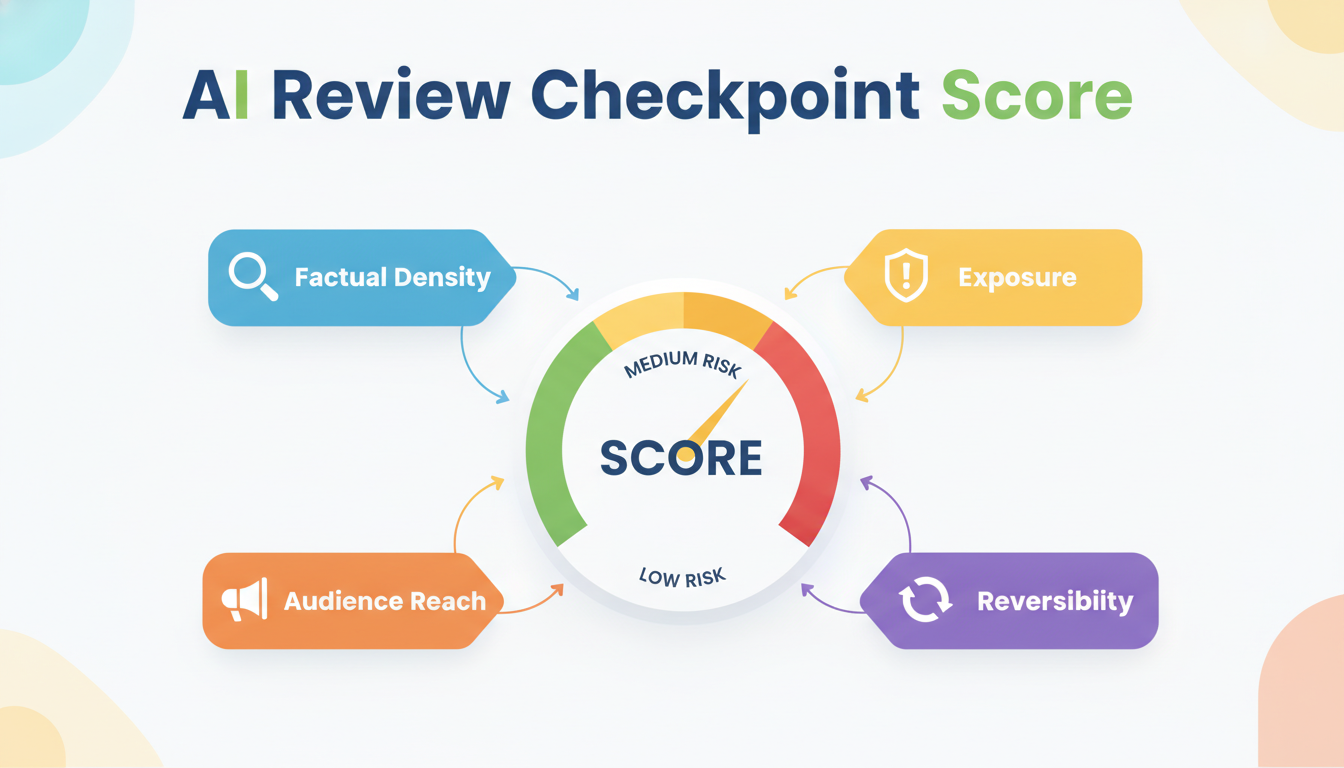
Score every piece of AI-touched content on four factors, each worth 0 to 3 points, for a maximum of 12. A score of 8 or higher requires full human review before publishing. A score of 4 to 7 requires a spot-check on the flagged section only. A score of 3 or below can move through AI-only QA with a human reviewing on a sampling basis (roughly 1 in 10 pieces), not every single one.
The four factors are factual density (how many checkable claims, numbers, or named entities the piece contains), exposure (whether it touches legal, financial, medical, or competitor-comparison territory), audience reach (whether it’s going to a cold list, a high-traffic page, or a paid distribution channel versus a low-traffic archive post), and reversibility (how hard it is to fix after it’s live, factoring in syndication, email sends, and how fast it gets indexed).
Score each one honestly using the table below, add them up, and route the content based on the total. This single scoring pass replaces the all-or-nothing review habit most teams default to.
| Factor | 0 points | 1-2 points | 3 points |
|---|---|---|---|
| Factual density | Opinion or narrative, no checkable claims | A few stats or named tools/companies | Heavy data, pricing, or named-entity claims |
| Exposure | General how-to, no regulated topics | Industry-adjacent claims, soft comparisons | Legal, financial, medical, or direct competitor claims |
| Audience reach | Low-traffic archive or internal page | Organic blog post, owned channels | Paid distribution, cold email, gated asset, homepage |
| Reversibility | Easy to edit post-publish, no syndication | Indexed and shared, but editable | Sent to an email list or syndicated, can’t be unsent |
The Five Checkpoints Every B2B Content Workflow Needs
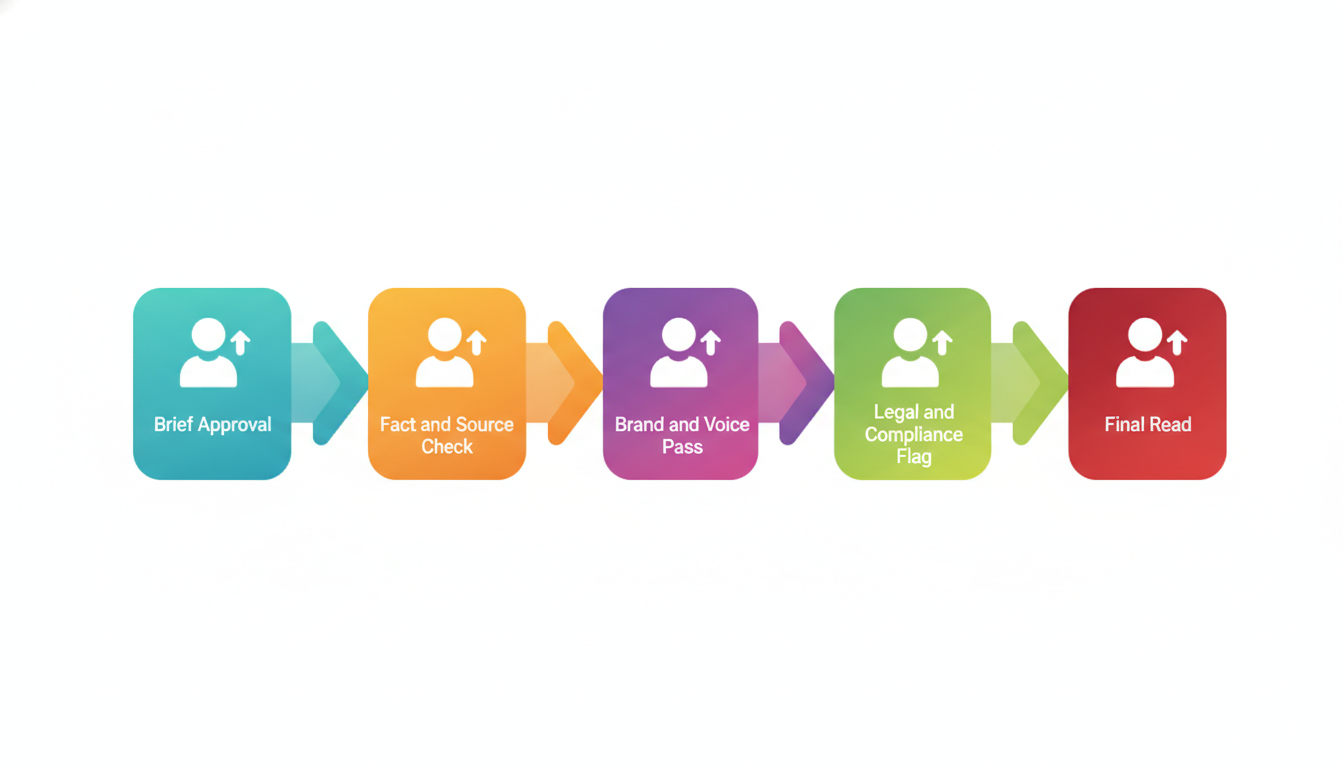
Place human review at five fixed points in the production line, regardless of how a piece scores, because these are structural checkpoints, not content-specific ones.
1. the brief approval, where a strategist confirms the angle, keyword target, and any claims that will need sourcing before AI starts drafting. In our own audits, this checkpoint is the one teams skip first under deadline pressure, and it’s also the one that prevents the most rework downstream, since a vague brief is what produces an AI draft that needs a full rewrite instead of an edit. A content brief generator built for this exact handoff makes the checkpoint take minutes instead of a meeting.
2. the fact and source check, where every statistic, quote, or named-entity claim in the AI draft gets verified against a real source or removed.
3. the brand and voice pass, where someone who knows your positioning confirms the piece doesn’t contradict something you’ve said elsewhere or claim expertise you don’t have.
4. the legal or compliance flag, which only triggers for content scoring 3 points on exposure, but needs a named owner who actually gets pinged, not a vague “someone should check this.”
5. the pre-publish final read, a five-minute pass for tone, formatting, and broken links before it goes live.
Run this as a literal checklist in your project management tool, not as institutional memory. The team that writes “fact-check,” “brand pass,” and “final read” as separate line items on every content ticket is the team that doesn’t have a viral AI-hallucination problem six months from now.
If you’re already running a repeatable content engine, these five checkpoints slot directly into the production stages you’ve already built, they don’t replace them.
Human-in-the-Loop vs Full Automation vs Fully Manual
Full automation publishes AI output with no review, which is fast but accumulates risk with every post and is not viable for anything touching exposure-heavy topics.
Fully manual means a human writes every word, which protects quality but caps your output at whatever one or two writers can physically produce, usually two to four long-form posts a month for a lean team.
Human-in-the-loop sits between them: AI compresses the drafting time from hours to minutes, and humans spend their time on the parts that actually require judgment, which is verification, brand alignment, and strategic framing rather than typing.
| Fully Manual | Full Automation | Human-in-the-Loop | |
|---|---|---|---|
| Speed | Slow (days per post) | Fast (minutes per post) | Moderate (1-3 hours per post) |
| Risk of factual errors | Low | High, compounds over volume | Low, if checkpoints are enforced |
| Output volume for a 1-2 person team | 2-4 posts/month | 20+ posts/month | 8-12 posts/month |
| Best fit | Flagship thought-leadership pieces | Internal docs, low-stakes archive content | Most B2B blog and SEO content |
What Most Teams Get Wrong with Human-in-the-Loop AI Content
The most common mistake is treating review as a single pass instead of five distinct checkpoints, which means the one person reading the draft is simultaneously trying to catch factual errors, judge brand voice, and proofread for typos, and inevitably misses something because the cognitive load is too high for one read-through.
The second mistake is reviewing everything at the same intensity regardless of risk, which burns the team’s limited review hours on a low-stakes internal explainer while a high-exposure competitor-comparison page gets the same five-minute glance.
The third mistake is having no named owner for the legal or compliance checkpoint, so it exists on paper but nobody actually does it under deadline pressure.
The fourth is treating AI-detected “hallucination risk” as binary instead of scoring it, which leads to either reviewing nothing or reviewing everything, both of which defeat the purpose of HITL in the first place.
How a One-Person or Two-Person Team Should Run This
If you’re a lean team, you don’t need five different people staffing five checkpoints. You need one person wearing multiple hats but switching modes deliberately between them, which is different from doing one blended review.
Run the fact-check pass and the brand pass as two separate fifteen-minute sessions, ideally on different days, because reviewing for accuracy and reviewing for voice use different parts of your attention and combining them is exactly how things slip through.
For the legal or compliance checkpoint on high-exposure content, that’s the one checkpoint worth keeping external, even for a one-person team, because catching your own legal blind spots is structurally hard.
A fractional legal review or a standing relationship with outside counsel for anything that scores 3 on exposure is cheaper than the alternative. Map these checkpoints onto your existing publishing cadence the same way you’d slot them into an editorial calendar or a set of marketing automation workflows, as fixed stages rather than optional extra steps.
AI Review Checkpoint Score Calculator
Frequently Asked Questions
Does human-in-the-loop AI content still save time compared to writing manually?
Yes, even with full checkpoint review, HITL workflows typically compress total production time from several hours of manual writing and research to one to three hours of drafting plus structured review per post. The time savings come from AI handling first-pass research and structure, not from skipping review.
How do I know if a piece of content needs full human review or just a spot-check?
Run it through the AI Review Checkpoint Score above. Content scoring 8 or higher on factual density, exposure, audience reach, and reversibility needs full review. Anything in the 4-7 range only needs the flagged section checked, not a full read-through.
Who should own the legal or compliance checkpoint on a small team?
Name one specific person, even on a two-person team, rather than leaving it as an implied step. For content that scores 3 points on exposure, route it to that named owner before publishing, and consider an external or fractional reviewer if nobody on the team has the relevant legal context.
Can AI handle the fact-checking step itself?
AI can flag claims that look like they need a source, but it cannot verify its own factual accuracy reliably, since hallucinated statistics are often phrased with the same confidence as correct ones. The fact-check checkpoint needs a human cross-referencing claims against real sources, not another AI pass.
How many posts a month can a one-person team realistically produce with this workflow?
Most lean teams running a properly checkpointed HITL workflow land between 8 and 12 long-form posts a month, depending on how many score high on the Checkpoint Score and need full review versus a spot-check.
What To Do Next
Score your next five pieces of AI-assisted content against the four factors above before you publish anything else.
Build the five checkpoints into your project management tool as separate, named line items, not a single “review” step. Name an actual owner for the legal and compliance checkpoint this week, even if that owner is yourself wearing a different hat on a different day.
Don’t review every AI draft with the same intensity, and don’t skip review on anything that scores 8 or higher just because deadline pressure is real. Start with the brief checkpoint, since a tighter brief reduces how much review the other four checkpoints need.
The teams that get burned by AI content aren’t the ones using AI, they’re the ones who never decided where their checkpoints go.
Recommended Tool: AWeber
If you’re building a B2B email list alongside your content marketing, AWeber is the most reliable option for small teams. Free up to 500 subscribers, with inbox placement rates that consistently outperform most competitors.
Affiliate disclosure: Some links in this post are affiliate links. If you sign up through them, I may earn a small commission at no extra cost to you.
